

108
for ( i = I; i :::; n; i ++ ) {
if ( I )
if ( (i > 1) && (
minimum of a function with inequality constraints.
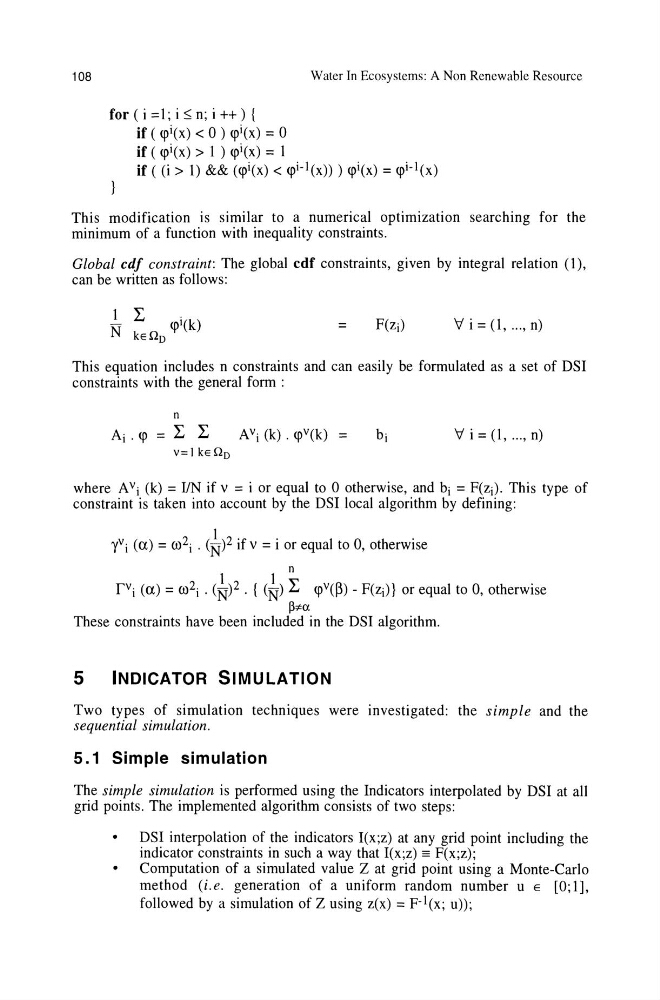
Global cd! constraint: The global cdf constraints. given by integral relation (1).
can be written as follows:
l L
=
V i = (1 •...• n)
This equation includes n constraints and can easily be formulated as a set of DSI
constraints with the general form :
n
A· I '
Vi = (1 •...• n)
v=! kEnD
where AVi (k) = lIN if v = i or equal to 0 otherwise. and bi = F(Zi). This type of
constraint is taken into account by the DSI local algorithm by defining:
YVi (a) = ro2i . (~)2 if v = i or equal to O. otherwise
n
rVi (a) = ro2i . (~)2 . { (~) L
These constraints have been included in the DSI algorithm.
5
INDICATOR SIMULATION
Two types of simulation techniques were investigated: the simple and the
sequential simulation.
5.1 Simple simulation
The simple simulation is performed using the Indicators interpolated by DSI at all
grid points. The implemented algorithm consists of two steps:
•
DSI interpolation of the indicators I(x;z) at any grid point including the
indicator constraints in such a way that I(x;z) == F(x;z);
Computation of a simulated value Z at grid point using a Monte-Carlo
method (i.e. generation of a uniform random number u E [0;1],
followed by a simulation of Z using z(x) = F-!(x; u»;
for ( i = I; i :::; n; i ++ ) {
if (
if ( (i > 1) && (
minimum of a function with inequality constraints.
Global cd! constraint: The global cdf constraints. given by integral relation (1).
can be written as follows:
l L
=
V i = (1 •...• n)
This equation includes n constraints and can easily be formulated as a set of DSI
constraints with the general form :
n
A· I '
Vi = (1 •...• n)
v=! kEnD
where AVi (k) = lIN if v = i or equal to 0 otherwise. and bi = F(Zi). This type of
constraint is taken into account by the DSI local algorithm by defining:
YVi (a) = ro2i . (~)2 if v = i or equal to O. otherwise
n
rVi (a) = ro2i . (~)2 . { (~) L
These constraints have been included in the DSI algorithm.
5
INDICATOR SIMULATION
Two types of simulation techniques were investigated: the simple and the
sequential simulation.
5.1 Simple simulation
The simple simulation is performed using the Indicators interpolated by DSI at all
grid points. The implemented algorithm consists of two steps:
•
DSI interpolation of the indicators I(x;z) at any grid point including the
indicator constraints in such a way that I(x;z) == F(x;z);
Computation of a simulated value Z at grid point using a Monte-Carlo
method (i.e. generation of a uniform random number u E [0;1],
followed by a simulation of Z using z(x) = F-!(x; u»;