

D. K. S. Reddyalld K.L. N. Rao : Incidence of Fluorosis in India
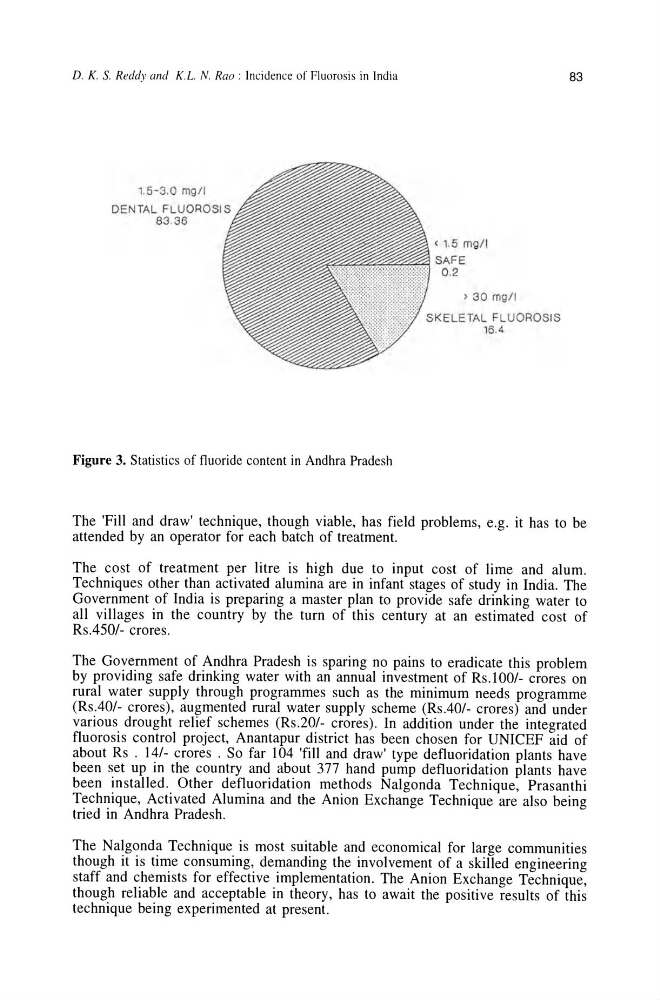
1.5-3.0 mg/l
DENTAL FLUOAOSIS
83 .36
< 1.5 mg/l
IlIi
SAFE
0 .2
) 30 mg/l
Figure 3. Statistics of fluoride content in Andhra Pradesh
SKELETAL FLUOAOSIS
16.4
83
The 'Fill and draw' technique, though viable, has field problems, e.g. it has to be
attended by an operator for each batch of treatment.
The cost of treatment per litre is high due to input cost of lime and alum.
Techniques other than activated alumina are in infant stages of study in India. The
Government of India is preparing a master plan to provide safe drinking water to
all villages in the country by the turn of this century at an estimated cost of
RsA50/- crores.
The Government of Andhra Pradesh is sparing no pains to eradicate this problem
by providing safe drinking water with an annual investment of Rs.lOO/- crores on
rural water supply through programmes such as the minimum needs programme
(RsAO/- crores), augmented rural water supply scheme (RsAO/- crores) and under
various drought relief schemes (Rs.20/- crores). In addition under the integrated
fluorosis control project, Anantapur district has been chosen for UNICEF aid of
about Rs . 14/- crores . So far 104 'fill and draw' type defluoridation plants have
been set up in the country and about 377 hand pump defluoridation plants have
been installed . Other defluoridation methods Nalgonda Technique, Prasanthi
Technique, Activated Alumina and the Anion Exchange Technique are also being
tried in Andhra Pradesh.
The Nalgonda Technique is most suitable and economical for large communities
though it is time consuming, demanding the involvement of a skilled engineering
staff and chemists for effective implementation. The Anion Exchange Technique,
though reliable and acceptable in theory, has to await the positive results of this
technique being experimented at present.
1.5-3.0 mg/l
DENTAL FLUOAOSIS
83 .36
< 1.5 mg/l
IlIi
SAFE
0 .2
) 30 mg/l
Figure 3. Statistics of fluoride content in Andhra Pradesh
SKELETAL FLUOAOSIS
16.4
83
The 'Fill and draw' technique, though viable, has field problems, e.g. it has to be
attended by an operator for each batch of treatment.
The cost of treatment per litre is high due to input cost of lime and alum.
Techniques other than activated alumina are in infant stages of study in India. The
Government of India is preparing a master plan to provide safe drinking water to
all villages in the country by the turn of this century at an estimated cost of
RsA50/- crores.
The Government of Andhra Pradesh is sparing no pains to eradicate this problem
by providing safe drinking water with an annual investment of Rs.lOO/- crores on
rural water supply through programmes such as the minimum needs programme
(RsAO/- crores), augmented rural water supply scheme (RsAO/- crores) and under
various drought relief schemes (Rs.20/- crores). In addition under the integrated
fluorosis control project, Anantapur district has been chosen for UNICEF aid of
about Rs . 14/- crores . So far 104 'fill and draw' type defluoridation plants have
been set up in the country and about 377 hand pump defluoridation plants have
been installed . Other defluoridation methods Nalgonda Technique, Prasanthi
Technique, Activated Alumina and the Anion Exchange Technique are also being
tried in Andhra Pradesh.
The Nalgonda Technique is most suitable and economical for large communities
though it is time consuming, demanding the involvement of a skilled engineering
staff and chemists for effective implementation. The Anion Exchange Technique,
though reliable and acceptable in theory, has to await the positive results of this
technique being experimented at present.