

3. Near Field and Far Field: Monopoles and Dipoles
Two concepts central to all theoretical treatments of sound transmission
in an aquatic environment are the near field and the far field. Kalmijn
(1988) provides a comprehensive review of this topic, whereas Coombs and
Janssen (1988) and Rogers and Cox (1988) provide more concise treatments. For historical purposes, the reader is also referred to the early essays
of van Bergeijk (1964), Harris (1964), and Siler (1969) on this subject.
The movements of sound sources in an ideal, boundless medium that
lacks any obstacles (a free field) have been modeled as either a pulsating
or a vibrating sphere. A pulsating sphere is a monopole source of sound
that uniformly expands and contracts, whereas a vibrating sphere is a dipole
source that vibrates back and forth along one axis. The sonic swim bladder
of some fish has often been compared to a monopole source (Harris 1964;
Kalmijn 1988), and recent work on baleen whale sound production models
2. Physical Acoustics of Underwater Sound Communication
21
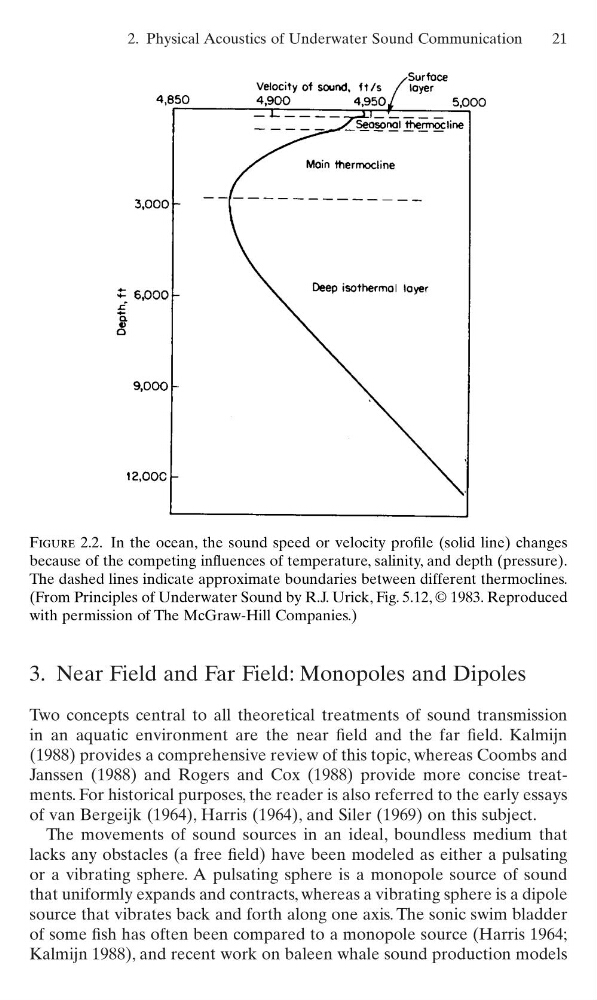
Figure 2.2. In the ocean, the sound speed or velocity profile (solid line) changes
because of the competing influences of temperature, salinity, and depth (pressure).
The dashed lines indicate approximate boundaries between different thermoclines.
(From Principles of Underwater Sound by R.J. Urick, Fig. 5.12, © 1983. Reproduced
with permission of The McGraw-Hill Companies.)
Two concepts central to all theoretical treatments of sound transmission
in an aquatic environment are the near field and the far field. Kalmijn
(1988) provides a comprehensive review of this topic, whereas Coombs and
Janssen (1988) and Rogers and Cox (1988) provide more concise treatments. For historical purposes, the reader is also referred to the early essays
of van Bergeijk (1964), Harris (1964), and Siler (1969) on this subject.
The movements of sound sources in an ideal, boundless medium that
lacks any obstacles (a free field) have been modeled as either a pulsating
or a vibrating sphere. A pulsating sphere is a monopole source of sound
that uniformly expands and contracts, whereas a vibrating sphere is a dipole
source that vibrates back and forth along one axis. The sonic swim bladder
of some fish has often been compared to a monopole source (Harris 1964;
Kalmijn 1988), and recent work on baleen whale sound production models
2. Physical Acoustics of Underwater Sound Communication
21
Figure 2.2. In the ocean, the sound speed or velocity profile (solid line) changes
because of the competing influences of temperature, salinity, and depth (pressure).
The dashed lines indicate approximate boundaries between different thermoclines.
(From Principles of Underwater Sound by R.J. Urick, Fig. 5.12, © 1983. Reproduced
with permission of The McGraw-Hill Companies.)