

density. However, the elasticity or resistance to distortion in a fluid has a
large contribution to the determination of sound velocity. The theoretical
determination of sound velocity in water includes the “isothermal bulk
modulus” that measures the compressibility of a liquid (see Kinsler and
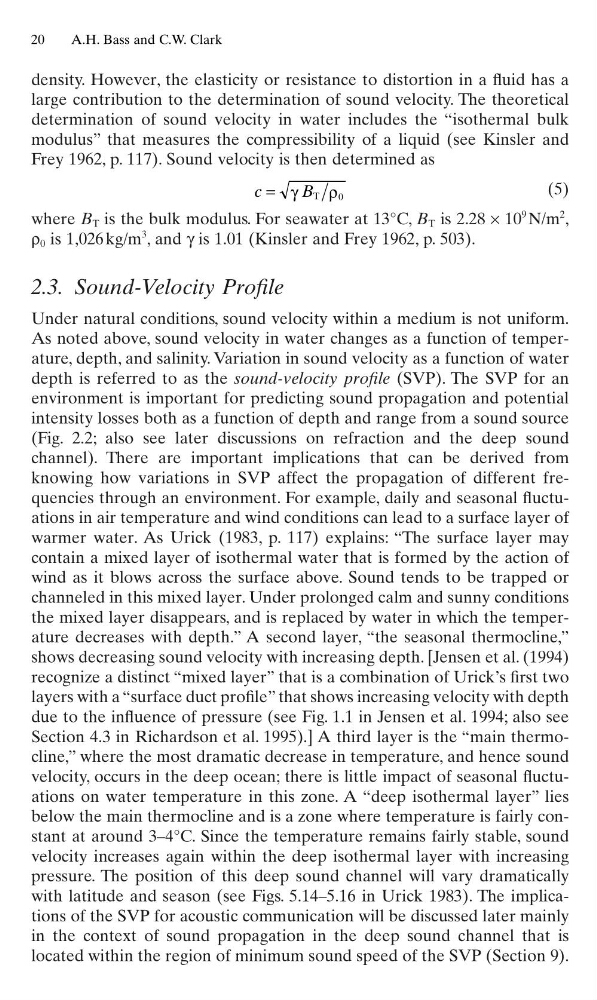
Frey 1962, p. 117). Sound velocity is then determined as
(5)
where B T is the bulk modulus. For seawater at 13°C, B T is 2.28 ¥ 10
9 N/m
2 ,
r 0 is 1,026 kg/m
3 , and g is 1.01 (Kinsler and Frey 1962, p. 503).
2.3. Sound-Velocity Profile
Under natural conditions, sound velocity within a medium is not uniform.
As noted above, sound velocity in water changes as a function of temperature, depth, and salinity. Variation in sound velocity as a function of water
depth is referred to as the sound-velocity profile (SVP). The SVP for an
environment is important for predicting sound propagation and potential
intensity losses both as a function of depth and range from a sound source
(Fig. 2.2; also see later discussions on refraction and the deep sound
channel). There are important implications that can be derived from
knowing how variations in SVP affect the propagation of different frequencies through an environment. For example, daily and seasonal fluctuations in air temperature and wind conditions can lead to a surface layer of
warmer water. As Urick (1983, p. 117) explains: “The surface layer may
contain a mixed layer of isothermal water that is formed by the action of
wind as it blows across the surface above. Sound tends to be trapped or
channeled in this mixed layer. Under prolonged calm and sunny conditions
the mixed layer disappears, and is replaced by water in which the temperature decreases with depth.” A second layer, “the seasonal thermocline,”
shows decreasing sound velocity with increasing depth. [Jensen et al. (1994)
recognize a distinct “mixed layer” that is a combination of Urick’s first two
layers with a “surface duct profile” that shows increasing velocity with depth
due to the influence of pressure (see Fig. 1.1 in Jensen et al. 1994; also see
Section 4.3 in Richardson et al. 1995).] A third layer is the “main thermocline,” where the most dramatic decrease in temperature, and hence sound
velocity, occurs in the deep ocean; there is little impact of seasonal fluctuations on water temperature in this zone. A “deep isothermal layer” lies
below the main thermocline and is a zone where temperature is fairly constant at around 3–4°C. Since the temperature remains fairly stable, sound
velocity increases again within the deep isothermal layer with increasing
pressure. The position of this deep sound channel will vary dramatically
with latitude and season (see Figs. 5.14–5.16 in Urick 1983). The implications of the SVP for acoustic communication will be discussed later mainly
in the context of sound propagation in the deep sound channel that is
located within the region of minimum sound speed of the SVP (Section 9).
c
B
= g
r
T
0
20
A.H. Bass and C.W. Clark
large contribution to the determination of sound velocity. The theoretical
determination of sound velocity in water includes the “isothermal bulk
modulus” that measures the compressibility of a liquid (see Kinsler and
Frey 1962, p. 117). Sound velocity is then determined as
(5)
where B T is the bulk modulus. For seawater at 13°C, B T is 2.28 ¥ 10
9 N/m
2 ,
r 0 is 1,026 kg/m
3 , and g is 1.01 (Kinsler and Frey 1962, p. 503).
2.3. Sound-Velocity Profile
Under natural conditions, sound velocity within a medium is not uniform.
As noted above, sound velocity in water changes as a function of temperature, depth, and salinity. Variation in sound velocity as a function of water
depth is referred to as the sound-velocity profile (SVP). The SVP for an
environment is important for predicting sound propagation and potential
intensity losses both as a function of depth and range from a sound source
(Fig. 2.2; also see later discussions on refraction and the deep sound
channel). There are important implications that can be derived from
knowing how variations in SVP affect the propagation of different frequencies through an environment. For example, daily and seasonal fluctuations in air temperature and wind conditions can lead to a surface layer of
warmer water. As Urick (1983, p. 117) explains: “The surface layer may
contain a mixed layer of isothermal water that is formed by the action of
wind as it blows across the surface above. Sound tends to be trapped or
channeled in this mixed layer. Under prolonged calm and sunny conditions
the mixed layer disappears, and is replaced by water in which the temperature decreases with depth.” A second layer, “the seasonal thermocline,”
shows decreasing sound velocity with increasing depth. [Jensen et al. (1994)
recognize a distinct “mixed layer” that is a combination of Urick’s first two
layers with a “surface duct profile” that shows increasing velocity with depth
due to the influence of pressure (see Fig. 1.1 in Jensen et al. 1994; also see
Section 4.3 in Richardson et al. 1995).] A third layer is the “main thermocline,” where the most dramatic decrease in temperature, and hence sound
velocity, occurs in the deep ocean; there is little impact of seasonal fluctuations on water temperature in this zone. A “deep isothermal layer” lies
below the main thermocline and is a zone where temperature is fairly constant at around 3–4°C. Since the temperature remains fairly stable, sound
velocity increases again within the deep isothermal layer with increasing
pressure. The position of this deep sound channel will vary dramatically
with latitude and season (see Figs. 5.14–5.16 in Urick 1983). The implications of the SVP for acoustic communication will be discussed later mainly
in the context of sound propagation in the deep sound channel that is
located within the region of minimum sound speed of the SVP (Section 9).
c
B
= g
r
T
0
20
A.H. Bass and C.W. Clark