

for their definitions and applications to acoustics. As Bradbury and
Vehrencamp (1998) point out, a medium’s impedance has important implications for sound communication in water as compared to air. Water’s characteristic impedance is almost 5,000 times greater because of its 1,000-fold
greater density and the fivefold greater speed of sound in water compared
to air (also see Section 2.2). Hence, an animal generating underwater sound
will have to produce much higher levels of pressure to attain the same stimulus energy at a receiver’s ear. The trade-off here is that it takes much less
energy to produce a sound at a given level of pressure in water.
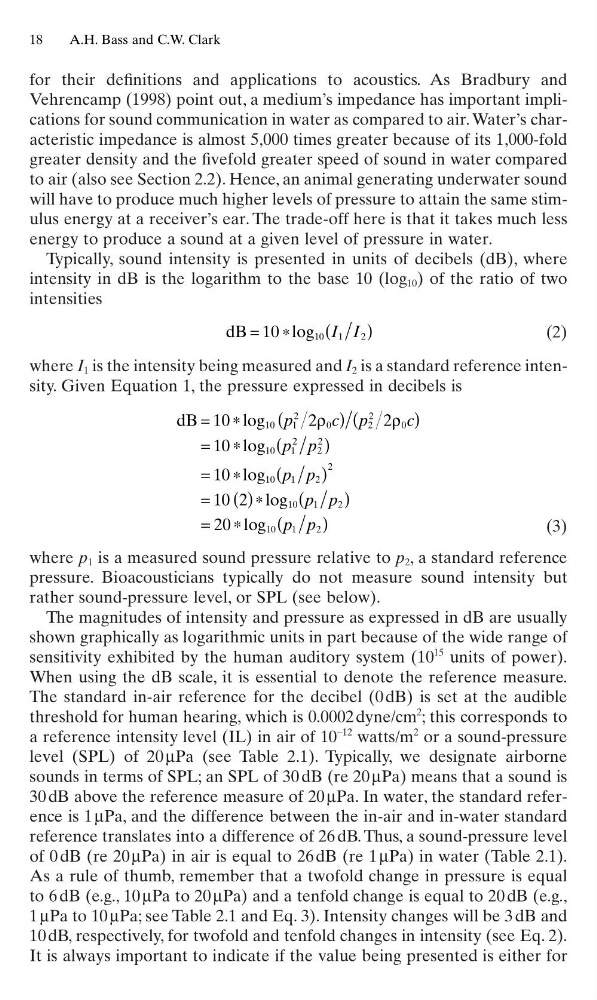
Typically, sound intensity is presented in units of decibels (dB), where
intensity in dB is the logarithm to the base 10 (log 10 ) of the ratio of two
intensities
(2)
where I 1 is the intensity being measured and I 2 is a standard reference intensity. Given Equation 1, the pressure expressed in decibels is
(3)
where p 1 is a measured sound pressure relative to p 2 , a standard reference
pressure. Bioacousticians typically do not measure sound intensity but
rather sound-pressure level, or SPL (see below).
The magnitudes of intensity and pressure as expressed in dB are usually
shown graphically as logarithmic units in part because of the wide range of
sensitivity exhibited by the human auditory system (10
15 units of power).
When using the dB scale, it is essential to denote the reference measure.
The standard in-air reference for the decibel (0 dB) is set at the audible
threshold for human hearing, which is 0.0002 dyne/cm
2 ; this corresponds to
a reference intensity level (IL) in air of 10
-12 watts/m
2 or a sound-pressure
level (SPL) of 20 mPa (see Table 2.1). Typically, we designate airborne
sounds in terms of SPL; an SPL of 30 dB (re 20 mPa) means that a sound is
30 dB above the reference measure of 20 mPa. In water, the standard reference is 1 mPa, and the difference between the in-air and in-water standard
reference translates into a difference of 26 dB. Thus, a sound-pressure level
of 0 dB (re 20 mPa) in air is equal to 26 dB (re 1 mPa) in water (Table 2.1).
As a rule of thumb, remember that a twofold change in pressure is equal
to 6 dB (e.g., 10 mPa to 20 mPa) and a tenfold change is equal to 20 dB (e.g.,
1 mPa to 10 mPa; see Table 2.1 and Eq. 3). Intensity changes will be 3 dB and
10 dB, respectively, for twofold and tenfold changes in intensity (see Eq. 2).
It is always important to indicate if the value being presented is either for
dB = 10 * log
10 * log
10 * log
10
10
10
p
c p
c
p p
p p
p p
p p
1
2
0
2
2
0
1
2
2
2
1
2
2
10
1
2
10
1
2
2
2
10 2
20
r
r
(
) (
)
=
(
)
=
(
)
= ( )
(
)
=
(
)
* log
* log
dB = 10 * log 10 I I
1
2
(
)
18
A.H. Bass and C.W. Clark
Vehrencamp (1998) point out, a medium’s impedance has important implications for sound communication in water as compared to air. Water’s characteristic impedance is almost 5,000 times greater because of its 1,000-fold
greater density and the fivefold greater speed of sound in water compared
to air (also see Section 2.2). Hence, an animal generating underwater sound
will have to produce much higher levels of pressure to attain the same stimulus energy at a receiver’s ear. The trade-off here is that it takes much less
energy to produce a sound at a given level of pressure in water.
Typically, sound intensity is presented in units of decibels (dB), where
intensity in dB is the logarithm to the base 10 (log 10 ) of the ratio of two
intensities
(2)
where I 1 is the intensity being measured and I 2 is a standard reference intensity. Given Equation 1, the pressure expressed in decibels is
(3)
where p 1 is a measured sound pressure relative to p 2 , a standard reference
pressure. Bioacousticians typically do not measure sound intensity but
rather sound-pressure level, or SPL (see below).
The magnitudes of intensity and pressure as expressed in dB are usually
shown graphically as logarithmic units in part because of the wide range of
sensitivity exhibited by the human auditory system (10
15 units of power).
When using the dB scale, it is essential to denote the reference measure.
The standard in-air reference for the decibel (0 dB) is set at the audible
threshold for human hearing, which is 0.0002 dyne/cm
2 ; this corresponds to
a reference intensity level (IL) in air of 10
-12 watts/m
2 or a sound-pressure
level (SPL) of 20 mPa (see Table 2.1). Typically, we designate airborne
sounds in terms of SPL; an SPL of 30 dB (re 20 mPa) means that a sound is
30 dB above the reference measure of 20 mPa. In water, the standard reference is 1 mPa, and the difference between the in-air and in-water standard
reference translates into a difference of 26 dB. Thus, a sound-pressure level
of 0 dB (re 20 mPa) in air is equal to 26 dB (re 1 mPa) in water (Table 2.1).
As a rule of thumb, remember that a twofold change in pressure is equal
to 6 dB (e.g., 10 mPa to 20 mPa) and a tenfold change is equal to 20 dB (e.g.,
1 mPa to 10 mPa; see Table 2.1 and Eq. 3). Intensity changes will be 3 dB and
10 dB, respectively, for twofold and tenfold changes in intensity (see Eq. 2).
It is always important to indicate if the value being presented is either for
dB = 10 * log
10 * log
10 * log
10
10
10
p
c p
c
p p
p p
p p
p p
1
2
0
2
2
0
1
2
2
2
1
2
2
10
1
2
10
1
2
2
2
10 2
20
r
r
(
) (
)
=
(
)
=
(
)
= ( )
(
)
=
(
)
* log
* log
dB = 10 * log 10 I I
1
2
(
)
18
A.H. Bass and C.W. Clark