

composed of a fundamental frequency (f 0 ), and a number of harmonics
which are integer multiples of the fundamental (i.e., 2f 0 , 3f 0 , 4f 0 etc.).
2.1. Sound Intensity and Pressure
Two of the quantities most frequently used to describe the magnitude of a
sound wave are intensity and pressure. Sound intensity is directional (i.e.,
a vector quantity) and specifies the average amount of power that is transferred per unit area to an acoustic medium from an acoustic source; the
units of measure for intensity are erg/sec/cm
2 or watts/cm
2 . Pressure, a scalar
quantity, indicates the amount of force per unit area; the unit of measure is
1 Newton per square meter (N/m
2 ) or 1 Pascal (Pa). One Newton is “the
force required to accelerate a mass of 1 kg from a velocity of 0 m per sec to
a velocity of 1 m per sec in 1 sec of time” (Speaks 1992, p. 22). One Newton
or Pa equals 100,000 dynes; one dyne is “the force required to accelerate a
mass of 1 gram (g) from a velocity of 0 cm per sec to a velocity of 1 cm per
sec in 1 sec of time” (Speaks 1992, p. 22).
Sound intensity (I) is related to the effective sound pressure p e by the
following equation that applies to a sound wave in a homogeneous and
boundless medium (see Kinsler and Frey 1962, p. 162)
(1)
where r 0 is the density of the medium, c is the propagation velocity of the
sound wave in that medium, and r 0 c is also known as the medium’s characteristic acoustic impedance (2r 0 c refers to spherical waves; see Section
4.1.1). This impedance term varies with each medium and influences the
received intensity of an acoustic signal transmitted through that medium.
One should use caution in the use of the term impedance because there
are a number of different kinds; the reader is referred to Beranek (1988)
I p
c
= e
2
erg sec cm
2
0
2r
2. Physical Acoustics of Underwater Sound Communication
17
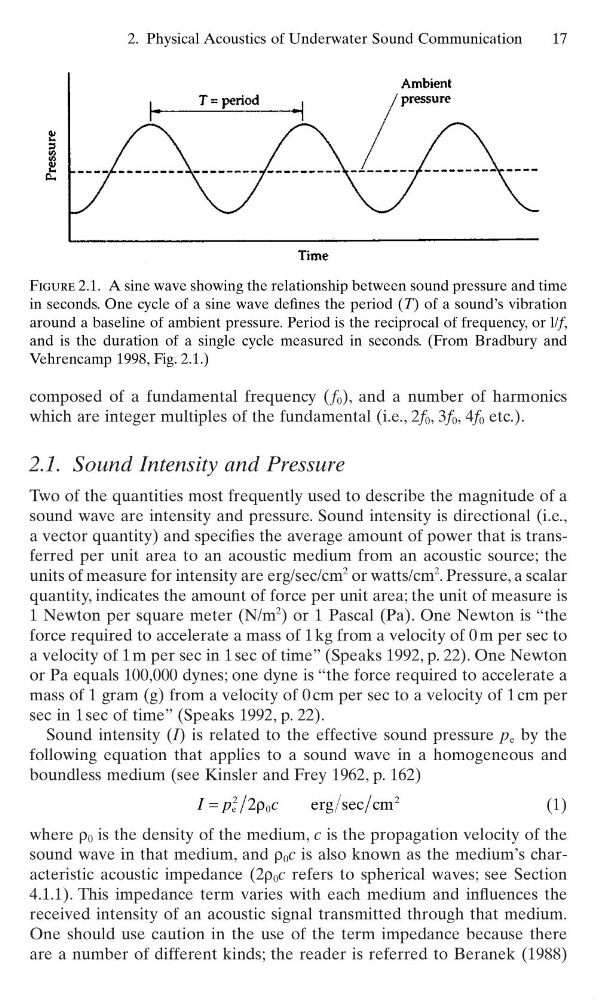
Figure 2.1. A sine wave showing the relationship between sound pressure and time
in seconds. One cycle of a sine wave defines the period (T) of a sound’s vibration
around a baseline of ambient pressure. Period is the reciprocal of frequency, or l/f,
and is the duration of a single cycle measured in seconds. (From Bradbury and
Vehrencamp 1998, Fig. 2.1.)
which are integer multiples of the fundamental (i.e., 2f 0 , 3f 0 , 4f 0 etc.).
2.1. Sound Intensity and Pressure
Two of the quantities most frequently used to describe the magnitude of a
sound wave are intensity and pressure. Sound intensity is directional (i.e.,
a vector quantity) and specifies the average amount of power that is transferred per unit area to an acoustic medium from an acoustic source; the
units of measure for intensity are erg/sec/cm
2 or watts/cm
2 . Pressure, a scalar
quantity, indicates the amount of force per unit area; the unit of measure is
1 Newton per square meter (N/m
2 ) or 1 Pascal (Pa). One Newton is “the
force required to accelerate a mass of 1 kg from a velocity of 0 m per sec to
a velocity of 1 m per sec in 1 sec of time” (Speaks 1992, p. 22). One Newton
or Pa equals 100,000 dynes; one dyne is “the force required to accelerate a
mass of 1 gram (g) from a velocity of 0 cm per sec to a velocity of 1 cm per
sec in 1 sec of time” (Speaks 1992, p. 22).
Sound intensity (I) is related to the effective sound pressure p e by the
following equation that applies to a sound wave in a homogeneous and
boundless medium (see Kinsler and Frey 1962, p. 162)
(1)
where r 0 is the density of the medium, c is the propagation velocity of the
sound wave in that medium, and r 0 c is also known as the medium’s characteristic acoustic impedance (2r 0 c refers to spherical waves; see Section
4.1.1). This impedance term varies with each medium and influences the
received intensity of an acoustic signal transmitted through that medium.
One should use caution in the use of the term impedance because there
are a number of different kinds; the reader is referred to Beranek (1988)
I p
c
= e
2
erg sec cm
2
0
2r
2. Physical Acoustics of Underwater Sound Communication
17
Figure 2.1. A sine wave showing the relationship between sound pressure and time
in seconds. One cycle of a sine wave defines the period (T) of a sound’s vibration
around a baseline of ambient pressure. Period is the reciprocal of frequency, or l/f,
and is the duration of a single cycle measured in seconds. (From Bradbury and
Vehrencamp 1998, Fig. 2.1.)