

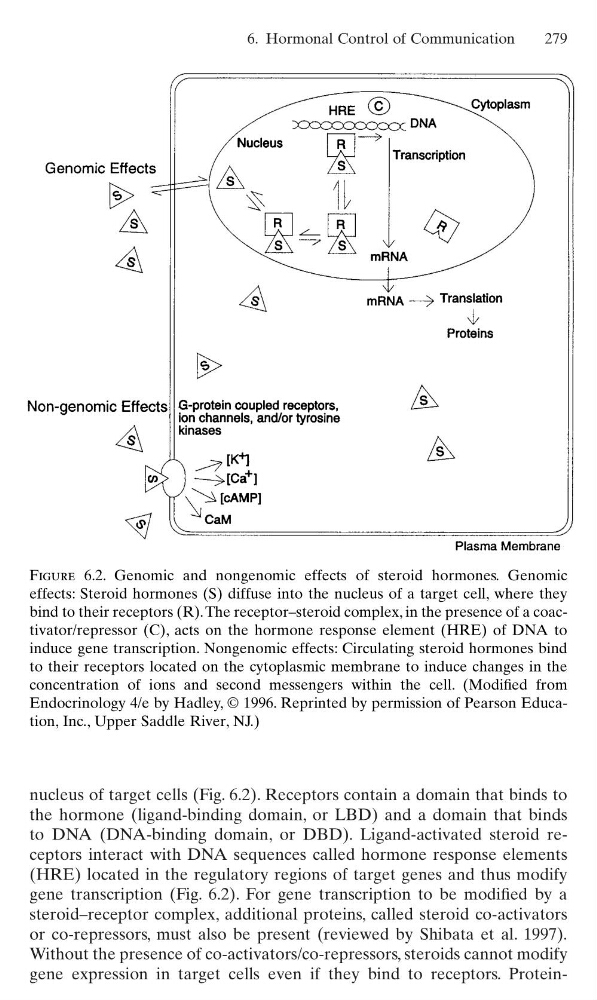
nucleus of target cells (Fig. 6.2). Receptors contain a domain that binds to
the hormone (ligand-binding domain, or LBD) and a domain that binds
to DNA (DNA-binding domain, or DBD). Ligand-activated steroid receptors interact with DNA sequences called hormone response elements
(HRE) located in the regulatory regions of target genes and thus modify
gene transcription (Fig. 6.2). For gene transcription to be modified by a
steroid–receptor complex, additional proteins, called steroid co-activators
or co-repressors, must also be present (reviewed by Shibata et al. 1997).
Without the presence of co-activators/co-repressors, steroids cannot modify
gene expression in target cells even if they bind to receptors. Protein6. Hormonal Control of Communication
279
Figure 6.2. Genomic and nongenomic effects of steroid hormones. Genomic
effects: Steroid hormones (S) diffuse into the nucleus of a target cell, where they
bind to their receptors (R). The receptor–steroid complex, in the presence of a coactivator/repressor (C), acts on the hormone response element (HRE) of DNA to
induce gene transcription. Nongenomic effects: Circulating steroid hormones bind
to their receptors located on the cytoplasmic membrane to induce changes in the
concentration of ions and second messengers within the cell. (Modified from
Endocrinology 4/e by Hadley, © 1996. Reprinted by permission of Pearson Education, Inc., Upper Saddle River, NJ.)
the hormone (ligand-binding domain, or LBD) and a domain that binds
to DNA (DNA-binding domain, or DBD). Ligand-activated steroid receptors interact with DNA sequences called hormone response elements
(HRE) located in the regulatory regions of target genes and thus modify
gene transcription (Fig. 6.2). For gene transcription to be modified by a
steroid–receptor complex, additional proteins, called steroid co-activators
or co-repressors, must also be present (reviewed by Shibata et al. 1997).
Without the presence of co-activators/co-repressors, steroids cannot modify
gene expression in target cells even if they bind to receptors. Protein6. Hormonal Control of Communication
279
Figure 6.2. Genomic and nongenomic effects of steroid hormones. Genomic
effects: Steroid hormones (S) diffuse into the nucleus of a target cell, where they
bind to their receptors (R). The receptor–steroid complex, in the presence of a coactivator/repressor (C), acts on the hormone response element (HRE) of DNA to
induce gene transcription. Nongenomic effects: Circulating steroid hormones bind
to their receptors located on the cytoplasmic membrane to induce changes in the
concentration of ions and second messengers within the cell. (Modified from
Endocrinology 4/e by Hadley, © 1996. Reprinted by permission of Pearson Education, Inc., Upper Saddle River, NJ.)