

perature effects on spectral properties of the call are either not significant
or less extreme—if there is an effect, frequency tends to be positively correlated with temperature.
One of the more interesting cases of temperature scaling involves study
of the diploid-tetraploid species complex of Hyla chrysoscelis and H. versicolor. These are otherwise cryptic species that can easily be distinguished
by the pulse rate of their call. H. chrysoscelis is diploid and has a faster pulse
rate (~25–65 pulses/sec), whereas H. versicolor is tetraploid and has a
slower pulse rate (~10–30 pulses/sec; Fig. 5.6). In both species, pulse rate is
positively correlated with temperature. These two species can be sympatric,
and if there is a wide enough range of temperature variation in the pond,
it is conceivable that an H. versicolor male would have a higher pulse rate
than an H. chrysoscelis male if, for example, the H. versicolor males were
calling at 24°C while the H. chrysoscelis male was calling at 12°C (Fig. 5.6).
Gerhardt (1978) showed that female preferences for pulse repetition rate
scale to temperature similarly to that exhibited by conspecific calls. When
challenged with calls that vary in pulse repetition rate, the female chooses
that signal that would be produced by a male calling at her body tempera5. Selection on Signals
249
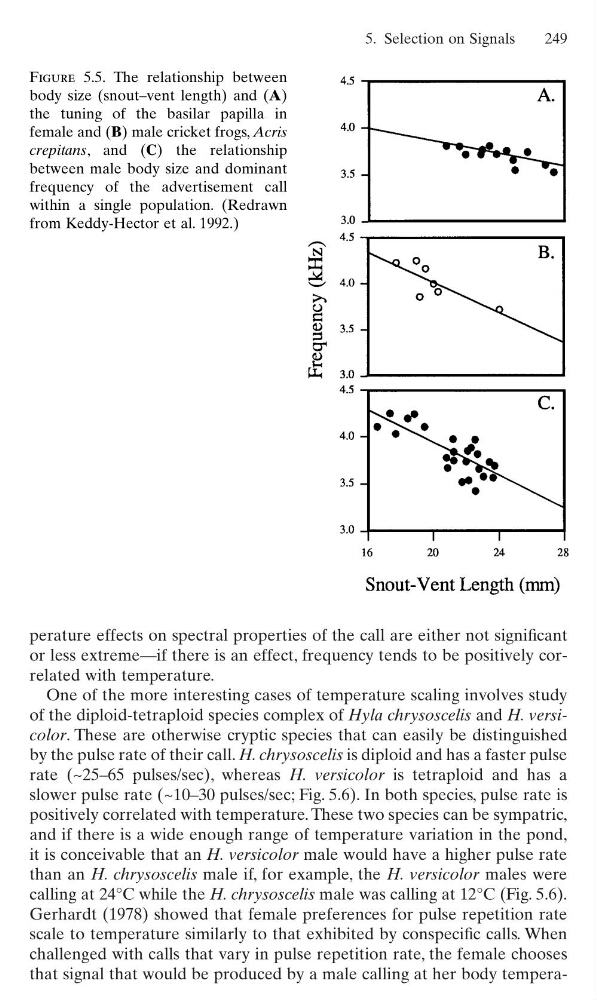
Figure 5.5. The relationship between
body size (snout–vent length) and (A)
the tuning of the basilar papilla in
female and (B) male cricket frogs, Acris
crepitans, and (C) the relationship
between male body size and dominant
frequency of the advertisement call
within a single population. (Redrawn
from Keddy-Hector et al. 1992.)
or less extreme—if there is an effect, frequency tends to be positively correlated with temperature.
One of the more interesting cases of temperature scaling involves study
of the diploid-tetraploid species complex of Hyla chrysoscelis and H. versicolor. These are otherwise cryptic species that can easily be distinguished
by the pulse rate of their call. H. chrysoscelis is diploid and has a faster pulse
rate (~25–65 pulses/sec), whereas H. versicolor is tetraploid and has a
slower pulse rate (~10–30 pulses/sec; Fig. 5.6). In both species, pulse rate is
positively correlated with temperature. These two species can be sympatric,
and if there is a wide enough range of temperature variation in the pond,
it is conceivable that an H. versicolor male would have a higher pulse rate
than an H. chrysoscelis male if, for example, the H. versicolor males were
calling at 24°C while the H. chrysoscelis male was calling at 12°C (Fig. 5.6).
Gerhardt (1978) showed that female preferences for pulse repetition rate
scale to temperature similarly to that exhibited by conspecific calls. When
challenged with calls that vary in pulse repetition rate, the female chooses
that signal that would be produced by a male calling at her body tempera5. Selection on Signals
249
Figure 5.5. The relationship between
body size (snout–vent length) and (A)
the tuning of the basilar papilla in
female and (B) male cricket frogs, Acris
crepitans, and (C) the relationship
between male body size and dominant
frequency of the advertisement call
within a single population. (Redrawn
from Keddy-Hector et al. 1992.)