

mates are examples of such radiators (Martin 1972; Schön-Ybarra 1988;
Rand and Dudley 1993; Fitch and Hauser, Chapter 3). The sound frequencies that can be efficiently coupled to the environment via a radiator depend
on its size—larger radiators allow lower dominant frequencies to be
coupled to the environment with greater efficiency. However, even with
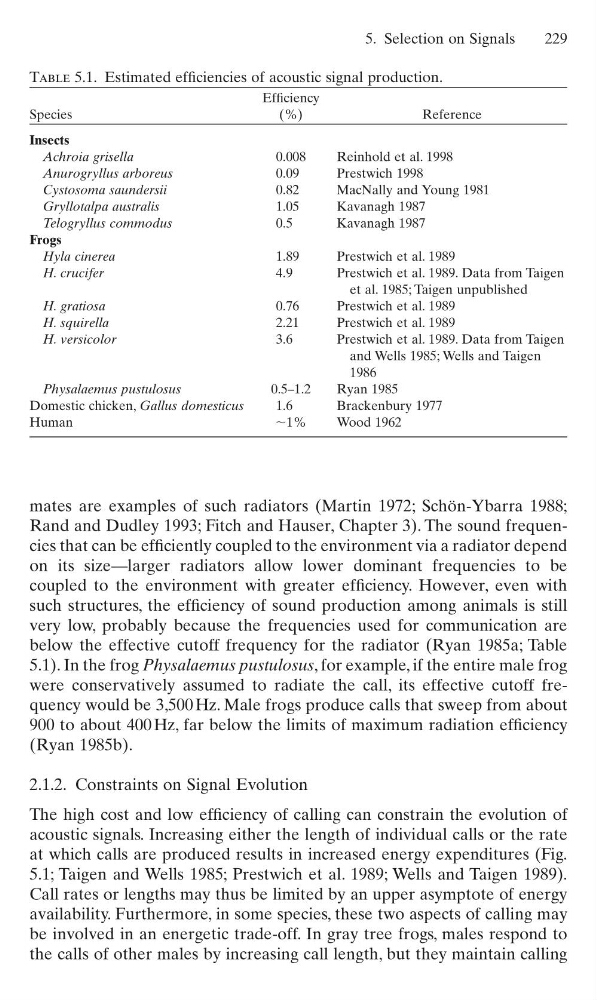
such structures, the efficiency of sound production among animals is still
very low, probably because the frequencies used for communication are
below the effective cutoff frequency for the radiator (Ryan 1985a; Table
5.1). In the frog Physalaemus pustulosus, for example, if the entire male frog
were conservatively assumed to radiate the call, its effective cutoff frequency would be 3,500 Hz. Male frogs produce calls that sweep from about
900 to about 400 Hz, far below the limits of maximum radiation efficiency
(Ryan 1985b).
2.1.2. Constraints on Signal Evolution
The high cost and low efficiency of calling can constrain the evolution of
acoustic signals. Increasing either the length of individual calls or the rate
at which calls are produced results in increased energy expenditures (Fig.
5.1; Taigen and Wells 1985; Prestwich et al. 1989; Wells and Taigen 1989).
Call rates or lengths may thus be limited by an upper asymptote of energy
availability. Furthermore, in some species, these two aspects of calling may
be involved in an energetic trade-off. In gray tree frogs, males respond to
the calls of other males by increasing call length, but they maintain calling
5. Selection on Signals
229
Table 5.1. Estimated efficiencies of acoustic signal production.
Efficiency
Species
(%)
Reference
Insects
Achroia grisella
0.008
Reinhold et al. 1998
Anurogryllus arboreus
0.09
Prestwich 1998
Cystosoma saundersii
0.82
MacNally and Young 1981
Gryllotalpa australis
1.05
Kavanagh 1987
Telogryllus commodus
0.5
Kavanagh 1987
Frogs
Hyla cinerea
1.89
Prestwich et al. 1989
H. crucifer
4.9
Prestwich et al. 1989. Data from Taigen
et al. 1985; Taigen unpublished
H. gratiosa
0.76
Prestwich et al. 1989
H. squirella
2.21
Prestwich et al. 1989
H. versicolor
3.6
Prestwich et al. 1989. Data from Taigen
and Wells 1985; Wells and Taigen
1986
Physalaemus pustulosus
0.5–1.2
Ryan 1985
Domestic chicken, Gallus domesticus
1.6
Brackenbury 1977
Human
ϳ1%
Wood 1962
Rand and Dudley 1993; Fitch and Hauser, Chapter 3). The sound frequencies that can be efficiently coupled to the environment via a radiator depend
on its size—larger radiators allow lower dominant frequencies to be
coupled to the environment with greater efficiency. However, even with
such structures, the efficiency of sound production among animals is still
very low, probably because the frequencies used for communication are
below the effective cutoff frequency for the radiator (Ryan 1985a; Table
5.1). In the frog Physalaemus pustulosus, for example, if the entire male frog
were conservatively assumed to radiate the call, its effective cutoff frequency would be 3,500 Hz. Male frogs produce calls that sweep from about
900 to about 400 Hz, far below the limits of maximum radiation efficiency
(Ryan 1985b).
2.1.2. Constraints on Signal Evolution
The high cost and low efficiency of calling can constrain the evolution of
acoustic signals. Increasing either the length of individual calls or the rate
at which calls are produced results in increased energy expenditures (Fig.
5.1; Taigen and Wells 1985; Prestwich et al. 1989; Wells and Taigen 1989).
Call rates or lengths may thus be limited by an upper asymptote of energy
availability. Furthermore, in some species, these two aspects of calling may
be involved in an energetic trade-off. In gray tree frogs, males respond to
the calls of other males by increasing call length, but they maintain calling
5. Selection on Signals
229
Table 5.1. Estimated efficiencies of acoustic signal production.
Efficiency
Species
(%)
Reference
Insects
Achroia grisella
0.008
Reinhold et al. 1998
Anurogryllus arboreus
0.09
Prestwich 1998
Cystosoma saundersii
0.82
MacNally and Young 1981
Gryllotalpa australis
1.05
Kavanagh 1987
Telogryllus commodus
0.5
Kavanagh 1987
Frogs
Hyla cinerea
1.89
Prestwich et al. 1989
H. crucifer
4.9
Prestwich et al. 1989. Data from Taigen
et al. 1985; Taigen unpublished
H. gratiosa
0.76
Prestwich et al. 1989
H. squirella
2.21
Prestwich et al. 1989
H. versicolor
3.6
Prestwich et al. 1989. Data from Taigen
and Wells 1985; Wells and Taigen
1986
Physalaemus pustulosus
0.5–1.2
Ryan 1985
Domestic chicken, Gallus domesticus
1.6
Brackenbury 1977
Human
ϳ1%
Wood 1962