

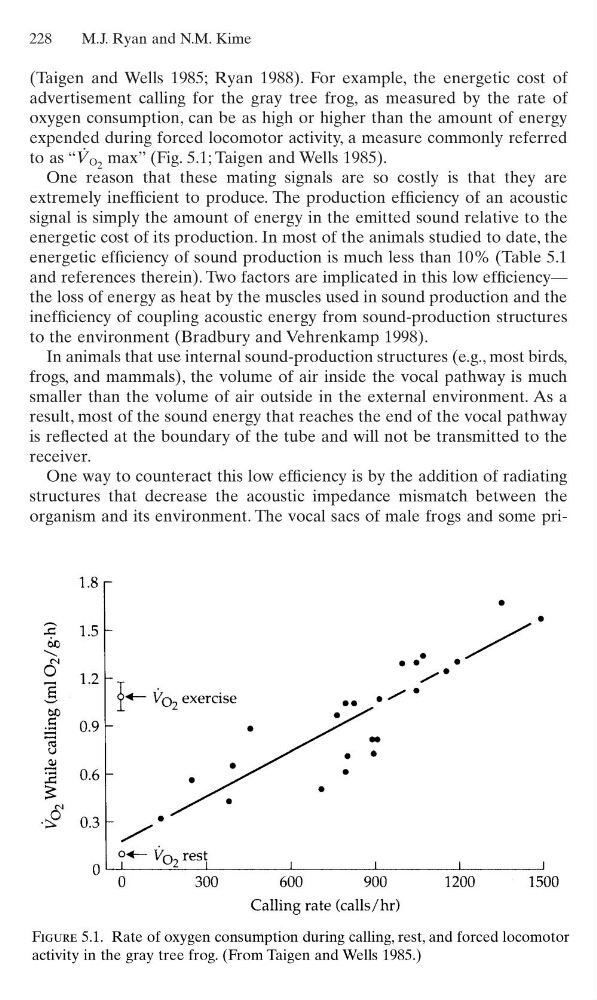
(Taigen and Wells 1985; Ryan 1988). For example, the energetic cost of
advertisement calling for the gray tree frog, as measured by the rate of
oxygen consumption, can be as high or higher than the amount of energy
expended during forced locomotor activity, a measure commonly referred
to as “V
.
O 2
max” (Fig. 5.1; Taigen and Wells 1985).
One reason that these mating signals are so costly is that they are
extremely inefficient to produce. The production efficiency of an acoustic
signal is simply the amount of energy in the emitted sound relative to the
energetic cost of its production. In most of the animals studied to date, the
energetic efficiency of sound production is much less than 10% (Table 5.1
and references therein). Two factors are implicated in this low efficiency—
the loss of energy as heat by the muscles used in sound production and the
inefficiency of coupling acoustic energy from sound-production structures
to the environment (Bradbury and Vehrenkamp 1998).
In animals that use internal sound-production structures (e.g., most birds,
frogs, and mammals), the volume of air inside the vocal pathway is much
smaller than the volume of air outside in the external environment. As a
result, most of the sound energy that reaches the end of the vocal pathway
is reflected at the boundary of the tube and will not be transmitted to the
receiver.
One way to counteract this low efficiency is by the addition of radiating
structures that decrease the acoustic impedance mismatch between the
organism and its environment. The vocal sacs of male frogs and some pri228
M.J. Ryan and N.M. Kime
Figure 5.1. Rate of oxygen consumption during calling, rest, and forced locomotor
activity in the gray tree frog. (From Taigen and Wells 1985.)
advertisement calling for the gray tree frog, as measured by the rate of
oxygen consumption, can be as high or higher than the amount of energy
expended during forced locomotor activity, a measure commonly referred
to as “V
.
O 2
max” (Fig. 5.1; Taigen and Wells 1985).
One reason that these mating signals are so costly is that they are
extremely inefficient to produce. The production efficiency of an acoustic
signal is simply the amount of energy in the emitted sound relative to the
energetic cost of its production. In most of the animals studied to date, the
energetic efficiency of sound production is much less than 10% (Table 5.1
and references therein). Two factors are implicated in this low efficiency—
the loss of energy as heat by the muscles used in sound production and the
inefficiency of coupling acoustic energy from sound-production structures
to the environment (Bradbury and Vehrenkamp 1998).
In animals that use internal sound-production structures (e.g., most birds,
frogs, and mammals), the volume of air inside the vocal pathway is much
smaller than the volume of air outside in the external environment. As a
result, most of the sound energy that reaches the end of the vocal pathway
is reflected at the boundary of the tube and will not be transmitted to the
receiver.
One way to counteract this low efficiency is by the addition of radiating
structures that decrease the acoustic impedance mismatch between the
organism and its environment. The vocal sacs of male frogs and some pri228
M.J. Ryan and N.M. Kime
Figure 5.1. Rate of oxygen consumption during calling, rest, and forced locomotor
activity in the gray tree frog. (From Taigen and Wells 1985.)