

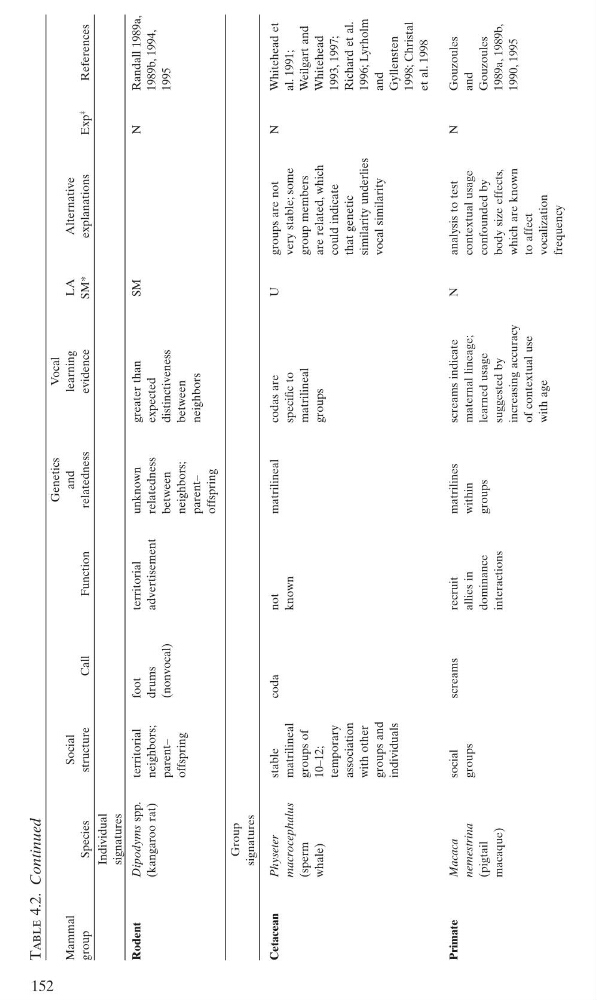
Table 4.2. Continued
Genetics
Vocal
Mammal
Social
and
learning
LA
Alternative
group
Species
structure
Call
Function
relatedness
evidence
SM*
explanations
Exp
‡
References
Individual
signatures
Rodent
Dipodyms spp.
territorial
foot
territorial
unknown
greater than
SM
N
Randall 1989a,
(kangaroo rat)
neighbors;
drums
advertisement
relatedness
expected
1989b, 1994,
parent–
(nonvocal)
between
distinctiveness
1995
offspring
neighbors;
between
parent–
neighbors
offspring
Group
signatures
Cetacean
Physeter
stable
coda
not
matrilineal
codas are
U
groups are not
N
Whitehead et
macrocephalus
matrilineal
known
specific to
very stable; some
al. 1991;
(sperm
groups of
matrilineal
group members
Weilgart and
whale)
10–12;
groups
are related, which
Whitehead
temporary
could indicate
1993, 1997;
association
that genetic
Richard et al.
with other
similarity underlies
1996; Lyrholm
groups and
vocal similarity
and
individuals
Gyllensten
1998; Christal
et al. 1998
Primate
Macaca
social
screams
recruit
matrilines
screams indicate
N
analysis to test
N
Gouzoules
nemestrina
groups
allies in
within
maternal lineage;
contextual usage
and
(pigtail
dominance
groups
learned usage
confounded by
Gouzoules
macaque)
interactions
suggested by
body size effects,
1989a, 1989b,
increasing accuracy
which are known
1990, 1995
of contextual use
to affect
with age
vocalization
frequency
152
Genetics
Vocal
Mammal
Social
and
learning
LA
Alternative
group
Species
structure
Call
Function
relatedness
evidence
SM*
explanations
Exp
‡
References
Individual
signatures
Rodent
Dipodyms spp.
territorial
foot
territorial
unknown
greater than
SM
N
Randall 1989a,
(kangaroo rat)
neighbors;
drums
advertisement
relatedness
expected
1989b, 1994,
parent–
(nonvocal)
between
distinctiveness
1995
offspring
neighbors;
between
parent–
neighbors
offspring
Group
signatures
Cetacean
Physeter
stable
coda
not
matrilineal
codas are
U
groups are not
N
Whitehead et
macrocephalus
matrilineal
known
specific to
very stable; some
al. 1991;
(sperm
groups of
matrilineal
group members
Weilgart and
whale)
10–12;
groups
are related, which
Whitehead
temporary
could indicate
1993, 1997;
association
that genetic
Richard et al.
with other
similarity underlies
1996; Lyrholm
groups and
vocal similarity
and
individuals
Gyllensten
1998; Christal
et al. 1998
Primate
Macaca
social
screams
recruit
matrilines
screams indicate
N
analysis to test
N
Gouzoules
nemestrina
groups
allies in
within
maternal lineage;
contextual usage
and
(pigtail
dominance
groups
learned usage
confounded by
Gouzoules
macaque)
interactions
suggested by
body size effects,
1989a, 1989b,
increasing accuracy
which are known
1990, 1995
of contextual use
to affect
with age
vocalization
frequency
152