

(17)
10. Acoustic Models of Sound Production
455
valve will excite large pressure fluctuations in the nasal passages, which
are accompanied by fluctuations in the volume of the laryngeal sac that are
large compared to the fluctuations in the air flow through the valve. The
sound intensity produced will be larger by the ratio of the volume of the
air stream fluctuations to the laryngeal sac-nasal passage volume fluctuations. A realistic resonance calculation for the laryngeal-nasal volume will
take account of the Helmholtz resonator formed by the laryngeal sac at the
end of the rigid nasal passage and should take account of the semirigid terminations at the nasal plugs. Following the analysis of Fletcher (1992, pp.
178-186) and assuming the anatomical dimensions discussed previously, the
sound speed of a 17-Hz wave in a nasal passage tube would have a velocity about 0.65 times that of the sound speed in air. When we combine this
lowered velocity with the Helmholtz frequency calculation, applicable
because of the short tube length relative to the wavelength, we calculate
the resonance frequency as follows (Fletcher 1992, p. 185):
,rs
O)H =c ~W
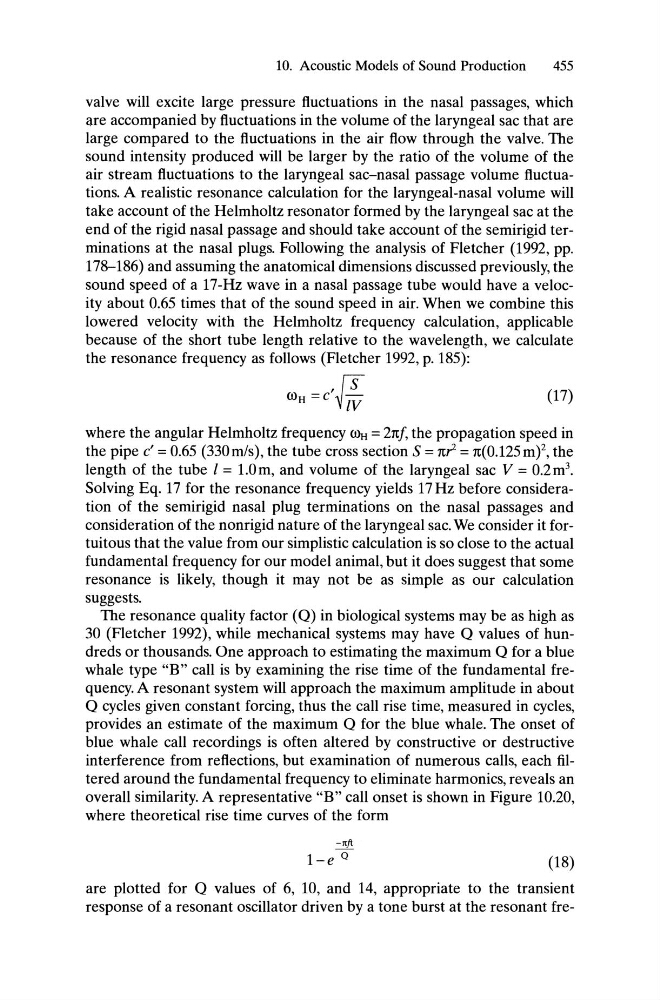
where the angular Helmholtz frequency ffiH = 2nf, the propagation speed in
the pipe c' = 0.65 (330 m/s), the tube cross section S = nr = n(0.125m)2, the
length of the tube 1= l.Om, and volume of the laryngeal sac V = 0.2m
3 •
Solving Eq. 17 for the resonance frequency yields 17 Hz before consideration of the semirigid nasal plug terminations on the nasal passages and
consideration of the nonrigid nature of the laryngeal sac. We consider it fortuitous that the value from our simplistic calculation is so close to the actual
fundamental frequency for our model animal, but it does suggest that some
resonance is likely, though it may not be as simple as our calculation
suggests.
The resonance quality factor (Q) in biological systems may be as high as
30 (Fletcher 1992), while mechanical systems may have Q values of hundreds or thousands. One approach to estimating the maximum Q for a blue
whale type "B" call is by examining the rise time of the fundamental frequency. A resonant system will approach the maximum amplitude in about
Q cycles given constant forcing, thus the call rise time, measured in cycles,
provides an estimate of the maximum Q for the blue whale. The onset of
blue whale call recordings is often altered by constructive or destructive
interference from reflections, but examination of numerous calls, each filtered around the fundamental frequency to eliminate harmonics, reveals an
overall similarity. A representative "B" call onset is shown in Figure 10.20,
where theoretical rise time curves of the form
-rtjt
l-e Q
(18)
are plotted for Q values of 6, 10, and 14, appropriate to the transient
response of a resonant oscillator driven by a tone burst at the resonant fre-
10. Acoustic Models of Sound Production
455
valve will excite large pressure fluctuations in the nasal passages, which
are accompanied by fluctuations in the volume of the laryngeal sac that are
large compared to the fluctuations in the air flow through the valve. The
sound intensity produced will be larger by the ratio of the volume of the
air stream fluctuations to the laryngeal sac-nasal passage volume fluctuations. A realistic resonance calculation for the laryngeal-nasal volume will
take account of the Helmholtz resonator formed by the laryngeal sac at the
end of the rigid nasal passage and should take account of the semirigid terminations at the nasal plugs. Following the analysis of Fletcher (1992, pp.
178-186) and assuming the anatomical dimensions discussed previously, the
sound speed of a 17-Hz wave in a nasal passage tube would have a velocity about 0.65 times that of the sound speed in air. When we combine this
lowered velocity with the Helmholtz frequency calculation, applicable
because of the short tube length relative to the wavelength, we calculate
the resonance frequency as follows (Fletcher 1992, p. 185):
,rs
O)H =c ~W
where the angular Helmholtz frequency ffiH = 2nf, the propagation speed in
the pipe c' = 0.65 (330 m/s), the tube cross section S = nr = n(0.125m)2, the
length of the tube 1= l.Om, and volume of the laryngeal sac V = 0.2m
3 •
Solving Eq. 17 for the resonance frequency yields 17 Hz before consideration of the semirigid nasal plug terminations on the nasal passages and
consideration of the nonrigid nature of the laryngeal sac. We consider it fortuitous that the value from our simplistic calculation is so close to the actual
fundamental frequency for our model animal, but it does suggest that some
resonance is likely, though it may not be as simple as our calculation
suggests.
The resonance quality factor (Q) in biological systems may be as high as
30 (Fletcher 1992), while mechanical systems may have Q values of hundreds or thousands. One approach to estimating the maximum Q for a blue
whale type "B" call is by examining the rise time of the fundamental frequency. A resonant system will approach the maximum amplitude in about
Q cycles given constant forcing, thus the call rise time, measured in cycles,
provides an estimate of the maximum Q for the blue whale. The onset of
blue whale call recordings is often altered by constructive or destructive
interference from reflections, but examination of numerous calls, each filtered around the fundamental frequency to eliminate harmonics, reveals an
overall similarity. A representative "B" call onset is shown in Figure 10.20,
where theoretical rise time curves of the form
-rtjt
l-e Q
(18)
are plotted for Q values of 6, 10, and 14, appropriate to the transient
response of a resonant oscillator driven by a tone burst at the resonant fre-