

450
J.L. Aroyan et al.
where Po is pressure at the sea surface, Po is air density at the sea surface,
and r(z) is air density at depth z.1f the volume V n is constant, then air must
flow from the lungs through the valve during descent, or back into the lungs
during ascent from the narial side. If it is constant, the rate of change of the
mass of the air on the narial side is proportional to the rate of change of
the density:
(10)
The mass flow rate through the valve, rh, can be related to the volume flow
rate, Q, by the air density in the lung, PL:
rh=QPL
The volume flow rate can be expressed:
(11)
Q = V n apn
(12)
P L at
From Eq. 5, the change in air density with time is proportional to the change
in pressure:
(13)
(14)
(15)
(16)
Combining Eqs. 12 and 13, the volume flow rate, Q, is
Q= Vn aPL
P L at
The volume displacement, VD, across the arytenoids from the lung side to
the narial side is the integral of the volume flow from surface to collapse
depth:
V D = f' 2 Qdt = V n In[P{tZ)] = V n In[V(t Z )]
Jtl
P(t\)
V(t l )
When substituting the maximum values the volume displacement VDmax
becomes:
V Dmax = V n In[~]
V n +~
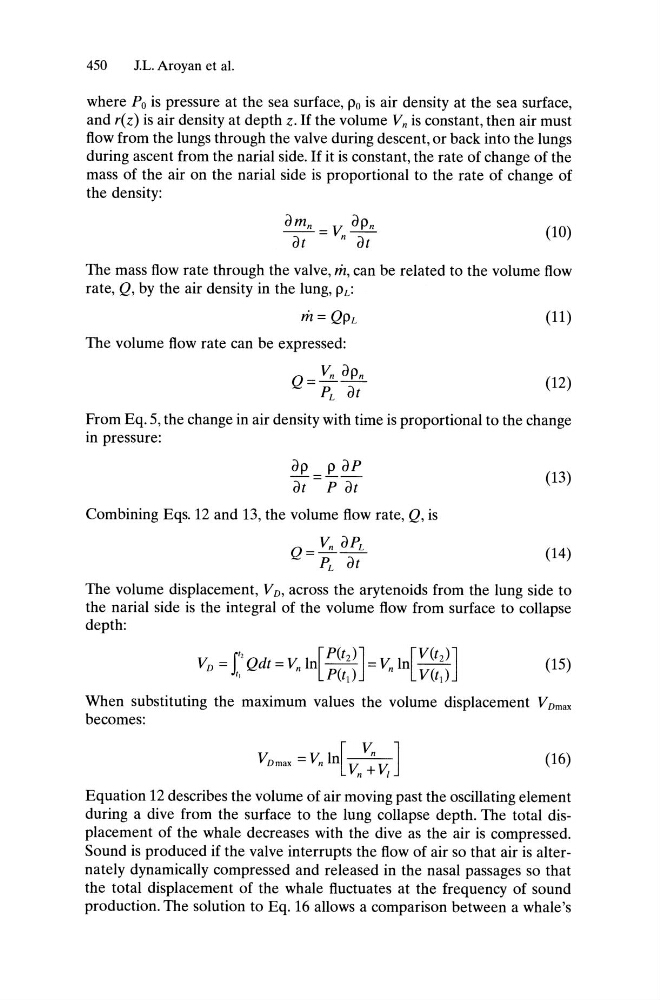
Equation 12 describes the volume of air moving past the oscillating element
during a dive from the surface to the lung collapse depth. The total displacement of the whale decreases with the dive as the air is compressed.
Sound is produced if the valve interrupts the flow of air so that air is alternately dynamically compressed and released in the nasal passages so that
the total displacement of the whale fluctuates at the frequency of sound
production. The solution to Eq. 16 allows a comparison between a whale's
J.L. Aroyan et al.
where Po is pressure at the sea surface, Po is air density at the sea surface,
and r(z) is air density at depth z.1f the volume V n is constant, then air must
flow from the lungs through the valve during descent, or back into the lungs
during ascent from the narial side. If it is constant, the rate of change of the
mass of the air on the narial side is proportional to the rate of change of
the density:
(10)
The mass flow rate through the valve, rh, can be related to the volume flow
rate, Q, by the air density in the lung, PL:
rh=QPL
The volume flow rate can be expressed:
(11)
Q = V n apn
(12)
P L at
From Eq. 5, the change in air density with time is proportional to the change
in pressure:
(13)
(14)
(15)
(16)
Combining Eqs. 12 and 13, the volume flow rate, Q, is
Q= Vn aPL
P L at
The volume displacement, VD, across the arytenoids from the lung side to
the narial side is the integral of the volume flow from surface to collapse
depth:
V D = f' 2 Qdt = V n In[P{tZ)] = V n In[V(t Z )]
Jtl
P(t\)
V(t l )
When substituting the maximum values the volume displacement VDmax
becomes:
V Dmax = V n In[~]
V n +~
Equation 12 describes the volume of air moving past the oscillating element
during a dive from the surface to the lung collapse depth. The total displacement of the whale decreases with the dive as the air is compressed.
Sound is produced if the valve interrupts the flow of air so that air is alternately dynamically compressed and released in the nasal passages so that
the total displacement of the whale fluctuates at the frequency of sound
production. The solution to Eq. 16 allows a comparison between a whale's