

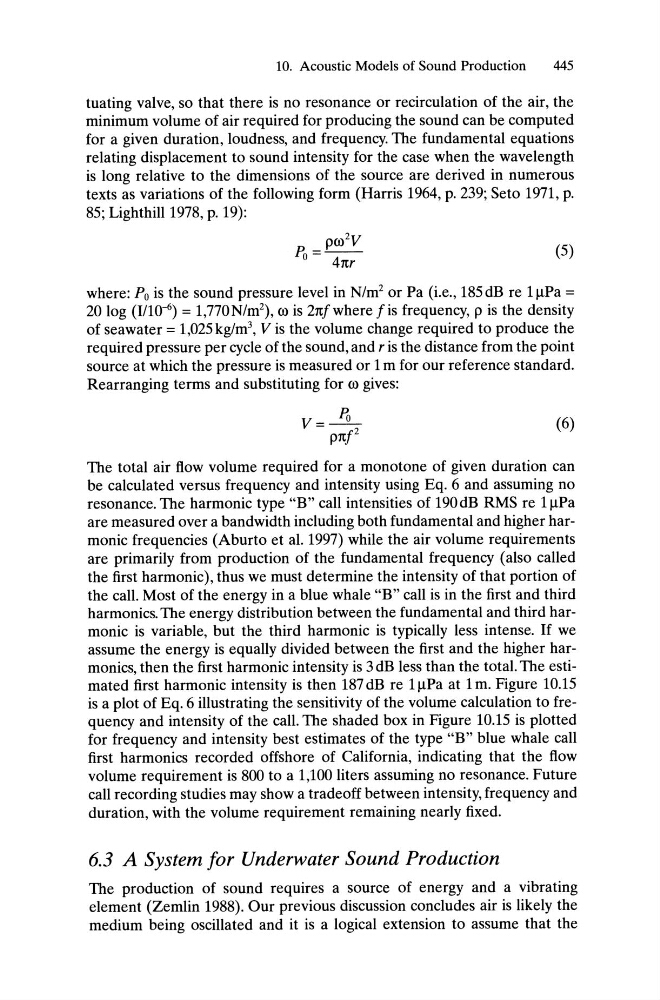
(5)
10. Acoustic Models of Sound Production
445
tuating valve, so that there is no resonance or recirculation of the air, the
minimum volume of air required for producing the sound can be computed
for a given duration, loudness, and frequency. The fundamental equations
relating displacement to sound intensity for the case when the wavelength
is long relative to the dimensions of the source are derived in numerous
texts as variations of the following form (Harris 1964, p. 239; Seto 1971, p.
85; LighthiII 1978, p. 19):
p0)2y
P o = - -
41tr
where: Po is the sound pressure level in N/m
2
or Pa (i.e., 185dB re 11lPa =
20 log (I/lO-6) = 1,770 N/m
2 ), 0) is 21tf where f is frequency, p is the density
of seawater = 1,025 kg/m
3 , Y is the volume change required to produce the
required pressure per cycle of the sound, and r is the distance from the point
source at which the pressure is measured or 1m for our reference standard.
Rearranging terms and substituting for 0) gives:
(6)
The total air flow volume required for a monotone of given duration can
be calculated versus frequency and intensity using Eq. 6 and assuming no
resonance. The harmonic type "B" call intensities of 190dB RMS re 1JlPa
are measured over a bandwidth including both fundamental and higher harmonic frequencies (Aburto et al. 1997) while the air volume requirements
are primarily from production of the fundamental frequency (also called
the first harmonic), thus we must determine the intensity of that portion of
the call. Most of the energy in a blue whale "B" call is in the first and third
harmonics. The energy distribution between the fundamental and third harmonic is variable, but the third harmonic is typically less intense. If we
assume the energy is equally divided between the first and the higher harmonics, then the first harmonic intensity is 3 dB less than the total. The estimated first harmonic intensity is then 187 dB re 1JlPa at 1 m. Figure 10.15
is a plot of Eq. 6 illustrating the sensitivity of the volume calculation to frequency and intensity of the call. The shaded box in Figure 10.15 is plotted
for frequency and intensity best estimates of the type "B" blue whale call
first harmonics recorded offshore of California, indicating that the flow
volume requirement is 800 to a 1,100 liters assuming no resonance. Future
call recording studies may show a tradeoff between intensity, frequency and
duration, with the volume requirement remaining nearly fixed.
6.3 A System for Underwater Sound Production
The production of sound requires a source of energy and a vibrating
element (Zemlin 1988). Our previous discussion concludes air is likely the
medium being oscillated and it is a logical extension to assume that the
10. Acoustic Models of Sound Production
445
tuating valve, so that there is no resonance or recirculation of the air, the
minimum volume of air required for producing the sound can be computed
for a given duration, loudness, and frequency. The fundamental equations
relating displacement to sound intensity for the case when the wavelength
is long relative to the dimensions of the source are derived in numerous
texts as variations of the following form (Harris 1964, p. 239; Seto 1971, p.
85; LighthiII 1978, p. 19):
p0)2y
P o = - -
41tr
where: Po is the sound pressure level in N/m
2
or Pa (i.e., 185dB re 11lPa =
20 log (I/lO-6) = 1,770 N/m
2 ), 0) is 21tf where f is frequency, p is the density
of seawater = 1,025 kg/m
3 , Y is the volume change required to produce the
required pressure per cycle of the sound, and r is the distance from the point
source at which the pressure is measured or 1m for our reference standard.
Rearranging terms and substituting for 0) gives:
(6)
The total air flow volume required for a monotone of given duration can
be calculated versus frequency and intensity using Eq. 6 and assuming no
resonance. The harmonic type "B" call intensities of 190dB RMS re 1JlPa
are measured over a bandwidth including both fundamental and higher harmonic frequencies (Aburto et al. 1997) while the air volume requirements
are primarily from production of the fundamental frequency (also called
the first harmonic), thus we must determine the intensity of that portion of
the call. Most of the energy in a blue whale "B" call is in the first and third
harmonics. The energy distribution between the fundamental and third harmonic is variable, but the third harmonic is typically less intense. If we
assume the energy is equally divided between the first and the higher harmonics, then the first harmonic intensity is 3 dB less than the total. The estimated first harmonic intensity is then 187 dB re 1JlPa at 1 m. Figure 10.15
is a plot of Eq. 6 illustrating the sensitivity of the volume calculation to frequency and intensity of the call. The shaded box in Figure 10.15 is plotted
for frequency and intensity best estimates of the type "B" blue whale call
first harmonics recorded offshore of California, indicating that the flow
volume requirement is 800 to a 1,100 liters assuming no resonance. Future
call recording studies may show a tradeoff between intensity, frequency and
duration, with the volume requirement remaining nearly fixed.
6.3 A System for Underwater Sound Production
The production of sound requires a source of energy and a vibrating
element (Zemlin 1988). Our previous discussion concludes air is likely the
medium being oscillated and it is a logical extension to assume that the