

10. Acoustic Models of Sound Production
413
(A)
z y
x
Simulation grid
PSR region
Tissue model region
(8)
n
Flat
Source
Area
s
0'
r= O'-R
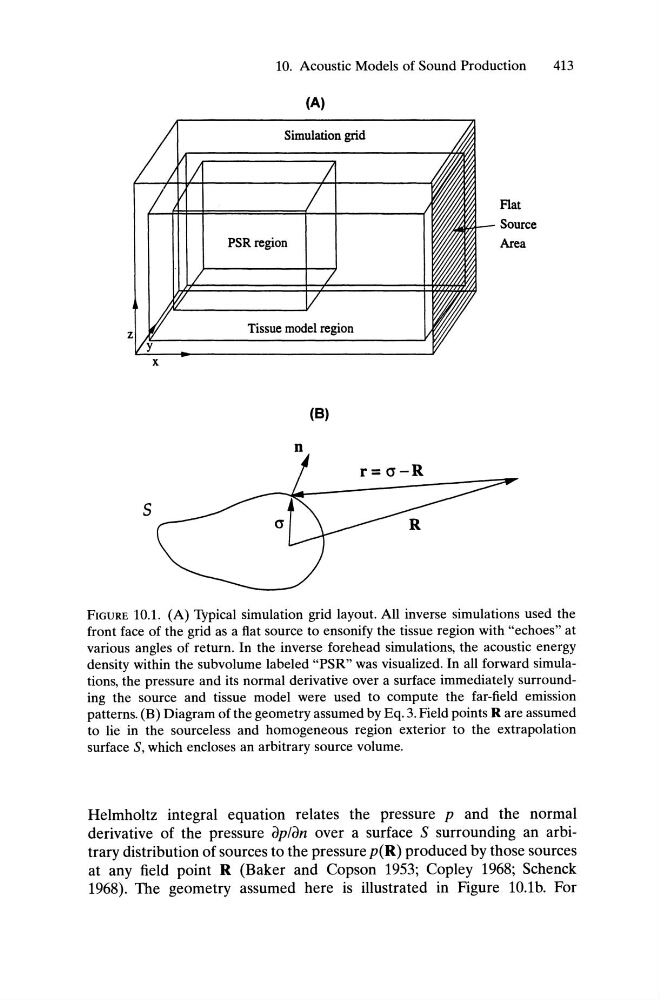
FIGURE 10.1. (A) Typical simulation grid layout. All inverse simulations used the
front face of the grid as a flat source to ensonify the tissue region with "echoes" at
various angles of return. In the inverse forehead simulations, the acoustic energy
density within the subvolume labeled "PSR" was visualized. In all forward simulations, the pressure and its normal derivative over a surface immediately surrounding the source and tissue model were used to compute the far-field emission
patterns. (B) Diagram of the geometry assumed by Eq. 3. Field points R are assumed
to lie in the sourceless and homogeneous region exterior to the extrapolation
surface S, which encloses an arbitrary source volume.
Helmholtz integral equation relates the pressure p and the normal
derivative of the pressure dp/dn over a surface S surrounding an arbitrary distribution of sources to the pressure p(R) produced by those sources
at any field point R (Baker and Copson 1953; Copley 1968; Schenck
1968). The geometry assumed here is illustrated in Figure 1O.1b. For
413
(A)
z y
x
Simulation grid
PSR region
Tissue model region
(8)
n
Flat
Source
Area
s
0'
r= O'-R
FIGURE 10.1. (A) Typical simulation grid layout. All inverse simulations used the
front face of the grid as a flat source to ensonify the tissue region with "echoes" at
various angles of return. In the inverse forehead simulations, the acoustic energy
density within the subvolume labeled "PSR" was visualized. In all forward simulations, the pressure and its normal derivative over a surface immediately surrounding the source and tissue model were used to compute the far-field emission
patterns. (B) Diagram of the geometry assumed by Eq. 3. Field points R are assumed
to lie in the sourceless and homogeneous region exterior to the extrapolation
surface S, which encloses an arbitrary source volume.
Helmholtz integral equation relates the pressure p and the normal
derivative of the pressure dp/dn over a surface S surrounding an arbitrary distribution of sources to the pressure p(R) produced by those sources
at any field point R (Baker and Copson 1953; Copley 1968; Schenck
1968). The geometry assumed here is illustrated in Figure 1O.1b. For