

388
w.w.L. Au
100
,..
\\/1
J\
"
'"
/
/
/
.... ~......
/
..' " ......
."
..,......
_. ...
•..... //
..........1 ....
..... /
'" . . . .
......" «' /
.••••~+
rI
•...
/ «'
i
/~+~
i
/ r
:
/
!f
i /
iI
!/
.:/ ."
J
80
90
g ..
8 70
E
~ II
a.
6
5
4
J
AR Ceml
2
O-+-----r-----r----,----,----,-------,
o
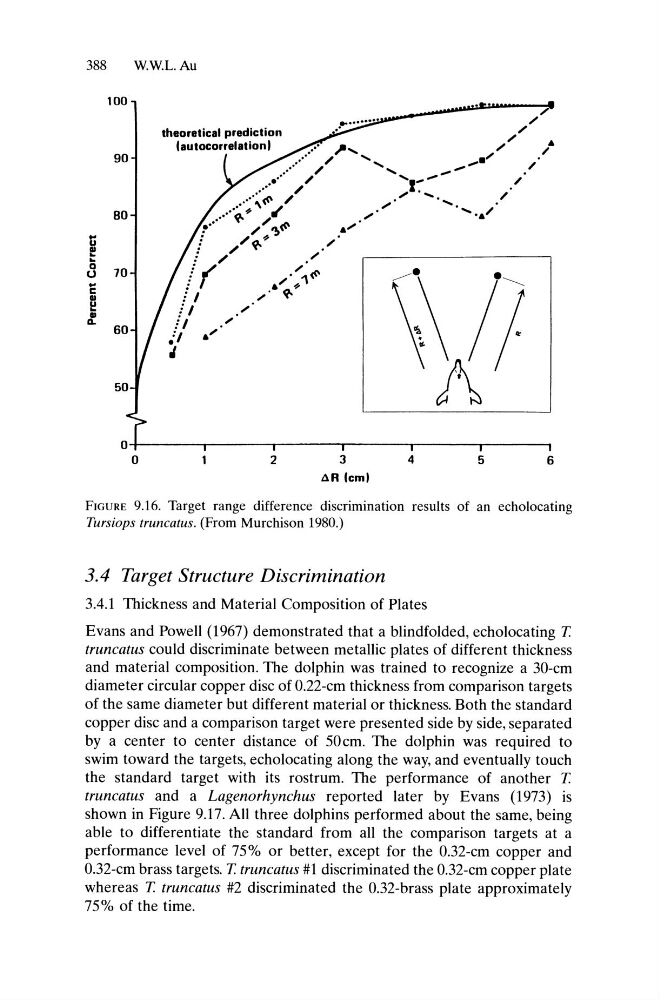
FIGURE 9.16. Target range difference discrimination results of an echolocating
Tursiops truncatus. (From Murchison 1980.)
3.4 Target Structure Discrimination
3.4.1 Thickness and Material Composition of Plates
Evans and Powell (1967) demonstrated that a blindfolded, echolocating T
truncatus could discriminate between metallic plates of different thickness
and material composition. The dolphin was trained to recognize a 30-cm
diameter circular copper disc of O.22-cm thickness from comparison targets
of the same diameter but different material or thickness. Both the standard
copper disc and a comparison target were presented side by side, separated
by a center to center distance of 50cm. The dolphin was required to
swim toward the targets, echolocating along the way, and eventually touch
the standard target with its rostrum. The performance of another T
truncatus and a Lagenorhynchus reported later by Evans (1973) is
shown in Figure 9.17. All three dolphins performed about the same, being
able to differentiate the standard from all the comparison targets at a
performance level of 75% or better, except for the O.32-cm copper and
0.32-cm brass targets. T truncatus #1 discriminated the O.32-cm copper plate
whereas T truncatus #2 discriminated the 0.32-brass plate approximately
75% of the time.
w.w.L. Au
100
,..
\\/1
J\
"
'"
/
/
/
.... ~......
/
..' " ......
."
..,......
_. ...
•..... //
..........1 ....
..... /
'" . . . .
......" «' /
.••••~+
rI
•...
/ «'
i
/~+~
i
/ r
:
/
!f
i /
iI
!/
.:/ ."
J
80
90
g ..
8 70
E
~ II
a.
6
5
4
J
AR Ceml
2
O-+-----r-----r----,----,----,-------,
o
FIGURE 9.16. Target range difference discrimination results of an echolocating
Tursiops truncatus. (From Murchison 1980.)
3.4 Target Structure Discrimination
3.4.1 Thickness and Material Composition of Plates
Evans and Powell (1967) demonstrated that a blindfolded, echolocating T
truncatus could discriminate between metallic plates of different thickness
and material composition. The dolphin was trained to recognize a 30-cm
diameter circular copper disc of O.22-cm thickness from comparison targets
of the same diameter but different material or thickness. Both the standard
copper disc and a comparison target were presented side by side, separated
by a center to center distance of 50cm. The dolphin was required to
swim toward the targets, echolocating along the way, and eventually touch
the standard target with its rostrum. The performance of another T
truncatus and a Lagenorhynchus reported later by Evans (1973) is
shown in Figure 9.17. All three dolphins performed about the same, being
able to differentiate the standard from all the comparison targets at a
performance level of 75% or better, except for the O.32-cm copper and
0.32-cm brass targets. T truncatus #1 discriminated the O.32-cm copper plate
whereas T truncatus #2 discriminated the 0.32-brass plate approximately
75% of the time.