

384
W.w.L. Au
Surface
O-r------------------~.::.:.:.--I
76.8
I
75.9
I
74.9
72.2
71.3
70.4
69.5
6.1 +---r--O:;:....--r---r--....
68.6
4.6
1.5
"E
e
! 3.0
i o
Distanca Imetersl
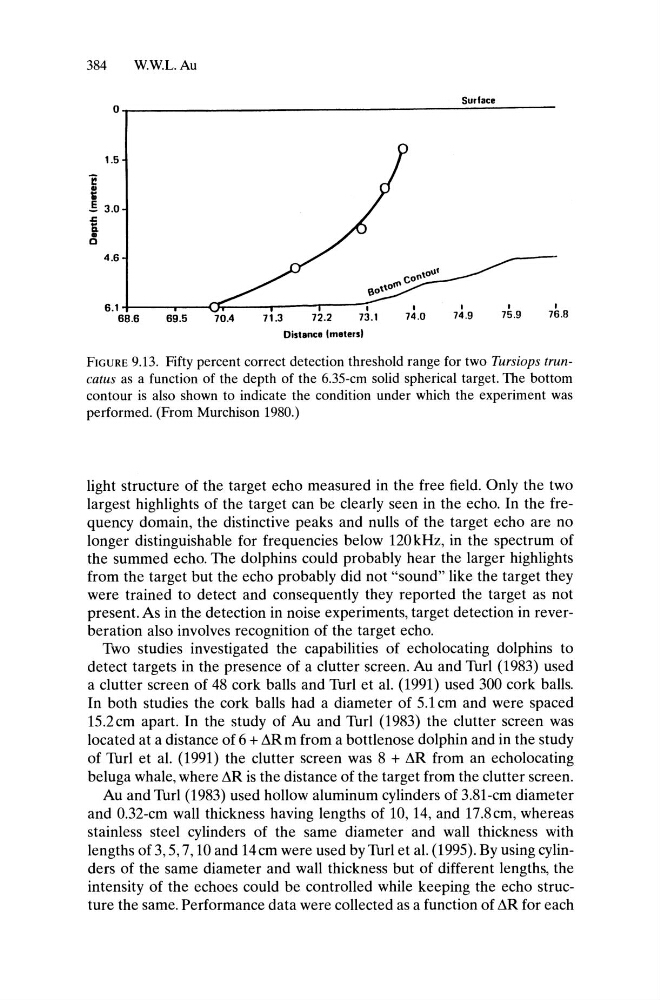
FIGURE 9.13. Fifty percent correct detection threshold range for two Tursiops truneatus as a function of the depth of the 6.35-cm solid spherical target. The bottom
contour is also shown to indicate the condition under which the experiment was
performed. (From Murchison 1980.)
light structure of the target echo measured in the free field. Only the two
largest highlights of the target can be clearly seen in the echo. In the frequency domain, the distinctive peaks and nulls of the target echo are no
longer distinguishable for frequencies below 120 kHz, in the spectrum of
the summed echo. The dolphins could probably hear the larger highlights
from the target but the echo probably did not "sound" like the target they
were trained to detect and consequently they reported the target as not
present. As in the detection in noise experiments, target detection in reverberation also involves recognition of the target echo.
Two studies investigated the capabilities of echolocating dolphins to
detect targets in the presence of a clutter screen. Au and Turl (1983) used
a clutter screen of 48 cork balls and Turl et al. (1991) used 300 cork balls.
In both studies the cork balls had a diameter of 5.1 cm and were spaced
15.2cm apart. In the study of Au and Turl (1983) the clutter screen was
located at a distance of 6 + ~R m from a bottlenose dolphin and in the study
of Turl et al. (1991) the clutter screen was 8 + ~R from an echolocating
beluga whale, where ~R is the distance of the target from the clutter screen.
Au and Turl (1983) used hollow aluminum cylinders of 3.81-cm diameter
and 0.32-cm wall thickness having lengths of 10, 14, and 17.8cm, whereas
stainless steel cylinders of the same diameter and wall thickness with
lengths of 3, 5, 7,10 and 14cm were used by Turl et al. (1995). By using cylinders of the same diameter and wall thickness but of different lengths, the
intensity of the echoes could be controlled while keeping the echo structure the same. Performance data were collected as a function of ~R for each
W.w.L. Au
Surface
O-r------------------~.::.:.:.--I
76.8
I
75.9
I
74.9
72.2
71.3
70.4
69.5
6.1 +---r--O:;:....--r---r--....
68.6
4.6
1.5
"E
e
! 3.0
i o
Distanca Imetersl
FIGURE 9.13. Fifty percent correct detection threshold range for two Tursiops truneatus as a function of the depth of the 6.35-cm solid spherical target. The bottom
contour is also shown to indicate the condition under which the experiment was
performed. (From Murchison 1980.)
light structure of the target echo measured in the free field. Only the two
largest highlights of the target can be clearly seen in the echo. In the frequency domain, the distinctive peaks and nulls of the target echo are no
longer distinguishable for frequencies below 120 kHz, in the spectrum of
the summed echo. The dolphins could probably hear the larger highlights
from the target but the echo probably did not "sound" like the target they
were trained to detect and consequently they reported the target as not
present. As in the detection in noise experiments, target detection in reverberation also involves recognition of the target echo.
Two studies investigated the capabilities of echolocating dolphins to
detect targets in the presence of a clutter screen. Au and Turl (1983) used
a clutter screen of 48 cork balls and Turl et al. (1991) used 300 cork balls.
In both studies the cork balls had a diameter of 5.1 cm and were spaced
15.2cm apart. In the study of Au and Turl (1983) the clutter screen was
located at a distance of 6 + ~R m from a bottlenose dolphin and in the study
of Turl et al. (1991) the clutter screen was 8 + ~R from an echolocating
beluga whale, where ~R is the distance of the target from the clutter screen.
Au and Turl (1983) used hollow aluminum cylinders of 3.81-cm diameter
and 0.32-cm wall thickness having lengths of 10, 14, and 17.8cm, whereas
stainless steel cylinders of the same diameter and wall thickness with
lengths of 3, 5, 7,10 and 14cm were used by Turl et al. (1995). By using cylinders of the same diameter and wall thickness but of different lengths, the
intensity of the echoes could be controlled while keeping the echo structure the same. Performance data were collected as a function of ~R for each