

8. Psychoacoustic Studies of Dolphins and Whales
357
45
40
~ 35
!
lD 30
:2o
I 25
' 3
~ 20
u
15
....Delphilepterus teuces
-0- Pseudorce cre..idens
1000.00
100.00
1.00
10.00
Frequency (kHz)
0.10
10 .....- - -......-----+----~I__--- ....---___4
0.01
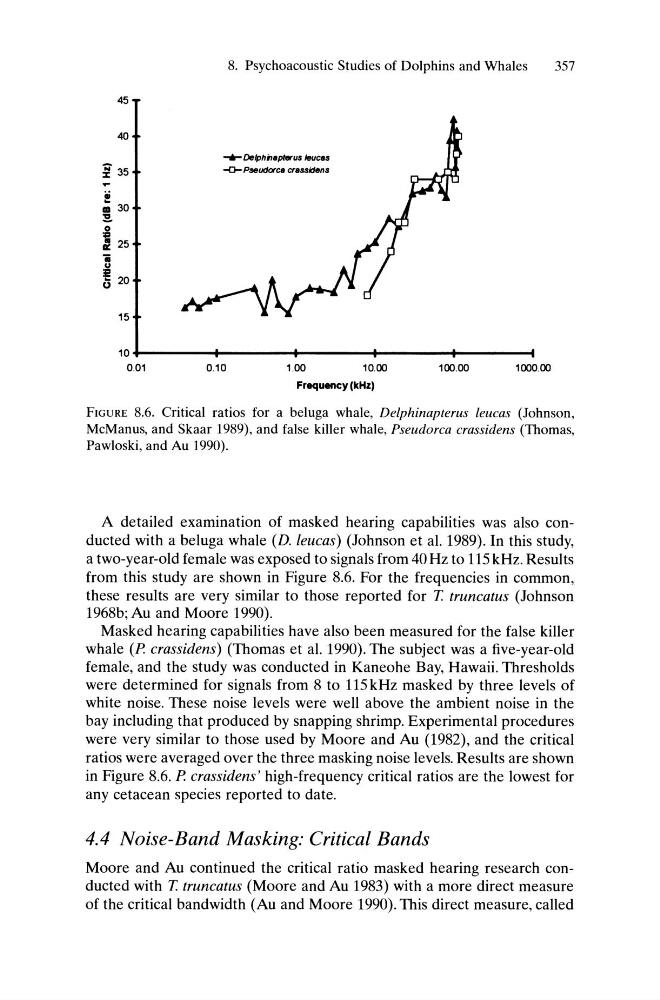
FIGURE 8.6. Critical ratios for a beluga whale, Delphinapterus leucas (Johnson,
McManus, and Skaar 1989), and false killer whale, Pseudorca crassidens (Thomas,
Pawloski, and Au 1990).
A detailed examination of masked hearing capabilities was also conducted with a beluga whale (D. leucas) (Johnson et al. 1989). In this study,
a two-year-old female was exposed to signals from 40 Hz to 115 kHz. Results
from this study are shown in Figure 8.6. For the frequencies in common,
these results are very similar to those reported for T truncatus (Johnson
1968b; Au and Moore 1990).
Masked hearing capabilities have also been measured for the false killer
whale (P. crassidens) (Thomas et al. 1990). The subject was a five-year-old
female, and the study was conducted in Kaneohe Bay, Hawaii. Thresholds
were determined for signals from 8 to 115 kHz masked by three levels of
white noise. These noise levels were well above the ambient noise in the
bay including that produced by snapping shrimp. Experimental procedures
were very similar to those used by Moore and Au (1982), and the critical
ratios were averaged over the three masking noise levels. Results are shown
in Figure 8.6. P. crassidens' high-frequency critical ratios are the lowest for
any cetacean species reported to date.
4.4 Noise-Band Masking: Critical Bands
Moore and Au continued the critical ratio masked hearing research conducted with T truncatus (Moore and Au 1983) with a more direct measure
of the critical bandwidth (Au and Moore 1990). This direct measure, called
357
45
40
~ 35
!
lD 30
:2o
I 25
' 3
~ 20
u
15
....Delphilepterus teuces
-0- Pseudorce cre..idens
1000.00
100.00
1.00
10.00
Frequency (kHz)
0.10
10 .....- - -......-----+----~I__--- ....---___4
0.01
FIGURE 8.6. Critical ratios for a beluga whale, Delphinapterus leucas (Johnson,
McManus, and Skaar 1989), and false killer whale, Pseudorca crassidens (Thomas,
Pawloski, and Au 1990).
A detailed examination of masked hearing capabilities was also conducted with a beluga whale (D. leucas) (Johnson et al. 1989). In this study,
a two-year-old female was exposed to signals from 40 Hz to 115 kHz. Results
from this study are shown in Figure 8.6. For the frequencies in common,
these results are very similar to those reported for T truncatus (Johnson
1968b; Au and Moore 1990).
Masked hearing capabilities have also been measured for the false killer
whale (P. crassidens) (Thomas et al. 1990). The subject was a five-year-old
female, and the study was conducted in Kaneohe Bay, Hawaii. Thresholds
were determined for signals from 8 to 115 kHz masked by three levels of
white noise. These noise levels were well above the ambient noise in the
bay including that produced by snapping shrimp. Experimental procedures
were very similar to those used by Moore and Au (1982), and the critical
ratios were averaged over the three masking noise levels. Results are shown
in Figure 8.6. P. crassidens' high-frequency critical ratios are the lowest for
any cetacean species reported to date.
4.4 Noise-Band Masking: Critical Bands
Moore and Au continued the critical ratio masked hearing research conducted with T truncatus (Moore and Au 1983) with a more direct measure
of the critical bandwidth (Au and Moore 1990). This direct measure, called