

8. Psychoacoustic Studies of Dolphins and Whales
355
1924). One notable difference was that masking of high-frequency signals
by a lower frequency masker in dolphins was not as effective as it was in
humans.
Tone-on-tone masking (masking the detection of one tone by the presentation of another) thresholds provide a rough estimate of auditory filter
shape. For the dolphin, the filter shape appears to be nearly symmetrical at
the low masking noise level, and slightly asymmetrical (wider on the highfrequency side) for the high-level noise. This change in basic shape with
increased noise level may be indicative of nonlinearities in the filtering
process. These interpretations should be taken cautiously, because this sort
of experiment was not designed explicitly to examine auditory filter shape.
4.3 White Noise Masking: Critical Ratios
Fletcher (1940) proposed the critical band concept based on evidence that
only energy in a relatively narrow frequency band around a center frequency can effectively mask tonal signals of that center frequency. The toneon-tone masking data for T truncatus presented above (Johnson 1971) are
an example of this phenomenon. The notion is that for each frequency there
is an associated critical band in which masking can occur. A critical band
can be conceptualized as a bandpass filter centered on a given frequency.
An auditory system that processes a wide band of frequencies can then be
modeled as a bank of overlapping bandpass filters.
Making the simplifying assumption that the auditory filter bank consists
of simple rectangular bandpass filters, Fletcher proposed two methods to
estimate the bandwidth (the critical band) in which a tone can effectively
be masked. The first method was an indirect measure based on broadband
white-noise masked hearing thresholds, and is known as the critical ratio.
Fletcher made the assumption that at threshold, the ratio of signal power
to masking noise spectral density (power in a I-Hz band) is equal to one.
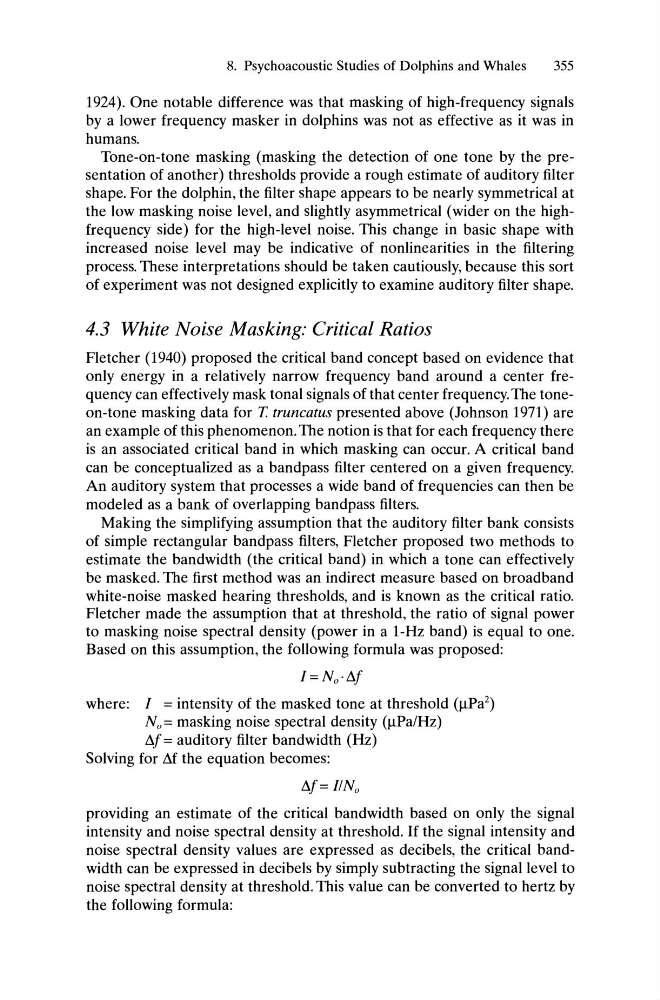
Based on this assumption, the following formula was proposed:
I=No·N
where: I = intensity of the masked tone at threshold (IlPa2)
N o = masking noise spectral density (IlPa/Hz)
N = auditory filter bandwidth (Hz)
Solving for M the equation becomes:
N= lINo
providing an estimate of the critical bandwidth based on only the signal
intensity and noise spectral density at threshold. If the signal intensity and
noise spectral density values are expressed as decibels, the critical bandwidth can be expressed in decibels by simply subtracting the signal level to
noise spectral density at threshold. This value can be converted to hertz by
the following formula:
355
1924). One notable difference was that masking of high-frequency signals
by a lower frequency masker in dolphins was not as effective as it was in
humans.
Tone-on-tone masking (masking the detection of one tone by the presentation of another) thresholds provide a rough estimate of auditory filter
shape. For the dolphin, the filter shape appears to be nearly symmetrical at
the low masking noise level, and slightly asymmetrical (wider on the highfrequency side) for the high-level noise. This change in basic shape with
increased noise level may be indicative of nonlinearities in the filtering
process. These interpretations should be taken cautiously, because this sort
of experiment was not designed explicitly to examine auditory filter shape.
4.3 White Noise Masking: Critical Ratios
Fletcher (1940) proposed the critical band concept based on evidence that
only energy in a relatively narrow frequency band around a center frequency can effectively mask tonal signals of that center frequency. The toneon-tone masking data for T truncatus presented above (Johnson 1971) are
an example of this phenomenon. The notion is that for each frequency there
is an associated critical band in which masking can occur. A critical band
can be conceptualized as a bandpass filter centered on a given frequency.
An auditory system that processes a wide band of frequencies can then be
modeled as a bank of overlapping bandpass filters.
Making the simplifying assumption that the auditory filter bank consists
of simple rectangular bandpass filters, Fletcher proposed two methods to
estimate the bandwidth (the critical band) in which a tone can effectively
be masked. The first method was an indirect measure based on broadband
white-noise masked hearing thresholds, and is known as the critical ratio.
Fletcher made the assumption that at threshold, the ratio of signal power
to masking noise spectral density (power in a I-Hz band) is equal to one.
Based on this assumption, the following formula was proposed:
I=No·N
where: I = intensity of the masked tone at threshold (IlPa2)
N o = masking noise spectral density (IlPa/Hz)
N = auditory filter bandwidth (Hz)
Solving for M the equation becomes:
N= lINo
providing an estimate of the critical bandwidth based on only the signal
intensity and noise spectral density at threshold. If the signal intensity and
noise spectral density values are expressed as decibels, the critical bandwidth can be expressed in decibels by simply subtracting the signal level to
noise spectral density at threshold. This value can be converted to hertz by
the following formula: