

7. Electrophysiological Techniques
299
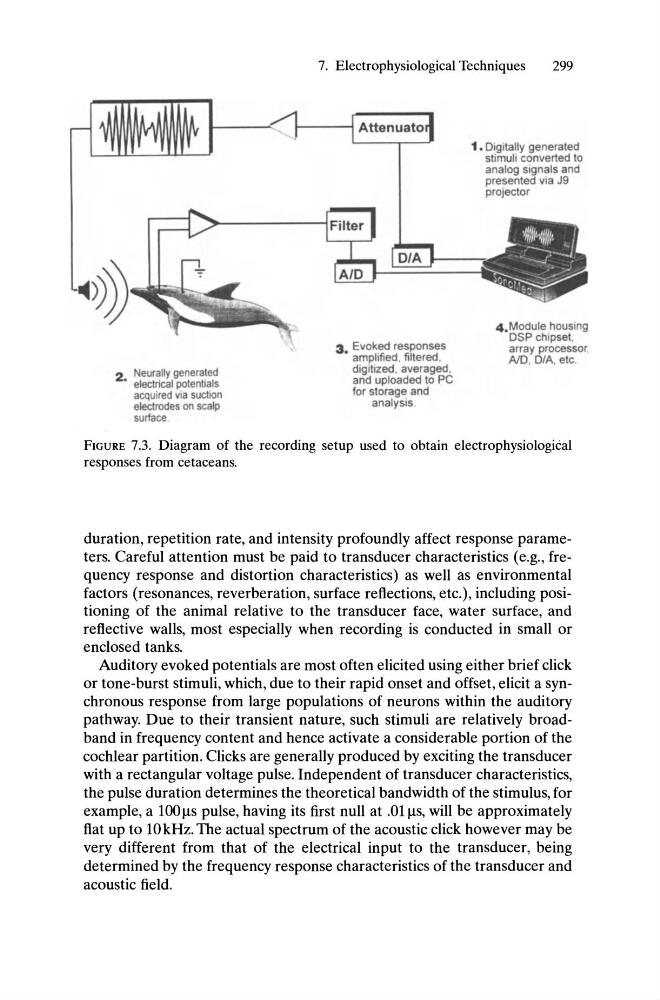
1. Digitally generated
stimuli converted to
analog signals and
presented via J9
projector
2 Neurally generated
• electrical potentials
acquired via suchon
electrodes on scalp
surface
3 Evoked responses
• amplified, filtered,
digitized, averaged,
and uploaded to PC
for storage and
analysis.
4.Module housing
DSP chipset,
array processor,
AlD, DIA, etc.
FIGURE 7.3. Diagram of the recording setup used to obtain electrophysiologiCal
responses from cetaceans.
duration, repetition rate, and intensity profoundly affect response parameters. Careful attention must be paid to transducer characteristics (e.g., frequency response and distortion characteristics) as well as environmental
factors (resonances, reverberation, surface reflections, etc.), including positioning of the animal relative to the transducer face, water surface, and
reflective walls, most especially when recording is conducted in small or
enclosed tanks.
Auditory evoked potentials are most often elicited using either brief click
or tone-burst stimuli, which, due to their rapid onset and offset, elicit a synchronous response from large populations of neurons within the auditory
pathway. Due to their transient nature, such stimuli are relatively broadband in frequency content and hence activate a considerable portion of the
cochlear partition. Clicks are generally produced by exciting the transducer
with a rectangular voltage pulse. Independent of transducer characteristics,
the pulse duration determines the theoretical bandwidth of the stimulus, for
example, a lOOlls pulse, having its first null at .Ollls, will be approximately
flat up to 10 kHz. The actual spectrum of the acoustic click however may be
very different from that of the electrical input to the transducer, being
determined by the frequency response characteristics of the transducer and
acoustic field.
299
1. Digitally generated
stimuli converted to
analog signals and
presented via J9
projector
2 Neurally generated
• electrical potentials
acquired via suchon
electrodes on scalp
surface
3 Evoked responses
• amplified, filtered,
digitized, averaged,
and uploaded to PC
for storage and
analysis.
4.Module housing
DSP chipset,
array processor,
AlD, DIA, etc.
FIGURE 7.3. Diagram of the recording setup used to obtain electrophysiologiCal
responses from cetaceans.
duration, repetition rate, and intensity profoundly affect response parameters. Careful attention must be paid to transducer characteristics (e.g., frequency response and distortion characteristics) as well as environmental
factors (resonances, reverberation, surface reflections, etc.), including positioning of the animal relative to the transducer face, water surface, and
reflective walls, most especially when recording is conducted in small or
enclosed tanks.
Auditory evoked potentials are most often elicited using either brief click
or tone-burst stimuli, which, due to their rapid onset and offset, elicit a synchronous response from large populations of neurons within the auditory
pathway. Due to their transient nature, such stimuli are relatively broadband in frequency content and hence activate a considerable portion of the
cochlear partition. Clicks are generally produced by exciting the transducer
with a rectangular voltage pulse. Independent of transducer characteristics,
the pulse duration determines the theoretical bandwidth of the stimulus, for
example, a lOOlls pulse, having its first null at .Ollls, will be approximately
flat up to 10 kHz. The actual spectrum of the acoustic click however may be
very different from that of the electrical input to the transducer, being
determined by the frequency response characteristics of the transducer and
acoustic field.