

7. Electrophysiological Techniques
297
10.0
8.0
:>
2. 6.0
Q)
" :E 4.0
'ii
E
c( 2.0
0.0
I 1- V
I~ V
Peak
Amplitude
0.0 1.0 2.0 3.0 4.0 5.0 6.0 7.0 8.0
Time (msec)
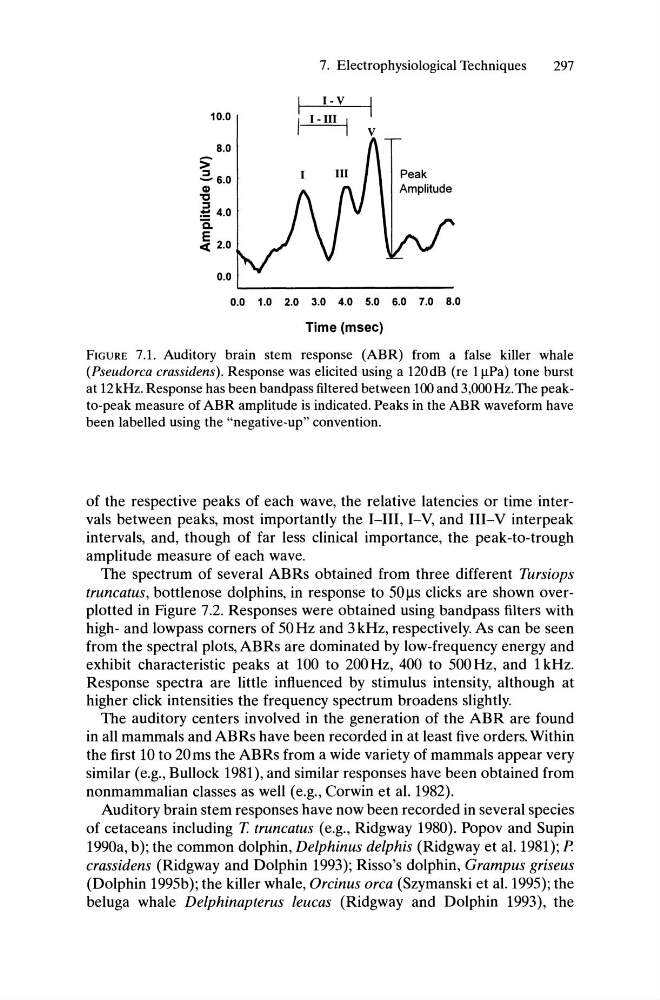
FIGURE 7.1. Auditory brain stem response (ABR) from a false killer whale
(Pseudorca crassidens). Response was elicited using a 120dB (re 11lPa) tone burst
at 12 kHz. Response has been bandpass filtered between 100 and 3,000 Hz. The peakto-peak measure of ABR amplitude is indicated. Peaks in the ABR waveform have
been labelled using the "negative-up" convention.
of the respective peaks of each wave, the relative latencies or time intervals between peaks, most importantly the I-III, I-V, and III-V interpeak
intervals, and, though of far less clinical importance, the peak-to-trough
amplitude measure of each wave.
The spectrum of several ABRs obtained from three different Tursiops
truncatus, bottlenose dolphins, in response to SOilS clicks are shown overplotted in Figure 7.2. Responses were obtained using bandpass filters with
high- and lowpass corners of 50 Hz and 3 kHz, respectively. As can be seen
from the spectral plots, ABRs are dominated by low-frequency energy and
exhibit characteristic peaks at 100 to 200 Hz, 400 to 500 Hz, and 1kHz.
Response spectra are little influenced by stimulus intensity, although at
higher click intensities the frequency spectrum broadens slightly.
The auditory centers involved in the generation of the ABR are found
in all mammals and ABRs have been recorded in at least five orders. Within
the first 10 to 20ms the ABRs from a wide variety of mammals appear very
similar (e.g., Bullock 1981), and similar responses have been obtained from
nonmammalian classes as well (e.g., Corwin et al. 1982).
Auditory brain stem responses have now been recorded in several species
of cetaceans including T. truncatus (e.g., Ridgway 1980). Popov and Supin
1990a, b); the common dolphin, Delphinus delphis (Ridgway et al. 1981); P.
crassidens (Ridgway and Dolphin 1993); Risso's dolphin, Grampus griseus
(Dolphin 1995b); the killer whale, Orcinus orca (Szymanski et al. 1995); the
beluga whale Delphinapterus leucas (Ridgway and Dolphin 1993), the
297
10.0
8.0
:>
2. 6.0
Q)
" :E 4.0
'ii
E
c( 2.0
0.0
I 1- V
I~ V
Peak
Amplitude
0.0 1.0 2.0 3.0 4.0 5.0 6.0 7.0 8.0
Time (msec)
FIGURE 7.1. Auditory brain stem response (ABR) from a false killer whale
(Pseudorca crassidens). Response was elicited using a 120dB (re 11lPa) tone burst
at 12 kHz. Response has been bandpass filtered between 100 and 3,000 Hz. The peakto-peak measure of ABR amplitude is indicated. Peaks in the ABR waveform have
been labelled using the "negative-up" convention.
of the respective peaks of each wave, the relative latencies or time intervals between peaks, most importantly the I-III, I-V, and III-V interpeak
intervals, and, though of far less clinical importance, the peak-to-trough
amplitude measure of each wave.
The spectrum of several ABRs obtained from three different Tursiops
truncatus, bottlenose dolphins, in response to SOilS clicks are shown overplotted in Figure 7.2. Responses were obtained using bandpass filters with
high- and lowpass corners of 50 Hz and 3 kHz, respectively. As can be seen
from the spectral plots, ABRs are dominated by low-frequency energy and
exhibit characteristic peaks at 100 to 200 Hz, 400 to 500 Hz, and 1kHz.
Response spectra are little influenced by stimulus intensity, although at
higher click intensities the frequency spectrum broadens slightly.
The auditory centers involved in the generation of the ABR are found
in all mammals and ABRs have been recorded in at least five orders. Within
the first 10 to 20ms the ABRs from a wide variety of mammals appear very
similar (e.g., Bullock 1981), and similar responses have been obtained from
nonmammalian classes as well (e.g., Corwin et al. 1982).
Auditory brain stem responses have now been recorded in several species
of cetaceans including T. truncatus (e.g., Ridgway 1980). Popov and Supin
1990a, b); the common dolphin, Delphinus delphis (Ridgway et al. 1981); P.
crassidens (Ridgway and Dolphin 1993); Risso's dolphin, Grampus griseus
(Dolphin 1995b); the killer whale, Orcinus orca (Szymanski et al. 1995); the
beluga whale Delphinapterus leucas (Ridgway and Dolphin 1993), the