

14
w.w.L. Au
frontal sac
d' tal museau
skull
IS
de single ~~;~s;pe~rm~a~ceiti~'s~a~c;~~~~~-.
air sac
b l o w h o l e . 'c
..
skull
junk
left nasal passage
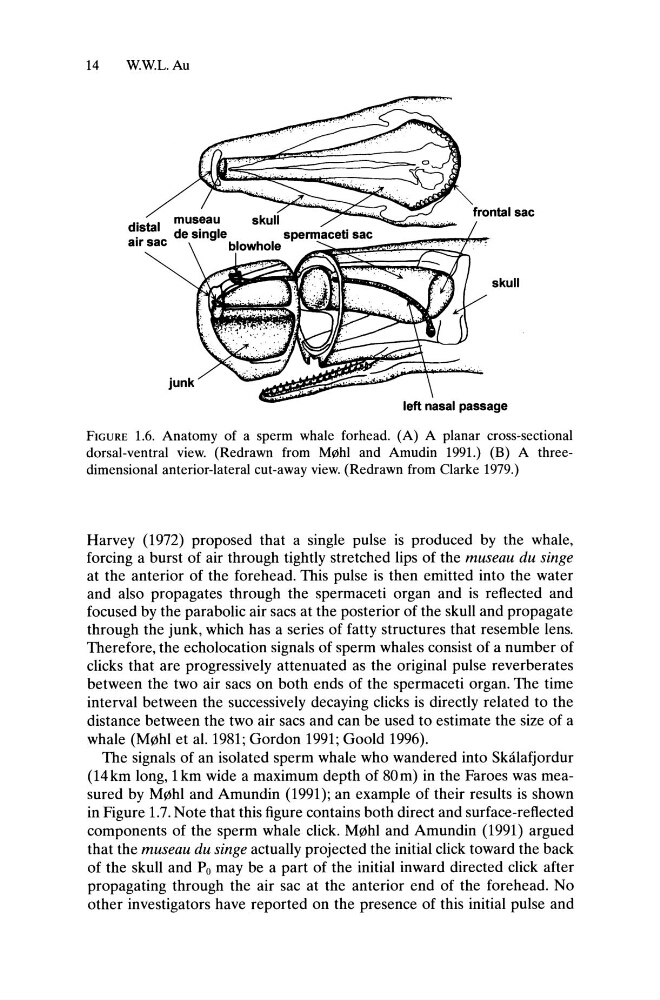
FIGURE 1.6. Anatomy of a sperm whale forhead. (A) A planar cross-sectional
dorsal-ventral view. (Redrawn from Ml/Ihl and Amudin 1991.) (B) A threedimensional anterior-lateral cut-away view. (Redrawn from Clarke 1979.)
Harvey (1972) proposed that a single pulse is produced by the whale,
forcing a burst of air through tightly stretched lips of the museau du singe
at the anterior of the forehead. This pulse is then emitted into the water
and also propagates through the spermaceti organ and is reflected and
focused by the parabolic air sacs at the posterior of the skull and propagate
through the junk, which has a series of fatty structures that resemble lens.
Therefore, the echolocation signals of sperm whales consist of a number of
clicks that are progressively attenuated as the original pulse reverberates
between the two air sacs on both ends of the spermaceti organ. The time
interval between the successively decaying clicks is directly related to the
distance between the two air sacs and can be used to estimate the size of a
whale (Ml/lhl et al. 1981; Gordon 1991; Goold 1996).
The signals of an isolated sperm whale who wandered into Skalafjordur
(14km long, 1 km wide a maximum depth of 80m) in the Faroes was measured by Ml/lhl and Amundin (1991); an example of their results is shown
in Figure 1.7. Note that this figure contains both direct and surface-reflected
components of the sperm whale click. Ml/lhl and Amundin (1991) argued
that the museau du singe actually projected the initial click toward the back
of the skull and Po may be a part of the initial inward directed click after
propagating through the air sac at the anterior end of the forehead. No
other investigators have reported on the presence of this initial pulse and
w.w.L. Au
frontal sac
d' tal museau
skull
IS
de single ~~;~s;pe~rm~a~ceiti~'s~a~c;~~~~~-.
air sac
b l o w h o l e . 'c
..
skull
junk
left nasal passage
FIGURE 1.6. Anatomy of a sperm whale forhead. (A) A planar cross-sectional
dorsal-ventral view. (Redrawn from Ml/Ihl and Amudin 1991.) (B) A threedimensional anterior-lateral cut-away view. (Redrawn from Clarke 1979.)
Harvey (1972) proposed that a single pulse is produced by the whale,
forcing a burst of air through tightly stretched lips of the museau du singe
at the anterior of the forehead. This pulse is then emitted into the water
and also propagates through the spermaceti organ and is reflected and
focused by the parabolic air sacs at the posterior of the skull and propagate
through the junk, which has a series of fatty structures that resemble lens.
Therefore, the echolocation signals of sperm whales consist of a number of
clicks that are progressively attenuated as the original pulse reverberates
between the two air sacs on both ends of the spermaceti organ. The time
interval between the successively decaying clicks is directly related to the
distance between the two air sacs and can be used to estimate the size of a
whale (Ml/lhl et al. 1981; Gordon 1991; Goold 1996).
The signals of an isolated sperm whale who wandered into Skalafjordur
(14km long, 1 km wide a maximum depth of 80m) in the Faroes was measured by Ml/lhl and Amundin (1991); an example of their results is shown
in Figure 1.7. Note that this figure contains both direct and surface-reflected
components of the sperm whale click. Ml/lhl and Amundin (1991) argued
that the museau du singe actually projected the initial click toward the back
of the skull and Po may be a part of the initial inward directed click after
propagating through the air sac at the anterior end of the forehead. No
other investigators have reported on the presence of this initial pulse and