

274
S.H. Ridgway
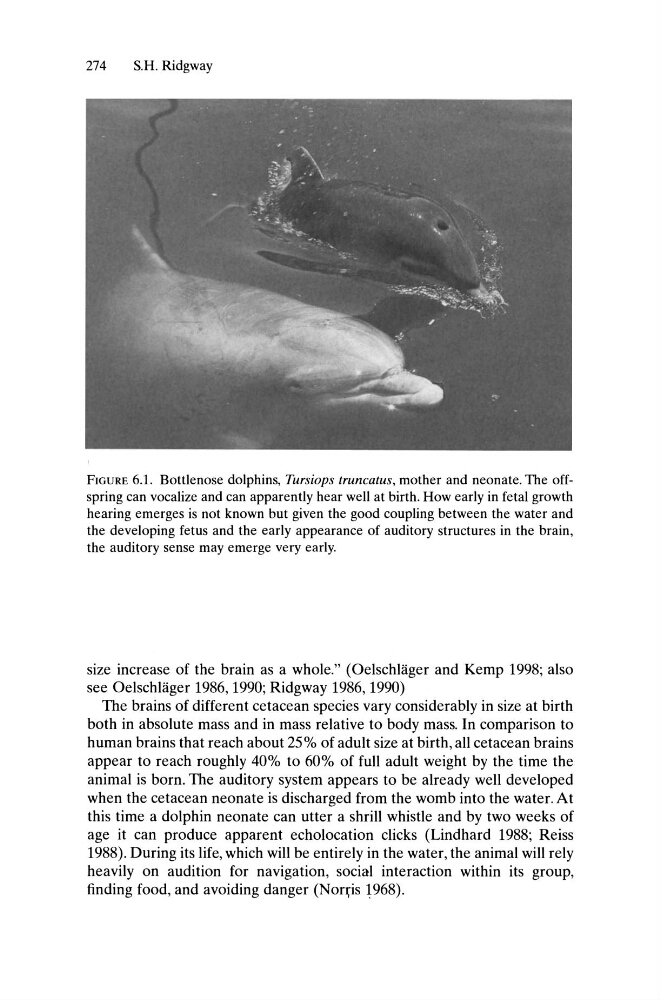
FIGURE 6.1. Bottlenose dolphins, Tursiops truncatus, mother and neonate. The offspring can vocalize and can apparently hear well at birth. How early in fetal growth
hearing emerges is not known but given the good coupling between the water and
the developing fetus and the early appearance of auditory structures in the brain,
the auditory sense may emerge very early.
size increase of the brain as a whole." (OelschHiger and Kemp 1998; also
see Oelschlager 1986, 1990; Ridgway 1986, 1990)
The brains of different cetacean species vary considerably in size at birth
both in absolute mass and in mass relative to body mass. In comparison to
human brains that reach about 25% of adult size at birth, all cetacean brains
appear to reach roughly 40% to 60% of full adult weight by the time the
animal is born. The auditory system appears to be already well developed
when the cetacean neonate is discharged from the womb into the water. At
this time a dolphin neonate can utter a shrill whistle and by two weeks of
age it can produce apparent echolocation clicks (Lindhard 1988; Reiss
1988). During its life, which will be entirely in the water, the animal will rely
heavily on audition for navigation, social interaction within its group,
finding food, and avoiding danger (Non;is 1968).
S.H. Ridgway
FIGURE 6.1. Bottlenose dolphins, Tursiops truncatus, mother and neonate. The offspring can vocalize and can apparently hear well at birth. How early in fetal growth
hearing emerges is not known but given the good coupling between the water and
the developing fetus and the early appearance of auditory structures in the brain,
the auditory sense may emerge very early.
size increase of the brain as a whole." (OelschHiger and Kemp 1998; also
see Oelschlager 1986, 1990; Ridgway 1986, 1990)
The brains of different cetacean species vary considerably in size at birth
both in absolute mass and in mass relative to body mass. In comparison to
human brains that reach about 25% of adult size at birth, all cetacean brains
appear to reach roughly 40% to 60% of full adult weight by the time the
animal is born. The auditory system appears to be already well developed
when the cetacean neonate is discharged from the womb into the water. At
this time a dolphin neonate can utter a shrill whistle and by two weeks of
age it can produce apparent echolocation clicks (Lindhard 1988; Reiss
1988). During its life, which will be entirely in the water, the animal will rely
heavily on audition for navigation, social interaction within its group,
finding food, and avoiding danger (Non;is 1968).