

4. Acoustic Communication in Whales and Dolphins
199
often produce a series of calls with very similar acoustic features. Different
migrating bowheads will often counter-call. Sometimes each whale will
produce a different call; other times, both animals will produce nearly
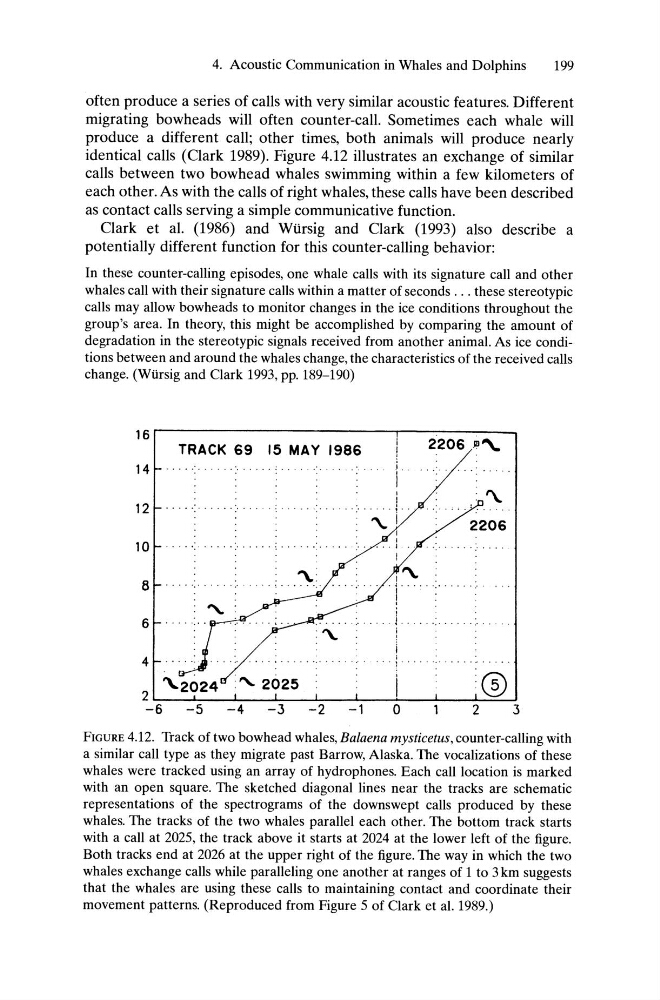
identical calls (Clark 1989). Figure 4.12 illustrates an exchange of similar
calls between two bowhead whales swimming within a few kilometers of
each other. As with the calls of right whales, these calls have been described
as contact calls serving a simple communicative function.
Clark et al. (1986) and Wiirsig and Clark (1993) also describe a
potentially different function for this counter-calling behavior:
In these counter-calling episodes, one whale calls with its signature call and other
whales call with their signature calls within a matter of seconds ... these stereotypic
calls may allow bowheads to monitor changes in the ice conditions throughout the
group's area. In theory, this might be accomplished by comparing the amount of
degradation in the stereotypic signals received from another animal. As ice conditions between and around the whales change, the characteristics of the received calls
change. (Wtirsig and Clark 1993, pp. 189-190)
16
2206 JlI"\.
TRACK 69 15 MAY 1986
14
I
:'\.
12
. . . . . . ~ .
....
2206
10
6
6
4
:@
-4
-2
-1
2
3
FiGURE 4.12. Track of two bowhead whales, Balaena mysticetus, counter-calling with
a similar call type as they migrate past Barrow, Alaska. The vocalizations of these
whales were tracked using an array of hydrophones. Each call location is marked
with an open square. The sketched diagonal lines near the tracks are schematic
representations of the spectrograms of the downswept calls produced by these
whales. The tracks of the two whales parallel each other. The bottom track starts
with a call at 2025, the track above it starts at 2024 at the lower left of the figure.
Both tracks end at 2026 at the upper right of the figure. The way in which the two
whales exchange calls while paralleling one another at ranges of 1 to 3 km suggests
that the whales are using these calls to maintaining contact and coordinate their
movement patterns. (Reproduced from Figure 5 of Clark et al. 1989.)
199
often produce a series of calls with very similar acoustic features. Different
migrating bowheads will often counter-call. Sometimes each whale will
produce a different call; other times, both animals will produce nearly
identical calls (Clark 1989). Figure 4.12 illustrates an exchange of similar
calls between two bowhead whales swimming within a few kilometers of
each other. As with the calls of right whales, these calls have been described
as contact calls serving a simple communicative function.
Clark et al. (1986) and Wiirsig and Clark (1993) also describe a
potentially different function for this counter-calling behavior:
In these counter-calling episodes, one whale calls with its signature call and other
whales call with their signature calls within a matter of seconds ... these stereotypic
calls may allow bowheads to monitor changes in the ice conditions throughout the
group's area. In theory, this might be accomplished by comparing the amount of
degradation in the stereotypic signals received from another animal. As ice conditions between and around the whales change, the characteristics of the received calls
change. (Wtirsig and Clark 1993, pp. 189-190)
16
2206 JlI"\.
TRACK 69 15 MAY 1986
14
I
:'\.
12
. . . . . . ~ .
....
2206
10
6
6
4
:@
-4
-2
-1
2
3
FiGURE 4.12. Track of two bowhead whales, Balaena mysticetus, counter-calling with
a similar call type as they migrate past Barrow, Alaska. The vocalizations of these
whales were tracked using an array of hydrophones. Each call location is marked
with an open square. The sketched diagonal lines near the tracks are schematic
representations of the spectrograms of the downswept calls produced by these
whales. The tracks of the two whales parallel each other. The bottom track starts
with a call at 2025, the track above it starts at 2024 at the lower left of the figure.
Both tracks end at 2026 at the upper right of the figure. The way in which the two
whales exchange calls while paralleling one another at ranges of 1 to 3 km suggests
that the whales are using these calls to maintaining contact and coordinate their
movement patterns. (Reproduced from Figure 5 of Clark et al. 1989.)