

198
PL. Tyack and C.W. Clark
several hypotheses concerning bowhead behavior during their migration
through the hazards of the spring ice. Ellison et al. (1987) presented preliminary surface reverberation data predicting that the reflection of a bowhead
call off deep-keeled ice would be 10 to 15 dB greater than its reflection off
thin ice. Later, Clark (1989; see Wiirsig and Clark 1993) and George et al.
(1989) argued that the echoes of low-frequency bowhead sounds, both calls
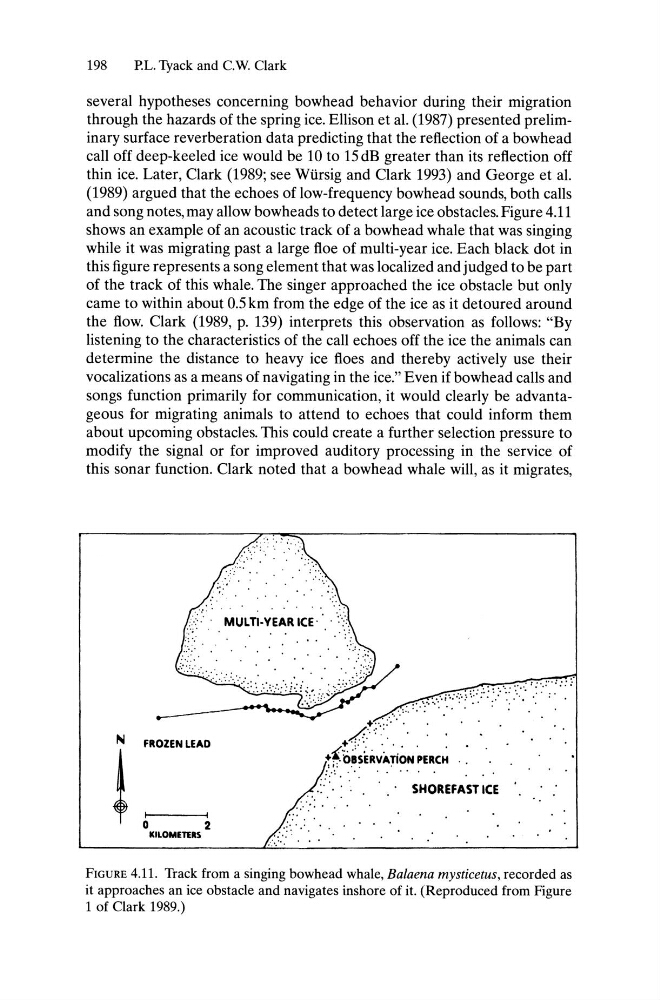
and song notes, may allow bowheads to detect large ice obstacles. Figure 4.11
shows an example of an acoustic track of a bowhead whale that was singing
while it was migrating past a large floe of multi-year ice. Each black dot in
this figure represents a song element that was localized and judged to be part
of the track of this whale. The singer approached the ice obstacle but only
came to within about 0.5 km from the edge of the ice as it detoured around
the flow. Clark (1989, p. 139) interprets this observation as follows: "By
listening to the characteristics of the call echoes off the ice the animals can
determine the distance to heavy ice floes and thereby actively use their
vocalizations as a means of navigating in the ice." Even if bowhead calls and
songs function primarily for communication, it would clearly be advantageous for migrating animals to attend to echoes that could inform them
about upcoming obstacles. This could create a further selection pressure to
modify the signal or for improved auditory processing in the service of
this sonar function. Clark noted that a bowhead whale will, as it migrates,
N FROZEN LEAD
~ , ,
o
2
KILOMETERS
;::.::: '. . .
+,.:.:':','.
. .
/ .., .
~f.i1~~~~A~~~~~RC~
SHOREFAST ICE
FIGURE 4.11. Track from a singing bowhead whale, Balaena mysticetus, recorded as
it approaches an ice obstacle and navigates inshore of it. (Reproduced from Figure
1 of Clark 1989.)
PL. Tyack and C.W. Clark
several hypotheses concerning bowhead behavior during their migration
through the hazards of the spring ice. Ellison et al. (1987) presented preliminary surface reverberation data predicting that the reflection of a bowhead
call off deep-keeled ice would be 10 to 15 dB greater than its reflection off
thin ice. Later, Clark (1989; see Wiirsig and Clark 1993) and George et al.
(1989) argued that the echoes of low-frequency bowhead sounds, both calls
and song notes, may allow bowheads to detect large ice obstacles. Figure 4.11
shows an example of an acoustic track of a bowhead whale that was singing
while it was migrating past a large floe of multi-year ice. Each black dot in
this figure represents a song element that was localized and judged to be part
of the track of this whale. The singer approached the ice obstacle but only
came to within about 0.5 km from the edge of the ice as it detoured around
the flow. Clark (1989, p. 139) interprets this observation as follows: "By
listening to the characteristics of the call echoes off the ice the animals can
determine the distance to heavy ice floes and thereby actively use their
vocalizations as a means of navigating in the ice." Even if bowhead calls and
songs function primarily for communication, it would clearly be advantageous for migrating animals to attend to echoes that could inform them
about upcoming obstacles. This could create a further selection pressure to
modify the signal or for improved auditory processing in the service of
this sonar function. Clark noted that a bowhead whale will, as it migrates,
N FROZEN LEAD
~ , ,
o
2
KILOMETERS
;::.::: '. . .
+,.:.:':','.
. .
/ .., .
~f.i1~~~~A~~~~~RC~
SHOREFAST ICE
FIGURE 4.11. Track from a singing bowhead whale, Balaena mysticetus, recorded as
it approaches an ice obstacle and navigates inshore of it. (Reproduced from Figure
1 of Clark 1989.)