

164
P.L. Tyack and c.w. Clark
' 1
I I
•
I
I'
I
I
I
t!
I
2
Time (s)
,:
o
.r
B
32
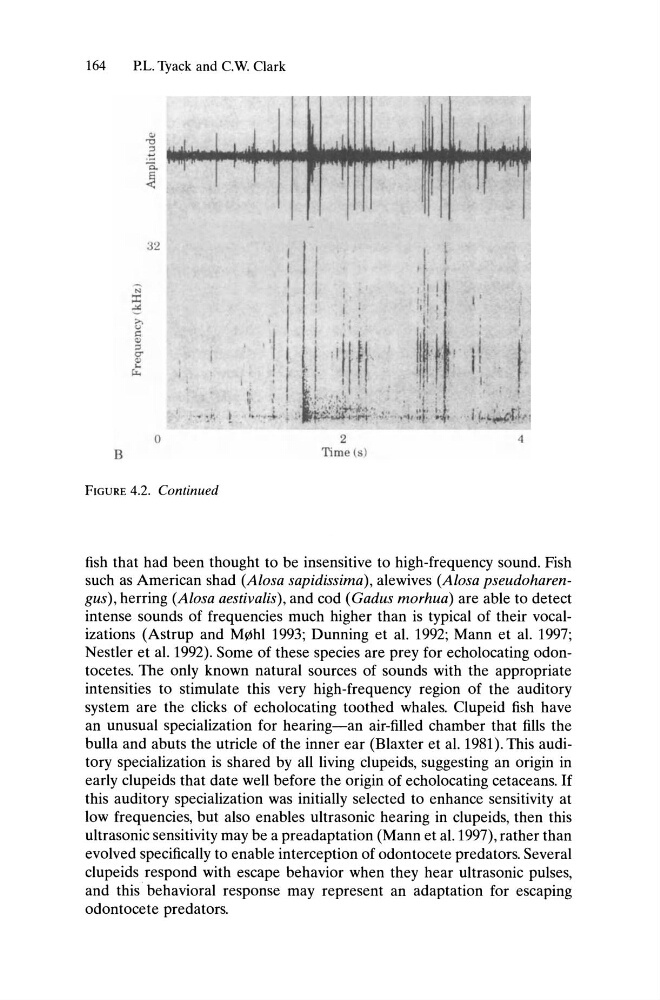
FIGURE 4.2. Continued
fish that had been thought to be insensitive to high-frequency sound. Fish
such as American shad (Alosa sapidissima), alewives (Alosa pseudoharengus), herring (Alosa aestivalis), and cod (Gadus morhua) are able to detect
intense sounds of frequencies much higher than is typical of their vocalizations (Astrup and MlZihl 1993; Dunning et al. 1992; Mann et al. 1997;
Nestler et al. 1992). Some of these species are prey for echolocating odontocetes. The only known natural sources of sounds with the appropriate
intensities to stimulate this very high-frequency region of the auditory
system are the clicks of echolocating toothed whales. Clupeid fish have
an unusual specialization for hearing-an air-filled chamber that fills the
bulla and abuts the utricle of the inner ear (Blaxter et al. 1981). This auditory specialization is shared by all living clupeids, suggesting an origin in
early clupeids that date well before the origin of echolocating cetaceans. If
this auditory specialization was initially selected to enhance sensitivity at
low frequencies, but also enables ultrasonic hearing in clupeids, then this
ultrasonic sensitivity may be a preadaptation (Mann et al. 1997), rather than
evolved specifically to enable interception of odontocete predators. Several
clupeids respond with escape behavior when they hear ultrasonic pulses,
and this· behavioral response may represent an adaptation for escaping
odontocete predators.
P.L. Tyack and c.w. Clark
' 1
I I
•
I
I'
I
I
I
t!
I
2
Time (s)
,:
o
.r
B
32
FIGURE 4.2. Continued
fish that had been thought to be insensitive to high-frequency sound. Fish
such as American shad (Alosa sapidissima), alewives (Alosa pseudoharengus), herring (Alosa aestivalis), and cod (Gadus morhua) are able to detect
intense sounds of frequencies much higher than is typical of their vocalizations (Astrup and MlZihl 1993; Dunning et al. 1992; Mann et al. 1997;
Nestler et al. 1992). Some of these species are prey for echolocating odontocetes. The only known natural sources of sounds with the appropriate
intensities to stimulate this very high-frequency region of the auditory
system are the clicks of echolocating toothed whales. Clupeid fish have
an unusual specialization for hearing-an air-filled chamber that fills the
bulla and abuts the utricle of the inner ear (Blaxter et al. 1981). This auditory specialization is shared by all living clupeids, suggesting an origin in
early clupeids that date well before the origin of echolocating cetaceans. If
this auditory specialization was initially selected to enhance sensitivity at
low frequencies, but also enables ultrasonic hearing in clupeids, then this
ultrasonic sensitivity may be a preadaptation (Mann et al. 1997), rather than
evolved specifically to enable interception of odontocete predators. Several
clupeids respond with escape behavior when they hear ultrasonic pulses,
and this· behavioral response may represent an adaptation for escaping
odontocete predators.