

4. Acoustic Communication in Whales and Dolphins
163
The interception of killer whale calls by marine mammal prey appears
to have selected for the evolution of countermeasures by killer whales.
Barrett-Leonard and colleagues (1996) report that mammal-eating killer
whales vary the intensity, repetition rate, and spectral composition within
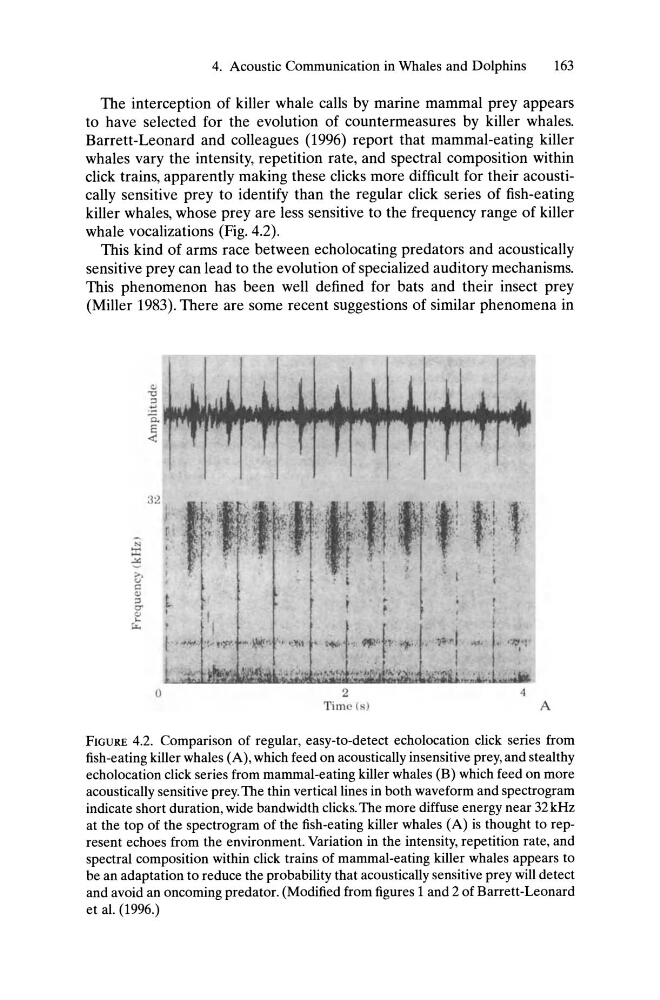
click trains, apparently making these clicks more difficult for their acoustically sensitive prey to identify than the regular click series of fish-eating
killer whales, whose prey are less sensitive to the frequency range of killer
whale vocalizations (Fig. 4.2).
This kind of arms race between echolocating predators and acoustically
sensitive prey can lead to the evolution of specialized auditory mechanisms.
This phenomenon has been well defined for bats and their insect prey
(Miller 1983). There are some recent suggestions of similar phenomena in
o
2
Time (s)
4
A
FIGURE 4.2. Comparison of regular, easy-to-detect echolocation click series from
fish-eating killer whales (A), which feed on acoustically insensitive prey, and stealthy
echolocation click series from mammal-eating killer whales (B) which feed on more
acoustically sensitive prey. The thin vertical lines in both waveform and spectrogram
indicate short duration, wide bandwidth clicks. The more diffuse energy near 32kHz
at the top of the spectrogram of the fish-eating killer whales (A) is thought to represent echoes from the environment. Variation in the intensity, repetition rate, and
spectral composition within click trains of mammal-eating killer whales appears to
be an adaptation to reduce the probability that acoustically sensitive prey will detect
and avoid an oncoming predator. (Modified from figures 1 and 2 of Barrett-Leonard
et al. (1996.)
163
The interception of killer whale calls by marine mammal prey appears
to have selected for the evolution of countermeasures by killer whales.
Barrett-Leonard and colleagues (1996) report that mammal-eating killer
whales vary the intensity, repetition rate, and spectral composition within
click trains, apparently making these clicks more difficult for their acoustically sensitive prey to identify than the regular click series of fish-eating
killer whales, whose prey are less sensitive to the frequency range of killer
whale vocalizations (Fig. 4.2).
This kind of arms race between echolocating predators and acoustically
sensitive prey can lead to the evolution of specialized auditory mechanisms.
This phenomenon has been well defined for bats and their insect prey
(Miller 1983). There are some recent suggestions of similar phenomena in
o
2
Time (s)
4
A
FIGURE 4.2. Comparison of regular, easy-to-detect echolocation click series from
fish-eating killer whales (A), which feed on acoustically insensitive prey, and stealthy
echolocation click series from mammal-eating killer whales (B) which feed on more
acoustically sensitive prey. The thin vertical lines in both waveform and spectrogram
indicate short duration, wide bandwidth clicks. The more diffuse energy near 32kHz
at the top of the spectrogram of the fish-eating killer whales (A) is thought to represent echoes from the environment. Variation in the intensity, repetition rate, and
spectral composition within click trains of mammal-eating killer whales appears to
be an adaptation to reduce the probability that acoustically sensitive prey will detect
and avoid an oncoming predator. (Modified from figures 1 and 2 of Barrett-Leonard
et al. (1996.)