

463
but if similar to rodents, we would expect to see a largely inhibitory effect on auditory
nerve physiology (Ruel et al. 2001 ; Ruel et al. 2007 ; Valdes-Baizabal et al. 2015 ).
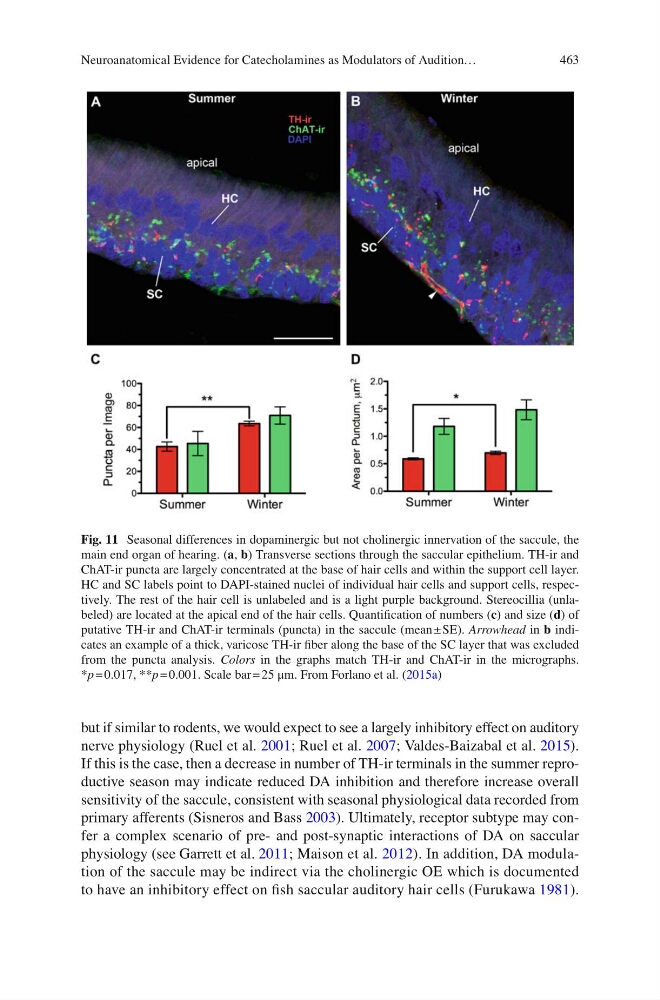
If this is the case, then a decrease in number of TH-ir terminals in the summer reproductive season may indicate reduced DA inhibition and therefore increase overall
sensitivity of the saccule, consistent with seasonal physiological data recorded from
primary afferents (Sisneros and Bass 2003 ). Ultimately, receptor subtype may confer a complex scenario of pre- and post-synaptic interactions of DA on saccular
physiology (see Garrett et al. 2011 ; Maison et al. 2012 ). In addition, DA modulation of the saccule may be indirect via the cholinergic OE which is documented
to have an inhibitory effect on fi sh saccular auditory hair cells (Furukawa 1981 ).
Fig. 11 Seasonal differences in dopaminergic but not cholinergic innervation of the saccule, the
main end organ of hearing. ( a , b ) Transverse sections through the saccular epithelium. TH-ir and
ChAT-ir puncta are largely concentrated at the base of hair cells and within the support cell layer.
HC and SC labels point to DAPI-stained nuclei of individual hair cells and support cells, respectively. The rest of the hair cell is unlabeled and is a light purple background. Stereocillia (unlabeled) are located at the apical end of the hair cells. Quantifi cation of numbers ( c ) and size ( d ) of
putative TH-ir and ChAT-ir terminals (puncta) in the saccule (mean ± SE). Arrowhead in b indicates an example of a thick, varicose TH-ir fi ber along the base of the SC layer that was excluded
from the puncta analysis. Colors in the graphs match TH-ir and ChAT-ir in the micrographs.
* p = 0.017, ** p = 0.001. Scale bar = 25 μm. From Forlano et al. ( 2015a )
Neuroanatomical Evidence for Catecholamines as Modulators of Audition…
but if similar to rodents, we would expect to see a largely inhibitory effect on auditory
nerve physiology (Ruel et al. 2001 ; Ruel et al. 2007 ; Valdes-Baizabal et al. 2015 ).
If this is the case, then a decrease in number of TH-ir terminals in the summer reproductive season may indicate reduced DA inhibition and therefore increase overall
sensitivity of the saccule, consistent with seasonal physiological data recorded from
primary afferents (Sisneros and Bass 2003 ). Ultimately, receptor subtype may confer a complex scenario of pre- and post-synaptic interactions of DA on saccular
physiology (see Garrett et al. 2011 ; Maison et al. 2012 ). In addition, DA modulation of the saccule may be indirect via the cholinergic OE which is documented
to have an inhibitory effect on fi sh saccular auditory hair cells (Furukawa 1981 ).
Fig. 11 Seasonal differences in dopaminergic but not cholinergic innervation of the saccule, the
main end organ of hearing. ( a , b ) Transverse sections through the saccular epithelium. TH-ir and
ChAT-ir puncta are largely concentrated at the base of hair cells and within the support cell layer.
HC and SC labels point to DAPI-stained nuclei of individual hair cells and support cells, respectively. The rest of the hair cell is unlabeled and is a light purple background. Stereocillia (unlabeled) are located at the apical end of the hair cells. Quantifi cation of numbers ( c ) and size ( d ) of
putative TH-ir and ChAT-ir terminals (puncta) in the saccule (mean ± SE). Arrowhead in b indicates an example of a thick, varicose TH-ir fi ber along the base of the SC layer that was excluded
from the puncta analysis. Colors in the graphs match TH-ir and ChAT-ir in the micrographs.
* p = 0.017, ** p = 0.001. Scale bar = 25 μm. From Forlano et al. ( 2015a )
Neuroanatomical Evidence for Catecholamines as Modulators of Audition…