

462
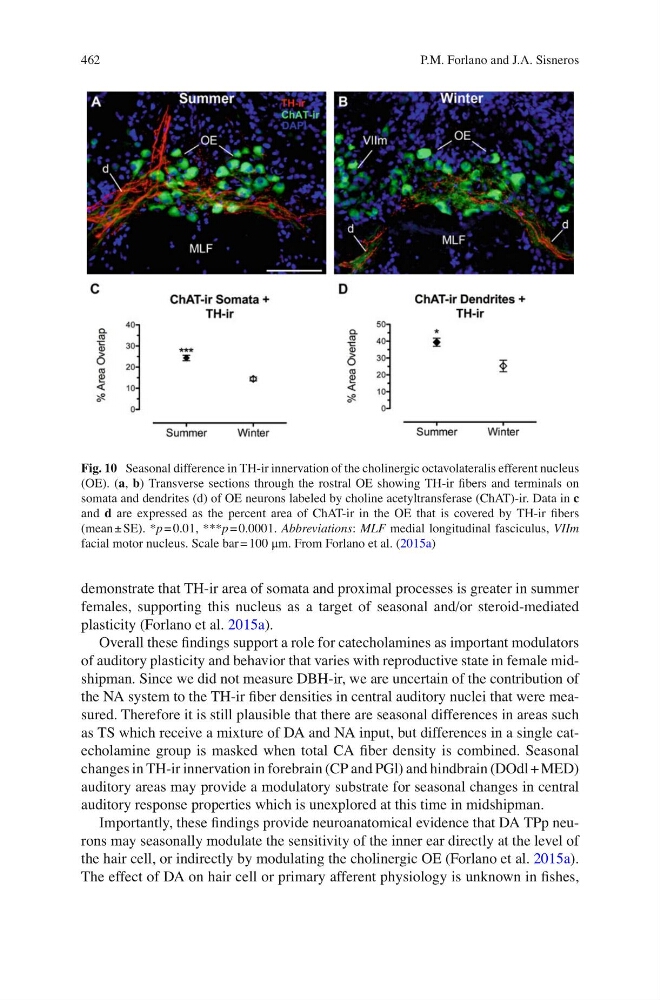
demonstrate that TH-ir area of somata and proximal processes is greater in summer
females, supporting this nucleus as a target of seasonal and/or steroid-mediated
plasticity (Forlano et al. 2015a ).
Overall these fi ndings support a role for catecholamines as important modulators
of auditory plasticity and behavior that varies with reproductive state in female midshipman. Since we did not measure DBH-ir, we are uncertain of the contribution of
the NA system to the TH-ir fi ber densities in central auditory nuclei that were measured. Therefore it is still plausible that there are seasonal differences in areas such
as TS which receive a mixture of DA and NA input, but differences in a single catecholamine group is masked when total CA fi ber density is combined. Seasonal
changes in TH-ir innervation in forebrain (CP and PGl) and hindbrain (DOdl + MED)
auditory areas may provide a modulatory substrate for seasonal changes in central
auditory response properties which is unexplored at this time in midshipman.
Importantly, these fi ndings provide neuroanatomical evidence that DA TPp neurons may seasonally modulate the sensitivity of the inner ear directly at the level of
the hair cell, or indirectly by modulating the cholinergic OE (Forlano et al. 2015a ).
The effect of DA on hair cell or primary afferent physiology is unknown in fi shes,
Fig. 10 Seasonal difference in TH-ir innervation of the cholinergic octavolateralis efferent nucleus
(OE). ( a , b ) Transverse sections through the rostral OE showing TH-ir fi bers and terminals on
somata and dendrites (d) of OE neurons labeled by choline acetyltransferase (ChAT)-ir. Data in c
and d are expressed as the percent area of ChAT-ir in the OE that is covered by TH-ir fi bers
(mean ± SE). * p = 0.01, *** p = 0.0001. Abbreviations : MLF medial longitudinal fasciculus, VIIm
facial motor nucleus. Scale bar = 100 μm. From Forlano et al. ( 2015a )
P.M. Forlano and J.A. Sisneros
demonstrate that TH-ir area of somata and proximal processes is greater in summer
females, supporting this nucleus as a target of seasonal and/or steroid-mediated
plasticity (Forlano et al. 2015a ).
Overall these fi ndings support a role for catecholamines as important modulators
of auditory plasticity and behavior that varies with reproductive state in female midshipman. Since we did not measure DBH-ir, we are uncertain of the contribution of
the NA system to the TH-ir fi ber densities in central auditory nuclei that were measured. Therefore it is still plausible that there are seasonal differences in areas such
as TS which receive a mixture of DA and NA input, but differences in a single catecholamine group is masked when total CA fi ber density is combined. Seasonal
changes in TH-ir innervation in forebrain (CP and PGl) and hindbrain (DOdl + MED)
auditory areas may provide a modulatory substrate for seasonal changes in central
auditory response properties which is unexplored at this time in midshipman.
Importantly, these fi ndings provide neuroanatomical evidence that DA TPp neurons may seasonally modulate the sensitivity of the inner ear directly at the level of
the hair cell, or indirectly by modulating the cholinergic OE (Forlano et al. 2015a ).
The effect of DA on hair cell or primary afferent physiology is unknown in fi shes,
Fig. 10 Seasonal difference in TH-ir innervation of the cholinergic octavolateralis efferent nucleus
(OE). ( a , b ) Transverse sections through the rostral OE showing TH-ir fi bers and terminals on
somata and dendrites (d) of OE neurons labeled by choline acetyltransferase (ChAT)-ir. Data in c
and d are expressed as the percent area of ChAT-ir in the OE that is covered by TH-ir fi bers
(mean ± SE). * p = 0.01, *** p = 0.0001. Abbreviations : MLF medial longitudinal fasciculus, VIIm
facial motor nucleus. Scale bar = 100 μm. From Forlano et al. ( 2015a )
P.M. Forlano and J.A. Sisneros