

421
line system, clusters of sensory hair cells and associated supporting cells are housed
in sensory organs called neuromasts that populate the head and body of the fi sh
(Fig. 2 ). Neuromasts are either contained within canals (canal neuromasts, CN) or
are free-standing (superfi cial neuromasts, SN). The lateral line system mediates
schooling, prey capture, and predator avoidance, as well as navigation around inanimate obstacles (Gompel et al. 2001 ; Bleckmann and Zelick 2009 ; Coombs et al.
2014 ). Throughout this chapter we used the terms “lateral line” and “lateral line
system” interchangeably to refer to the entire sensory system, with specifi c reference to subsystems (i.e., CN, canal neuromast; SN, superfi cial neuromast) where
appropriate.
Fish mechanosensory systems are of particular interest in biomedical sciences
because they contain hair cells that are structurally and functionally similar to the
hair cells of the human inner ear (Chang et al. 1992 ; Popper 2000 ; Coffi n et al.
2010 ). In addition, the sensory hair cells of fi sh have a propensity for regeneration—
a feature not observed in mammals (Matsuura et al. 1971 ; Lombarte et al. 1993 ;
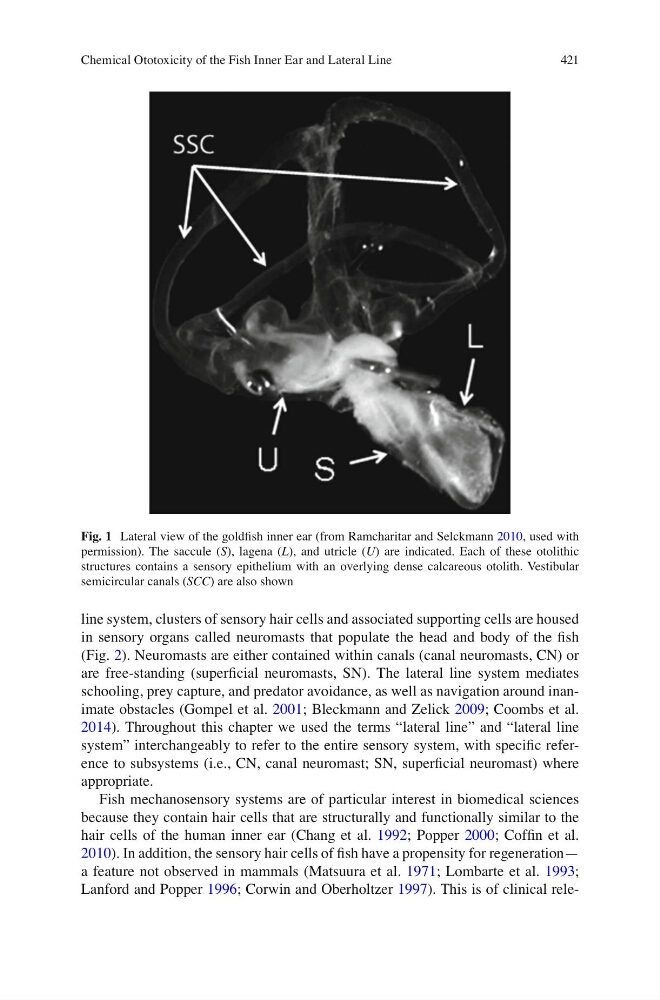
Lanford and Popper 1996 ; Corwin and Oberholtzer 1997 ). This is of clinical releFig. 1 Lateral view of the goldfi sh inner ear (from Ramcharitar and Selckmann 2010 , used with
permission). The saccule ( S ), lagena ( L ), and utricle ( U ) are indicated. Each of these otolithic
structures contains a sensory epithelium with an overlying dense calcareous otolith. Vestibular
semicircular canals ( SCC ) are also shown
Chemical Ototoxicity of the Fish Inner Ear and Lateral Line
line system, clusters of sensory hair cells and associated supporting cells are housed
in sensory organs called neuromasts that populate the head and body of the fi sh
(Fig. 2 ). Neuromasts are either contained within canals (canal neuromasts, CN) or
are free-standing (superfi cial neuromasts, SN). The lateral line system mediates
schooling, prey capture, and predator avoidance, as well as navigation around inanimate obstacles (Gompel et al. 2001 ; Bleckmann and Zelick 2009 ; Coombs et al.
2014 ). Throughout this chapter we used the terms “lateral line” and “lateral line
system” interchangeably to refer to the entire sensory system, with specifi c reference to subsystems (i.e., CN, canal neuromast; SN, superfi cial neuromast) where
appropriate.
Fish mechanosensory systems are of particular interest in biomedical sciences
because they contain hair cells that are structurally and functionally similar to the
hair cells of the human inner ear (Chang et al. 1992 ; Popper 2000 ; Coffi n et al.
2010 ). In addition, the sensory hair cells of fi sh have a propensity for regeneration—
a feature not observed in mammals (Matsuura et al. 1971 ; Lombarte et al. 1993 ;
Lanford and Popper 1996 ; Corwin and Oberholtzer 1997 ). This is of clinical releFig. 1 Lateral view of the goldfi sh inner ear (from Ramcharitar and Selckmann 2010 , used with
permission). The saccule ( S ), lagena ( L ), and utricle ( U ) are indicated. Each of these otolithic
structures contains a sensory epithelium with an overlying dense calcareous otolith. Vestibular
semicircular canals ( SCC ) are also shown
Chemical Ototoxicity of the Fish Inner Ear and Lateral Line