

345
represents the appropriate stimulus for the otolithic end organs but this particle
motion emanates from the oscillating swim bladder walls and not directly from the
sound source itself (e.g., Rogers et al. 1988 ). Fishes that can also make use of the
second stimulation pathway tend to have a wider hearing bandwidth and better auditory sensitivity than taxa without ancillary auditory structures (Fay 1988 ; Braun and
Grande 2008 ; Ladich and Fay 2013 ). The maculae, especially the macula sacculi, of
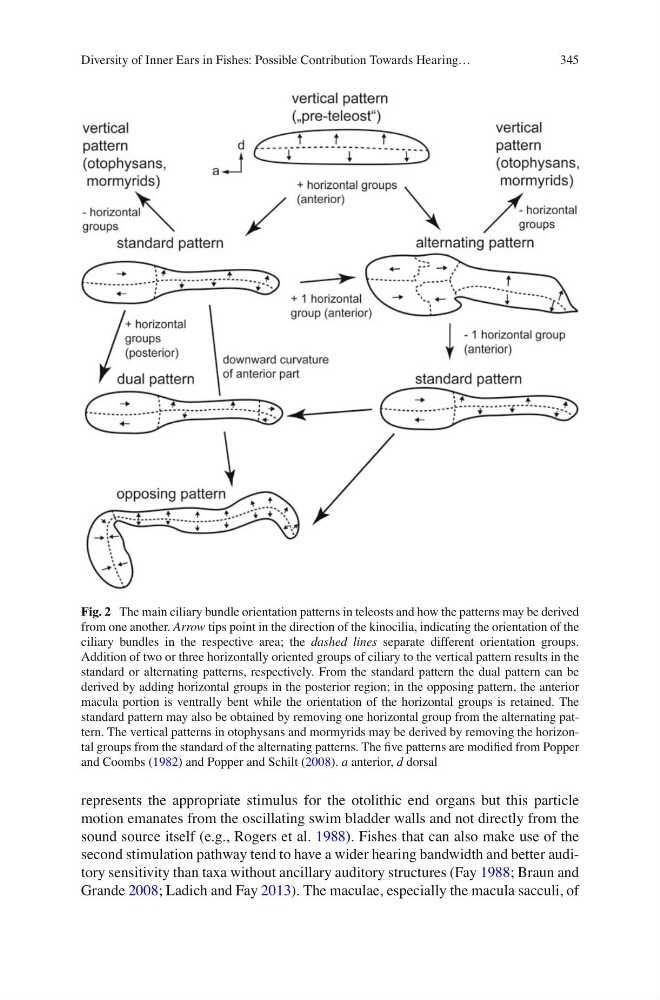
Fig. 2 The main ciliary bundle orientation patterns in teleosts and how the patterns may be derived
from one another. Arrow tips point in the direction of the kinocilia, indicating the orientation of the
ciliary bundles in the respective area; the dashed lines separate different orientation groups.
Addition of two or three horizontally oriented groups of ciliary to the vertical pattern results in the
standard or alternating patterns, respectively. From the standard pattern the dual pattern can be
derived by adding horizontal groups in the posterior region; in the opposing pattern, the anterior
macula portion is ventrally bent while the orientation of the horizontal groups is retained. The
standard pattern may also be obtained by removing one horizontal group from the alternating pattern. The vertical patterns in otophysans and mormyrids may be derived by removing the horizontal groups from the standard of the alternating patterns. The fi ve patterns are modifi ed from Popper
and Coombs ( 1982 ) and Popper and Schilt ( 2008 ). a anterior, d dorsal
Diversity of Inner Ears in Fishes: Possible Contribution Towards Hearing…
represents the appropriate stimulus for the otolithic end organs but this particle
motion emanates from the oscillating swim bladder walls and not directly from the
sound source itself (e.g., Rogers et al. 1988 ). Fishes that can also make use of the
second stimulation pathway tend to have a wider hearing bandwidth and better auditory sensitivity than taxa without ancillary auditory structures (Fay 1988 ; Braun and
Grande 2008 ; Ladich and Fay 2013 ). The maculae, especially the macula sacculi, of
Fig. 2 The main ciliary bundle orientation patterns in teleosts and how the patterns may be derived
from one another. Arrow tips point in the direction of the kinocilia, indicating the orientation of the
ciliary bundles in the respective area; the dashed lines separate different orientation groups.
Addition of two or three horizontally oriented groups of ciliary to the vertical pattern results in the
standard or alternating patterns, respectively. From the standard pattern the dual pattern can be
derived by adding horizontal groups in the posterior region; in the opposing pattern, the anterior
macula portion is ventrally bent while the orientation of the horizontal groups is retained. The
standard pattern may also be obtained by removing one horizontal group from the alternating pattern. The vertical patterns in otophysans and mormyrids may be derived by removing the horizontal groups from the standard of the alternating patterns. The fi ve patterns are modifi ed from Popper
and Coombs ( 1982 ) and Popper and Schilt ( 2008 ). a anterior, d dorsal
Diversity of Inner Ears in Fishes: Possible Contribution Towards Hearing…