

tures such as orientation patterns were not necessarily restricted to certain closely
related groups (Popper and Coombs 1982 ). The vertical pattern of ciliary bundles
on the macula sacculi, for example, was found in two non-related taxa, namely in
otophysans comprising four orders (8000 species) and in mormyrids, a family
within the order Osteoglossiformes (~70 species) (Popper 1981 ; Popper and Platt
1983 ). Interestingly, species closely related to mormyrids show diverse orientation
patterns such as the standard (Osteoglossidae) or alternating (Notopteridae) patterns. This contrasts with the extremely low variability of orientation patterns found
in all studied members of the four orders of the otophysans displaying the vertical
pattern and in the elopiforms, all of which possess the alternating pattern (Popper
1981 ; Coombs and Popper 1982 ; Buran et al. 2005 ).
In part, the diversity of inner ears and especially that of the macula sacculi in
modern bony fi shes (teleosts) seems to be coupled to the presence of a connection
(or close proximity) of a gas-fi lled compartment—such as the swim bladder—to the
inner ears. Numerous non-related taxa possess connections between air-fi lled cavities and the inner ears, so-called otophysic connections (Braun and Grande 2008 ).
These ancillary auditory structures function as ear drums analog to tetrapod tympana. They enable fi sh to detect sound pressure, which results in improved hearing
abilities in terms of higher auditory sensitivities and wider detectable frequency
ranges (Ladich and Popper 2004 ; Popper and Schilt 2008 ). In fi shes that lack swim
bladders or any other gas-fi lled cavities, sound can only stimulate the inner ears
through the direct stimulation pathway. Here, particle motion produced by a sound
source leads to the lagged movement of the denser otolith/otoconial mass relative to
the fi sh’s body and the sensory epithelium; the latter have a similar density than the
surrounding water and are thus almost transparent to sound. The inertial forces
exerted upon the ciliary bundles via the relative movement of otolith and sensory
epithelium lead to bundle defl ection. Stereovilli pivoting towards the kinocilium
provoke depolarization of the basolateral hair cell membrane, which leads to an
increased neurotransmitter release into the synaptic gap and fi nally stimulation of
the afferent nerve fi ber (Popper and Lu 2000 ; Popper et al. 2005 ). In fi shes that possess a swim bladder or a gas-fi lled cavity a second additional stimulation pathway
may become relevant, especially when an otophysic connection is present. The gasfi lled compartment, i.e. the swim bladder acts as a pressure-to-particle motion transducer. Due to the rather high compressibility of the gas in the swim bladder, sound
pressure provokes oscillation of the swim bladder walls. This motion of the walls
may be transmitted as reradiated particle motion via the surrounding tissue and
bone to the ears or directly to the walls of the inner ears if swim bladder extensions
and ears are directly connected to each other (Rogers et al. 1988 ; Popper and Lu
2000 ; Popper and Fay 2011 ). In this stimulation pathway again particle motion
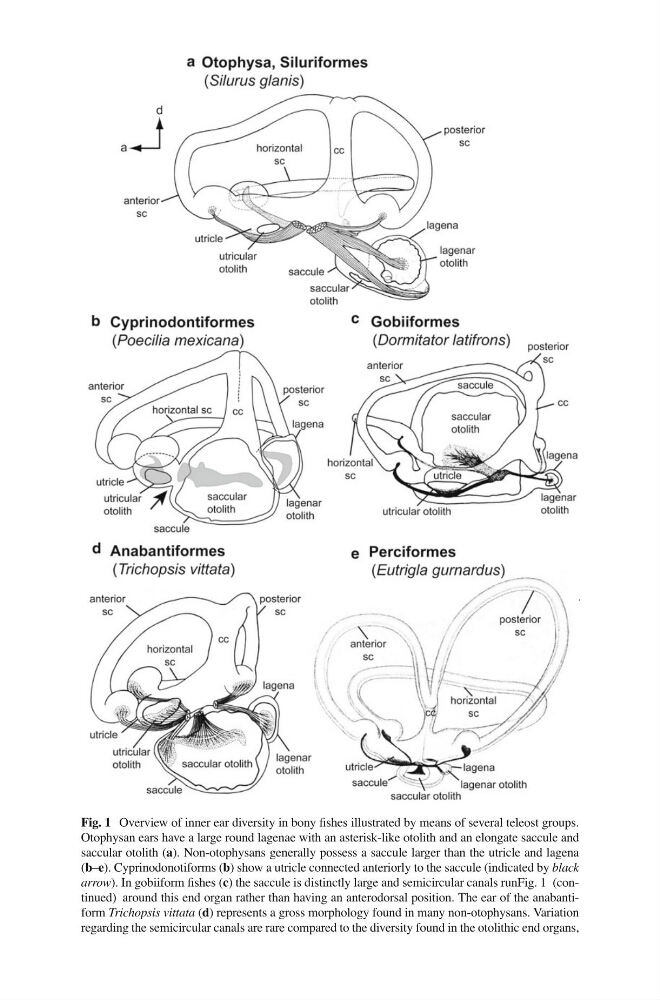
Fig. 1 Overview of inner ear diversity in bony fi shes illustrated by means of several teleost groups.
Otophysan ears have a large round lagenae with an asterisk-like otolith and an elongate saccule and
saccular otolith ( a ). Non-otophysans generally possess a saccule larger than the utricle and lagena
( b – e ). Cyprinodonotiforms ( b ) show a utricle connected anteriorly to the saccule (indicated by black
arrow ). In gobiiform fi shes ( c ) the saccule is distinctly large and semicircular canals runFig. 1 (continued) around this end organ rather than having an anterodorsal position. The ear of the anabantiform Trichopsis vittata ( d ) represents a gross morphology found in many non-otophysans. Variation
regarding the semicircular canals are rare compared to the diversity found in the otolithic end organs,
related groups (Popper and Coombs 1982 ). The vertical pattern of ciliary bundles
on the macula sacculi, for example, was found in two non-related taxa, namely in
otophysans comprising four orders (8000 species) and in mormyrids, a family
within the order Osteoglossiformes (~70 species) (Popper 1981 ; Popper and Platt
1983 ). Interestingly, species closely related to mormyrids show diverse orientation
patterns such as the standard (Osteoglossidae) or alternating (Notopteridae) patterns. This contrasts with the extremely low variability of orientation patterns found
in all studied members of the four orders of the otophysans displaying the vertical
pattern and in the elopiforms, all of which possess the alternating pattern (Popper
1981 ; Coombs and Popper 1982 ; Buran et al. 2005 ).
In part, the diversity of inner ears and especially that of the macula sacculi in
modern bony fi shes (teleosts) seems to be coupled to the presence of a connection
(or close proximity) of a gas-fi lled compartment—such as the swim bladder—to the
inner ears. Numerous non-related taxa possess connections between air-fi lled cavities and the inner ears, so-called otophysic connections (Braun and Grande 2008 ).
These ancillary auditory structures function as ear drums analog to tetrapod tympana. They enable fi sh to detect sound pressure, which results in improved hearing
abilities in terms of higher auditory sensitivities and wider detectable frequency
ranges (Ladich and Popper 2004 ; Popper and Schilt 2008 ). In fi shes that lack swim
bladders or any other gas-fi lled cavities, sound can only stimulate the inner ears
through the direct stimulation pathway. Here, particle motion produced by a sound
source leads to the lagged movement of the denser otolith/otoconial mass relative to
the fi sh’s body and the sensory epithelium; the latter have a similar density than the
surrounding water and are thus almost transparent to sound. The inertial forces
exerted upon the ciliary bundles via the relative movement of otolith and sensory
epithelium lead to bundle defl ection. Stereovilli pivoting towards the kinocilium
provoke depolarization of the basolateral hair cell membrane, which leads to an
increased neurotransmitter release into the synaptic gap and fi nally stimulation of
the afferent nerve fi ber (Popper and Lu 2000 ; Popper et al. 2005 ). In fi shes that possess a swim bladder or a gas-fi lled cavity a second additional stimulation pathway
may become relevant, especially when an otophysic connection is present. The gasfi lled compartment, i.e. the swim bladder acts as a pressure-to-particle motion transducer. Due to the rather high compressibility of the gas in the swim bladder, sound
pressure provokes oscillation of the swim bladder walls. This motion of the walls
may be transmitted as reradiated particle motion via the surrounding tissue and
bone to the ears or directly to the walls of the inner ears if swim bladder extensions
and ears are directly connected to each other (Rogers et al. 1988 ; Popper and Lu
2000 ; Popper and Fay 2011 ). In this stimulation pathway again particle motion
Fig. 1 Overview of inner ear diversity in bony fi shes illustrated by means of several teleost groups.
Otophysan ears have a large round lagenae with an asterisk-like otolith and an elongate saccule and
saccular otolith ( a ). Non-otophysans generally possess a saccule larger than the utricle and lagena
( b – e ). Cyprinodonotiforms ( b ) show a utricle connected anteriorly to the saccule (indicated by black
arrow ). In gobiiform fi shes ( c ) the saccule is distinctly large and semicircular canals runFig. 1 (continued) around this end organ rather than having an anterodorsal position. The ear of the anabantiform Trichopsis vittata ( d ) represents a gross morphology found in many non-otophysans. Variation
regarding the semicircular canals are rare compared to the diversity found in the otolithic end organs,