

232
2 Materials and Methods
2.1 Animals
Adult Hawaiian sergeant fi sh, Abudefduf abdominalis , were caught with hook and
line from Kane’ohe Bay, Oahu and used immediately in recording experiments,
with the exception of individuals used for saccular potential recordings (see below).
At the end of each experiment, fi sh were measured for standard length (SL) and
total length to the nearest 0.5 mm, body mass (BM) to the nearest 0.1 g, and sex was
determined by examination of sexually dimorphic genital papillae and gonads under
a dissection microscope. Collection, maintenance, surgical, and recording procedures for all fi sh used in this study were approved by the University of Hawaii
Institutional Animal Care and Use Committee.
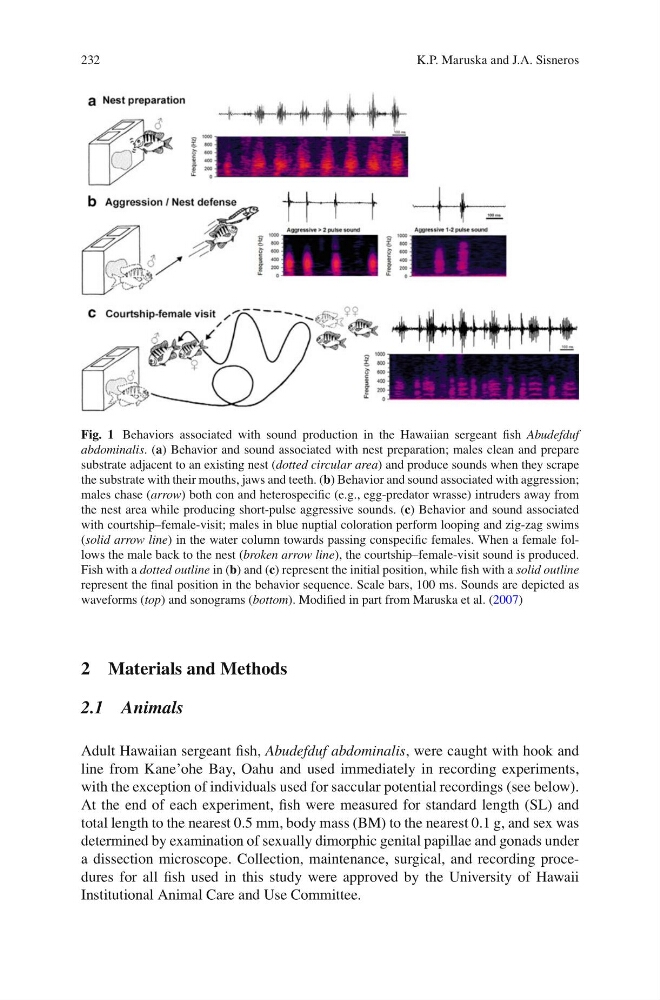
Fig. 1 Behaviors associated with sound production in the Hawaiian sergeant fi sh Abudefduf
abdominalis . ( a ) Behavior and sound associated with nest preparation; males clean and prepare
substrate adjacent to an existing nest ( dotted circular area ) and produce sounds when they scrape
the substrate with their mouths, jaws and teeth. ( b ) Behavior and sound associated with aggression;
males chase ( arrow ) both con and heterospecifi c (e.g., egg-predator wrasse) intruders away from
the nest area while producing short-pulse aggressive sounds. ( c ) Behavior and sound associated
with courtship–female-visit; males in blue nuptial coloration perform looping and zig-zag swims
( solid arrow line ) in the water column towards passing conspecifi c females. When a female follows the male back to the nest ( broken arrow line ), the courtship–female-visit sound is produced.
Fish with a dotted outline in ( b ) and ( c ) represent the initial position, while fi sh with a solid outline
represent the fi nal position in the behavior sequence. Scale bars, 100 ms. Sounds are depicted as
waveforms ( top ) and sonograms ( bottom ). Modifi ed in part from Maruska et al. ( 2007 )
K.P. Maruska and J.A. Sisneros
2 Materials and Methods
2.1 Animals
Adult Hawaiian sergeant fi sh, Abudefduf abdominalis , were caught with hook and
line from Kane’ohe Bay, Oahu and used immediately in recording experiments,
with the exception of individuals used for saccular potential recordings (see below).
At the end of each experiment, fi sh were measured for standard length (SL) and
total length to the nearest 0.5 mm, body mass (BM) to the nearest 0.1 g, and sex was
determined by examination of sexually dimorphic genital papillae and gonads under
a dissection microscope. Collection, maintenance, surgical, and recording procedures for all fi sh used in this study were approved by the University of Hawaii
Institutional Animal Care and Use Committee.
Fig. 1 Behaviors associated with sound production in the Hawaiian sergeant fi sh Abudefduf
abdominalis . ( a ) Behavior and sound associated with nest preparation; males clean and prepare
substrate adjacent to an existing nest ( dotted circular area ) and produce sounds when they scrape
the substrate with their mouths, jaws and teeth. ( b ) Behavior and sound associated with aggression;
males chase ( arrow ) both con and heterospecifi c (e.g., egg-predator wrasse) intruders away from
the nest area while producing short-pulse aggressive sounds. ( c ) Behavior and sound associated
with courtship–female-visit; males in blue nuptial coloration perform looping and zig-zag swims
( solid arrow line ) in the water column towards passing conspecifi c females. When a female follows the male back to the nest ( broken arrow line ), the courtship–female-visit sound is produced.
Fish with a dotted outline in ( b ) and ( c ) represent the initial position, while fi sh with a solid outline
represent the fi nal position in the behavior sequence. Scale bars, 100 ms. Sounds are depicted as
waveforms ( top ) and sonograms ( bottom ). Modifi ed in part from Maruska et al. ( 2007 )
K.P. Maruska and J.A. Sisneros