

214
1999) and the secondary octaval populations (that project to the auditory midbrain)
were located in medial areas of the medulla that were obscured by a large blood
sinus, and we were never able to confirm auditory recordings in any of those sites.
Therefore, we have focused our studies on the dDON (Fig. 3a). The research questions addressed in the dDON included: how are the response characteristics different from the saccular afferent responses? Is there evidence for convergence of inputs
and directional computations?
Edds-Walton and Fay (2008) found similarities and differences in the auditory
response characteristics of dDON cells when compared with saccular afferents. The
frequency response of dDON cells was similar to that of saccular afferents (best
frequencies of 84–185 Hz for 79 % of cells), however bandwidth of the responses
varied greatly, which was not a characteristic of saccular afferents. Most of the
dDON cells had iso-level frequency response functions with an inverted-V shape
(with various slopes), indicating narrowing of the frequency response (= tuning)
when compared to saccular afferents. However, given the breadth of the bandwidths
measured at 50 % of maximum response, the majority of afferents in dDON could
not be considered sharply tuned (see Figs. 4 and 6 in Edds-Walton and Fay 2008).
Thus, we conclude that the brain is capable of processing broadband sounds such as
the pulsed sounds produced by conspecifics. In addition, the observed responses to
pure tones (Winn’s behavioral studies and our physiological studies) can be attributed to the broad nature of tuning in the ear (Edds-Walton and Fay 2008). For example, many dDON cells not tuned to 100 Hz will respond well to it.
The majority of cells in dDON exhibited good phase-locking. As in saccular
afferents, Edds-Walton and Fay (2008) found a subset of cells for which phaselocking was level-dependent (improved with increasing levels above threshold).
Another subset of dDON cells phase-locked consistently at all levels and exhibited
level-dependent phase shifts (mean 2.7°/dB, maximum of 6°/dB; Fig. 4) as was seen
in saccular afferents. However, there was not a dichotomy of phase-locking accuracy in dDON, but rather an array of variations in the strength of phase-locking and
the degree of phase advance in the cells that exhibited it. Edds-Walton and Fay
(2008) concluded that within dDON there appears to be the potential for the generation of parallel computational pathways: one pathway in which phase is encoded
independent of level, and another pathway that could contribute to stimulus level
comparisons. Both of these pathways would contribute to soundscape analyses and,
potentially, to sound source localization.
Edds-Walton and Fay (2005b) determined that the convergence of auditory inputs
in the dorsal division of DON does not result in a loss of directional information. On
the contrary, the majority of cells in dDON exhibited DRPs in both the horizontal
and vertical planes that tended to be less broad with respect to the level of response
to stimulus angles adjacent to the best axis. This narrowing of the directional
response area is similar to frequency tuning and has been called “sharpening” of the
directional response (Edds-Walton and Fay 2005b). Quantification of this narrowing
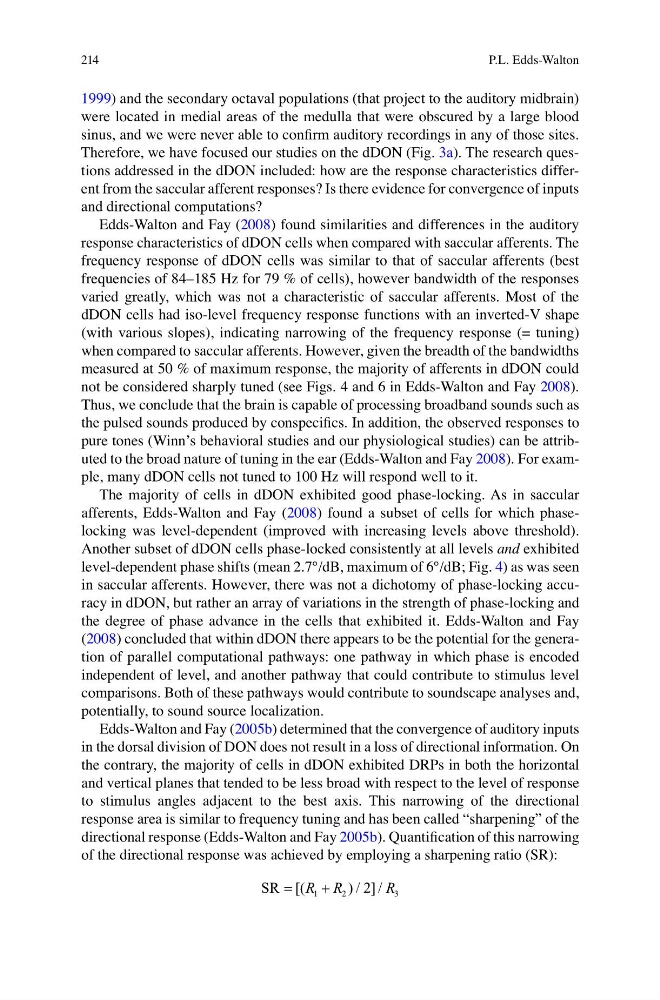
of the directional response was achieved by employing a sharpening ratio (SR):
SR =
+
[(
) / ] /
R R
R
1
2
3
2
P.L. Edds-Walton
1999) and the secondary octaval populations (that project to the auditory midbrain)
were located in medial areas of the medulla that were obscured by a large blood
sinus, and we were never able to confirm auditory recordings in any of those sites.
Therefore, we have focused our studies on the dDON (Fig. 3a). The research questions addressed in the dDON included: how are the response characteristics different from the saccular afferent responses? Is there evidence for convergence of inputs
and directional computations?
Edds-Walton and Fay (2008) found similarities and differences in the auditory
response characteristics of dDON cells when compared with saccular afferents. The
frequency response of dDON cells was similar to that of saccular afferents (best
frequencies of 84–185 Hz for 79 % of cells), however bandwidth of the responses
varied greatly, which was not a characteristic of saccular afferents. Most of the
dDON cells had iso-level frequency response functions with an inverted-V shape
(with various slopes), indicating narrowing of the frequency response (= tuning)
when compared to saccular afferents. However, given the breadth of the bandwidths
measured at 50 % of maximum response, the majority of afferents in dDON could
not be considered sharply tuned (see Figs. 4 and 6 in Edds-Walton and Fay 2008).
Thus, we conclude that the brain is capable of processing broadband sounds such as
the pulsed sounds produced by conspecifics. In addition, the observed responses to
pure tones (Winn’s behavioral studies and our physiological studies) can be attributed to the broad nature of tuning in the ear (Edds-Walton and Fay 2008). For example, many dDON cells not tuned to 100 Hz will respond well to it.
The majority of cells in dDON exhibited good phase-locking. As in saccular
afferents, Edds-Walton and Fay (2008) found a subset of cells for which phaselocking was level-dependent (improved with increasing levels above threshold).
Another subset of dDON cells phase-locked consistently at all levels and exhibited
level-dependent phase shifts (mean 2.7°/dB, maximum of 6°/dB; Fig. 4) as was seen
in saccular afferents. However, there was not a dichotomy of phase-locking accuracy in dDON, but rather an array of variations in the strength of phase-locking and
the degree of phase advance in the cells that exhibited it. Edds-Walton and Fay
(2008) concluded that within dDON there appears to be the potential for the generation of parallel computational pathways: one pathway in which phase is encoded
independent of level, and another pathway that could contribute to stimulus level
comparisons. Both of these pathways would contribute to soundscape analyses and,
potentially, to sound source localization.
Edds-Walton and Fay (2005b) determined that the convergence of auditory inputs
in the dorsal division of DON does not result in a loss of directional information. On
the contrary, the majority of cells in dDON exhibited DRPs in both the horizontal
and vertical planes that tended to be less broad with respect to the level of response
to stimulus angles adjacent to the best axis. This narrowing of the directional
response area is similar to frequency tuning and has been called “sharpening” of the
directional response (Edds-Walton and Fay 2005b). Quantification of this narrowing
of the directional response was achieved by employing a sharpening ratio (SR):
SR =
+
[(
) / ] /
R R
R
1
2
3
2
P.L. Edds-Walton