

213
all of the information that the brain uses. As noted previously, we have focused on
the saccule. Our data indicate that convergence of saccular input could be “sufficient” for the fish to determine the location of a sound source, but we have not
investigated the possibility that the horizontally oriented utricle and/or vertically
oriented lagena contribute important information (gravistatic, postural or auditory)
that facilitate behavioral responses to biologically relevant sounds. Projections from
the utricle overlap with those of the canal cristae (particularly the horizontal canal
cristae) at multiple sites in the octaval column in a variety of fishes, which ultimately contribute to circuits that control posture and coordinate head and eye movements (Straka and Baker 2011).
3.4.1 The Roles of DON
As noted in Sect. 3.2.3, retrograde transport of label injected into the torus semicircularis to fill the somata of projection cells in the medulla consistently labeled primarily the dDON with contralateral predominance. The medial region of the AON
(where bifurcating saccular afferents sometimes terminated; Edds-Walton et al.
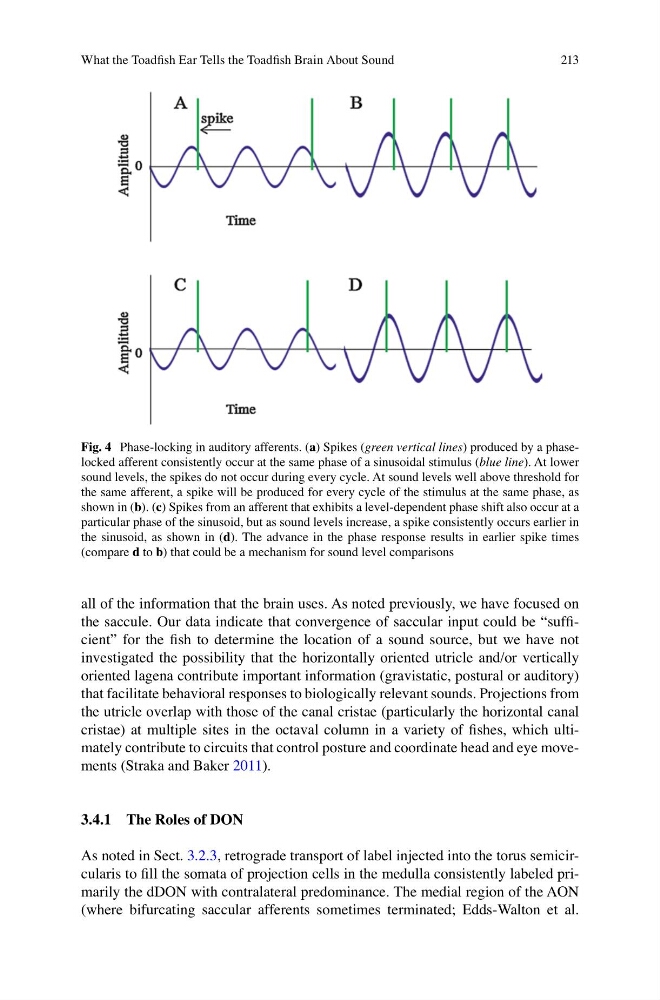
Fig. 4 Phase-locking in auditory afferents. (a) Spikes (green vertical lines) produced by a phaselocked afferent consistently occur at the same phase of a sinusoidal stimulus (blue line). At lower
sound levels, the spikes do not occur during every cycle. At sound levels well above threshold for
the same afferent, a spike will be produced for every cycle of the stimulus at the same phase, as
shown in (b). (c) Spikes from an afferent that exhibits a level-dependent phase shift also occur at a
particular phase of the sinusoid, but as sound levels increase, a spike consistently occurs earlier in
the sinusoid, as shown in (d). The advance in the phase response results in earlier spike times
(compare d to b) that could be a mechanism for sound level comparisons
What the Toadfish Ear Tells the Toadfish Brain About Sound
all of the information that the brain uses. As noted previously, we have focused on
the saccule. Our data indicate that convergence of saccular input could be “sufficient” for the fish to determine the location of a sound source, but we have not
investigated the possibility that the horizontally oriented utricle and/or vertically
oriented lagena contribute important information (gravistatic, postural or auditory)
that facilitate behavioral responses to biologically relevant sounds. Projections from
the utricle overlap with those of the canal cristae (particularly the horizontal canal
cristae) at multiple sites in the octaval column in a variety of fishes, which ultimately contribute to circuits that control posture and coordinate head and eye movements (Straka and Baker 2011).
3.4.1 The Roles of DON
As noted in Sect. 3.2.3, retrograde transport of label injected into the torus semicircularis to fill the somata of projection cells in the medulla consistently labeled primarily the dDON with contralateral predominance. The medial region of the AON
(where bifurcating saccular afferents sometimes terminated; Edds-Walton et al.
Fig. 4 Phase-locking in auditory afferents. (a) Spikes (green vertical lines) produced by a phaselocked afferent consistently occur at the same phase of a sinusoidal stimulus (blue line). At lower
sound levels, the spikes do not occur during every cycle. At sound levels well above threshold for
the same afferent, a spike will be produced for every cycle of the stimulus at the same phase, as
shown in (b). (c) Spikes from an afferent that exhibits a level-dependent phase shift also occur at a
particular phase of the sinusoid, but as sound levels increase, a spike consistently occurs earlier in
the sinusoid, as shown in (d). The advance in the phase response results in earlier spike times
(compare d to b) that could be a mechanism for sound level comparisons
What the Toadfish Ear Tells the Toadfish Brain About Sound