

148
pole in one direction and zero in the opposite direction. The pressure and particle
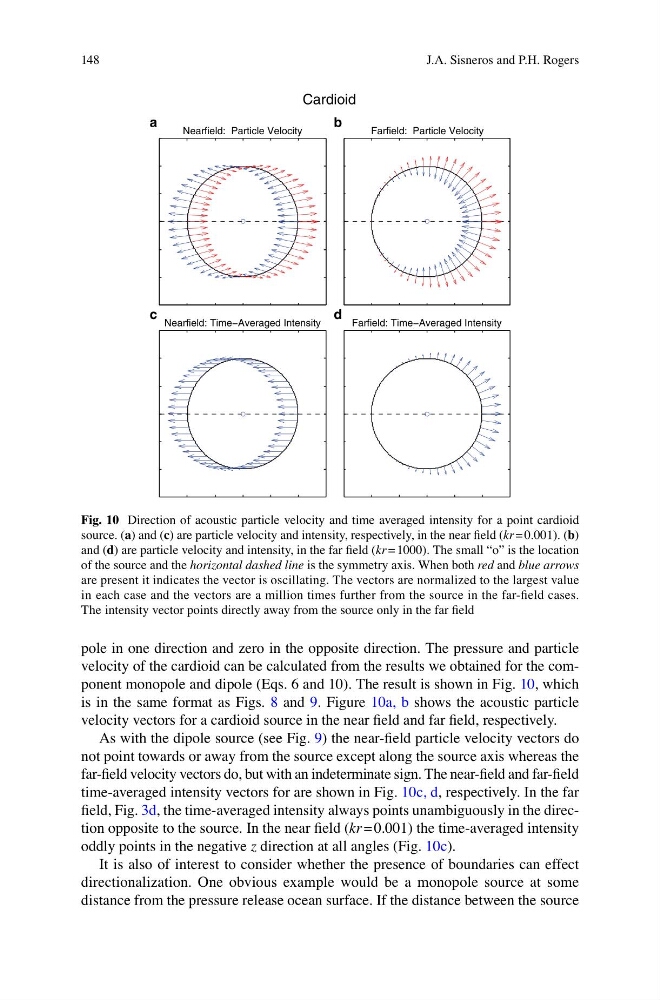
velocity of the cardioid can be calculated from the results we obtained for the component monopole and dipole (Eqs. 6 and 10). The result is shown in Fig. 10, which
is in the same format as Figs. 8 and 9. Figure 10a, b shows the acoustic particle
velocity vectors for a cardioid source in the near field and far field, respectively.
As with the dipole source (see Fig. 9) the near-field particle velocity vectors do
not point towards or away from the source except along the source axis whereas the
far-field velocity vectors do, but with an indeterminate sign. The near-field and far- field
time-averaged intensity vectors for are shown in Fig. 10c, d, respectively. In the far
field, Fig. 3d, the time-averaged intensity always points unambiguously in the direction opposite to the source. In the near field (kr = 0.001) the time-averaged intensity
oddly points in the negative z direction at all angles (Fig. 10c).
It is also of interest to consider whether the presence of boundaries can effect
directionalization. One obvious example would be a monopole source at some
distance from the pressure release ocean surface. If the distance between the source
a
Nearfield: Particle Velocity
Cardioid
Nearfield: Time−Averaged Intensity
c
b
Farfield: Particle Velocity
Farfield: Time−Averaged Intensity
d
Fig. 10 Direction of acoustic particle velocity and time averaged intensity for a point cardioid
source. (a) and (c) are particle velocity and intensity, respectively, in the near field (kr = 0.001). (b)
and (d) are particle velocity and intensity, in the far field (kr = 1000). The small “o” is the location
of the source and the horizontal dashed line is the symmetry axis. When both red and blue arrows
are present it indicates the vector is oscillating. The vectors are normalized to the largest value
in each case and the vectors are a million times further from the source in the far-field cases.
The intensity vector points directly away from the source only in the far field
J.A. Sisneros and P.H. Rogers
pole in one direction and zero in the opposite direction. The pressure and particle
velocity of the cardioid can be calculated from the results we obtained for the component monopole and dipole (Eqs. 6 and 10). The result is shown in Fig. 10, which
is in the same format as Figs. 8 and 9. Figure 10a, b shows the acoustic particle
velocity vectors for a cardioid source in the near field and far field, respectively.
As with the dipole source (see Fig. 9) the near-field particle velocity vectors do
not point towards or away from the source except along the source axis whereas the
far-field velocity vectors do, but with an indeterminate sign. The near-field and far- field
time-averaged intensity vectors for are shown in Fig. 10c, d, respectively. In the far
field, Fig. 3d, the time-averaged intensity always points unambiguously in the direction opposite to the source. In the near field (kr = 0.001) the time-averaged intensity
oddly points in the negative z direction at all angles (Fig. 10c).
It is also of interest to consider whether the presence of boundaries can effect
directionalization. One obvious example would be a monopole source at some
distance from the pressure release ocean surface. If the distance between the source
a
Nearfield: Particle Velocity
Cardioid
Nearfield: Time−Averaged Intensity
c
b
Farfield: Particle Velocity
Farfield: Time−Averaged Intensity
d
Fig. 10 Direction of acoustic particle velocity and time averaged intensity for a point cardioid
source. (a) and (c) are particle velocity and intensity, respectively, in the near field (kr = 0.001). (b)
and (d) are particle velocity and intensity, in the far field (kr = 1000). The small “o” is the location
of the source and the horizontal dashed line is the symmetry axis. When both red and blue arrows
are present it indicates the vector is oscillating. The vectors are normalized to the largest value
in each case and the vectors are a million times further from the source in the far-field cases.
The intensity vector points directly away from the source only in the far field
J.A. Sisneros and P.H. Rogers