

146
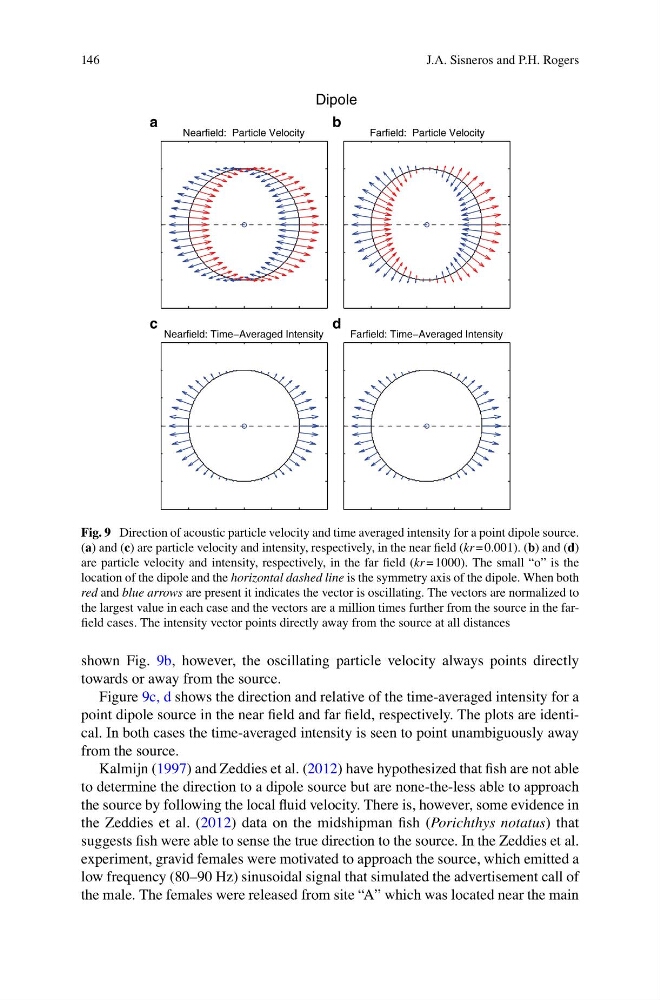
shown Fig. 9b, however, the oscillating particle velocity always points directly
towards or away from the source.
Figure 9c, d shows the direction and relative of the time-averaged intensity for a
point dipole source in the near field and far field, respectively. The plots are identical. In both cases the time-averaged intensity is seen to point unambiguously away
from the source.
Kalmijn (1997) and Zeddies et al. (2012) have hypothesized that fish are not able
to determine the direction to a dipole source but are none-the-less able to approach
the source by following the local fluid velocity. There is, however, some evidence in
the Zeddies et al. (2012) data on the midshipman fish (Porichthys notatus) that
suggests fish were able to sense the true direction to the source. In the Zeddies et al.
experiment, gravid females were motivated to approach the source, which emitted a
low frequency (80–90 Hz) sinusoidal signal that simulated the advertisement call of
the male. The females were released from site “A” which was located near the main
a
Nearfield: Particle Velocity
Dipole
Nearfield: Time−Averaged Intensity
c
b
Farfield: Particle Velocity
Farfield: Time−Averaged Intensity
d
Fig. 9 Direction of acoustic particle velocity and time averaged intensity for a point dipole source.
(a) and (c) are particle velocity and intensity, respectively, in the near field (kr = 0.001). (b) and (d)
are particle velocity and intensity, respectively, in the far field (kr = 1000). The small “o” is the
location of the dipole and the horizontal dashed line is the symmetry axis of the dipole. When both
red and blue arrows are present it indicates the vector is oscillating. The vectors are normalized to
the largest value in each case and the vectors are a million times further from the source in the farfield cases. The intensity vector points directly away from the source at all distances
J.A. Sisneros and P.H. Rogers
shown Fig. 9b, however, the oscillating particle velocity always points directly
towards or away from the source.
Figure 9c, d shows the direction and relative of the time-averaged intensity for a
point dipole source in the near field and far field, respectively. The plots are identical. In both cases the time-averaged intensity is seen to point unambiguously away
from the source.
Kalmijn (1997) and Zeddies et al. (2012) have hypothesized that fish are not able
to determine the direction to a dipole source but are none-the-less able to approach
the source by following the local fluid velocity. There is, however, some evidence in
the Zeddies et al. (2012) data on the midshipman fish (Porichthys notatus) that
suggests fish were able to sense the true direction to the source. In the Zeddies et al.
experiment, gravid females were motivated to approach the source, which emitted a
low frequency (80–90 Hz) sinusoidal signal that simulated the advertisement call of
the male. The females were released from site “A” which was located near the main
a
Nearfield: Particle Velocity
Dipole
Nearfield: Time−Averaged Intensity
c
b
Farfield: Particle Velocity
Farfield: Time−Averaged Intensity
d
Fig. 9 Direction of acoustic particle velocity and time averaged intensity for a point dipole source.
(a) and (c) are particle velocity and intensity, respectively, in the near field (kr = 0.001). (b) and (d)
are particle velocity and intensity, respectively, in the far field (kr = 1000). The small “o” is the
location of the dipole and the horizontal dashed line is the symmetry axis of the dipole. When both
red and blue arrows are present it indicates the vector is oscillating. The vectors are normalized to
the largest value in each case and the vectors are a million times further from the source in the farfield cases. The intensity vector points directly away from the source at all distances
J.A. Sisneros and P.H. Rogers