

144
of p and v is negative (positive) the source is in front of (behind) the fish. By using
time-averaged intensity, the fish could process non-oscillatory input to ascertain
unambiguous vector components of the source direction vector. Note that, as in the
sinusoidal case (Eq. 7), in general case (Eq. 9), I r
( ) is proportional to 1/r
2 as
required by conservation of energy. Note also that the instantaneous intensity
(before time averaging) does not have this property since it contains a term which is
proportional to 1/r
3
.
Dipole sources at audible frequencies are not common in nature but provide
some interesting insights into how fish process directional information. For sinusoidal signals, the acoustic pressure and particle velocity for a point dipole oriented in
the z direction are given by (Pierce 1981, see Section 4-2)
ˆ
ˆ
cos
p
p
r e
r
i kr
d
ikr
dip =
-
æ
è
ç
ö
ø
÷
0
0
1
1
q
(10a)
ˆ
ˆ
cos
s in
v
e r
dip =
+
-
æ
è
ç
ö
ø
÷
æ
è
ç
ö
ø
÷ +
-
p
c
r e
r
i
kr
ikr
i
d
ikr
0 0
1
2 1
1
1
1
r
q
q
k kr
i
kr
æ
è
ç
ö
ø
÷
é
ë
ê
ù
û
ú
e r
(10b)
Note that for dipoles the pressure and the particle velocity have a near field and that
the particle velocity has components in both the radial (e r ) and theta (e θ ) directions.
The 1/r
3 terms dominate the particle velocity close to in the source so that only at
q = 0 is the velocity vector aligned with the direction to the source and at q p
= / 2
it is orthogonal to it. In the far field kr 1
(
) the particle velocity is oriented in the
radial direction.
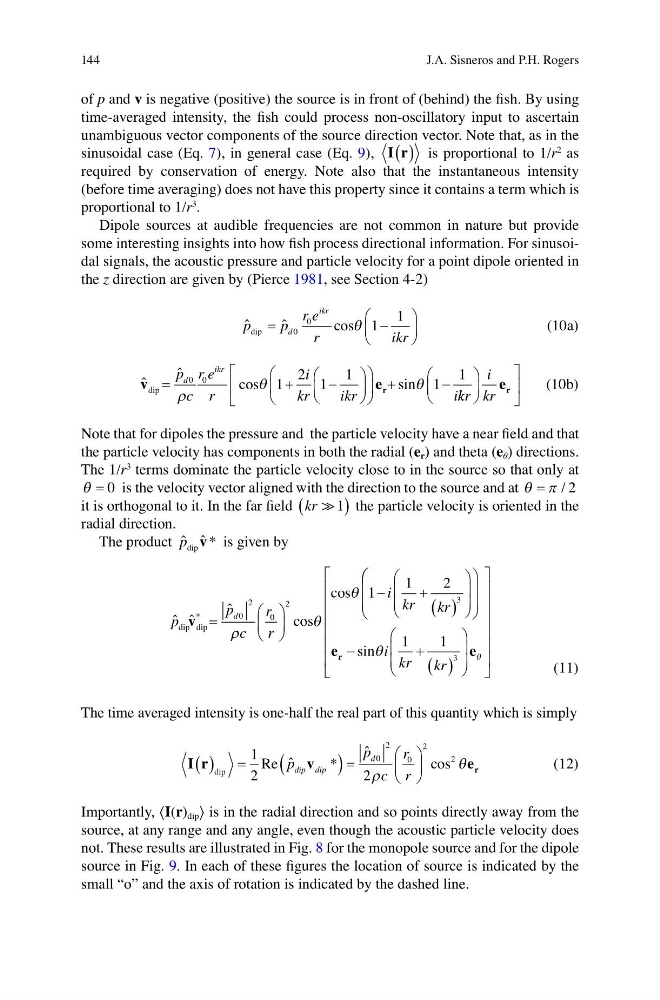
The product ˆ ˆ *
p dip v is given by
ˆ ˆ
ˆ
cos
cos
*
p
p
c
r
r
i kr
kr
d
dip dip
v =
æ
è
ç
ö
ø
÷
-
+ ( )
æ
è
ç
ç
ö
ø
÷
÷
0
2
0
2
3
1
1
2
r
q
q
æ æ
è
ç
ç
ö
ø
÷
÷
-
+ ( )
æ
è
ç
ç
ö
ø
÷
÷
é
ë
ê
ê
ê
ê
ê
ê
ù
û
ú
ú
ú
ú
ú
ú
e
e
r
sinq
q
i kr
kr
1
1
3
(11)
The time averaged intensity is one-half the real part of this quantity which is simply
I r
v
e r
( ) =
(
) =
æ
è
ç
ö
ø
÷
dip
Re
1
2
2
0
2
0
2
2
ˆ
ˆ
*
c os
p
p
c
r
r
dip dip
d
r
q
(12)
Importantly, 〈I(r) dip 〉 is in the radial direction and so points directly away from the
source, at any range and any angle, even though the acoustic particle velocity does
not. These results are illustrated in Fig. 8 for the monopole source and for the dipole
source in Fig. 9. In each of these figures the location of source is indicated by the
small “o” and the axis of rotation is indicated by the dashed line.
J.A. Sisneros and P.H. Rogers
of p and v is negative (positive) the source is in front of (behind) the fish. By using
time-averaged intensity, the fish could process non-oscillatory input to ascertain
unambiguous vector components of the source direction vector. Note that, as in the
sinusoidal case (Eq. 7), in general case (Eq. 9), I r
( ) is proportional to 1/r
2 as
required by conservation of energy. Note also that the instantaneous intensity
(before time averaging) does not have this property since it contains a term which is
proportional to 1/r
3
.
Dipole sources at audible frequencies are not common in nature but provide
some interesting insights into how fish process directional information. For sinusoidal signals, the acoustic pressure and particle velocity for a point dipole oriented in
the z direction are given by (Pierce 1981, see Section 4-2)
ˆ
ˆ
cos
p
p
r e
r
i kr
d
ikr
dip =
-
æ
è
ç
ö
ø
÷
0
0
1
1
q
(10a)
ˆ
ˆ
cos
s in
v
e r
dip =
+
-
æ
è
ç
ö
ø
÷
æ
è
ç
ö
ø
÷ +
-
p
c
r e
r
i
kr
ikr
i
d
ikr
0 0
1
2 1
1
1
1
r
q
q
k kr
i
kr
æ
è
ç
ö
ø
÷
é
ë
ê
ù
û
ú
e r
(10b)
Note that for dipoles the pressure and the particle velocity have a near field and that
the particle velocity has components in both the radial (e r ) and theta (e θ ) directions.
The 1/r
3 terms dominate the particle velocity close to in the source so that only at
q = 0 is the velocity vector aligned with the direction to the source and at q p
= / 2
it is orthogonal to it. In the far field kr 1
(
) the particle velocity is oriented in the
radial direction.
The product ˆ ˆ *
p dip v is given by
ˆ ˆ
ˆ
cos
cos
*
p
p
c
r
r
i kr
kr
d
dip dip
v =
æ
è
ç
ö
ø
÷
-
+ ( )
æ
è
ç
ç
ö
ø
÷
÷
0
2
0
2
3
1
1
2
r
q
q
æ æ
è
ç
ç
ö
ø
÷
÷
-
+ ( )
æ
è
ç
ç
ö
ø
÷
÷
é
ë
ê
ê
ê
ê
ê
ê
ù
û
ú
ú
ú
ú
ú
ú
e
e
r
sinq
q
i kr
kr
1
1
3
(11)
The time averaged intensity is one-half the real part of this quantity which is simply
I r
v
e r
( ) =
(
) =
æ
è
ç
ö
ø
÷
dip
Re
1
2
2
0
2
0
2
2
ˆ
ˆ
*
c os
p
p
c
r
r
dip dip
d
r
q
(12)
Importantly, 〈I(r) dip 〉 is in the radial direction and so points directly away from the
source, at any range and any angle, even though the acoustic particle velocity does
not. These results are illustrated in Fig. 8 for the monopole source and for the dipole
source in Fig. 9. In each of these figures the location of source is indicated by the
small “o” and the axis of rotation is indicated by the dashed line.
J.A. Sisneros and P.H. Rogers