

135
toward or away from the sound source. In these experiments, Zeddies et al. (2012)
described the phonotaxic pathways of gravid females that localized a dipole sound
source when: (1) females were released along the dipole axis where the sound pressure is high and the particle motion vectors point to and from the source, and (2)
when the females were released at a point along a line orthogonal to the dipole axis
where sound pressure is low and the particle motion vectors do not point towards or
away from the source. Because the local sound field differed at the release sites, the
researchers hypothesized that the pathways the fish would take to the source from
these alternative release sites would also differ if the local particle motion vectors
were crucial sensory cues that fish used for locating sound sources. The dipole
sound field, which was created using two monopole sound sources back-to-back to
yield a push pull action, was characterized via measurements of sound pressure
using hydrophones and acoustic particle motion using an underwater accelerometer.
The test tank and the procedures used in the phonotaxis experiments were similar to
the previous monopole experiments (Zeddies et al. 2010). After characterizing the
dipole sound field, the phonotaxic responses of 44 gravid females to the dipole
source from two alternative release sites were recorded, analyzed, and compared
with the sound field. As mentioned previously, one release site was approximately
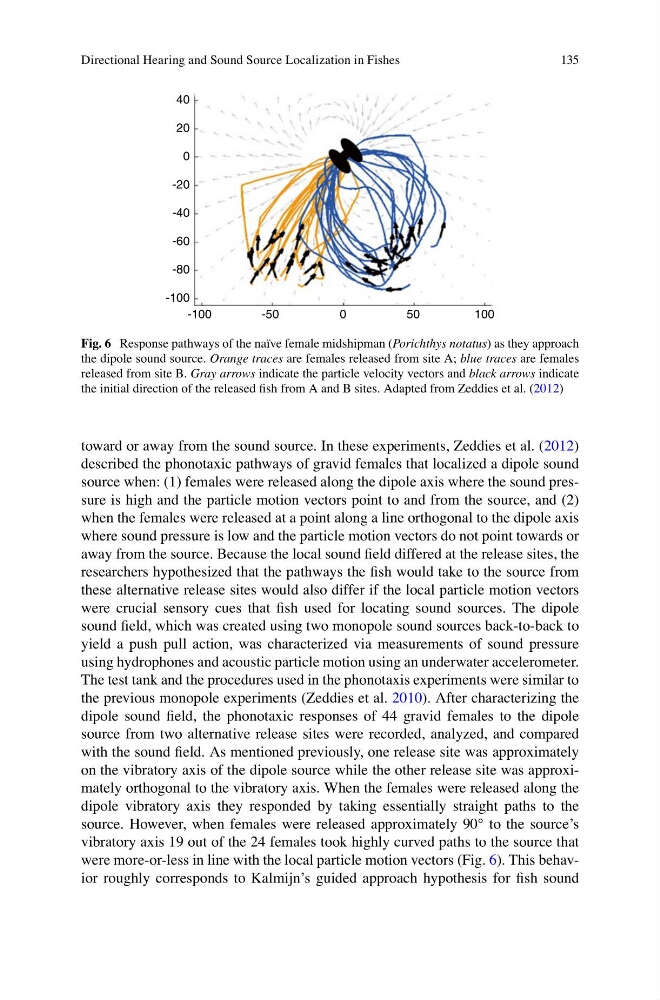
on the vibratory axis of the dipole source while the other release site was approximately orthogonal to the vibratory axis. When the females were released along the
dipole vibratory axis they responded by taking essentially straight paths to the
source. However, when females were released approximately 90° to the source’s
vibratory axis 19 out of the 24 females took highly curved paths to the source that
were more-or-less in line with the local particle motion vectors (Fig. 6). This behavior roughly corresponds to Kalmijn’s guided approach hypothesis for fish sound
-100
-100
-80
-60
-40
-50
-20
0
20
40
0
5 0
100
Fig. 6 Response pathways of the naïve female midshipman (Porichthys notatus) as they approach
the dipole sound source. Orange traces are females released from site A; blue traces are females
released from site B. Gray arrows indicate the particle velocity vectors and black arrows indicate
the initial direction of the released fish from A and B sites. Adapted from Zeddies et al. (2012)
Directional Hearing and Sound Source Localization in Fishes
toward or away from the sound source. In these experiments, Zeddies et al. (2012)
described the phonotaxic pathways of gravid females that localized a dipole sound
source when: (1) females were released along the dipole axis where the sound pressure is high and the particle motion vectors point to and from the source, and (2)
when the females were released at a point along a line orthogonal to the dipole axis
where sound pressure is low and the particle motion vectors do not point towards or
away from the source. Because the local sound field differed at the release sites, the
researchers hypothesized that the pathways the fish would take to the source from
these alternative release sites would also differ if the local particle motion vectors
were crucial sensory cues that fish used for locating sound sources. The dipole
sound field, which was created using two monopole sound sources back-to-back to
yield a push pull action, was characterized via measurements of sound pressure
using hydrophones and acoustic particle motion using an underwater accelerometer.
The test tank and the procedures used in the phonotaxis experiments were similar to
the previous monopole experiments (Zeddies et al. 2010). After characterizing the
dipole sound field, the phonotaxic responses of 44 gravid females to the dipole
source from two alternative release sites were recorded, analyzed, and compared
with the sound field. As mentioned previously, one release site was approximately
on the vibratory axis of the dipole source while the other release site was approximately orthogonal to the vibratory axis. When the females were released along the
dipole vibratory axis they responded by taking essentially straight paths to the
source. However, when females were released approximately 90° to the source’s
vibratory axis 19 out of the 24 females took highly curved paths to the source that
were more-or-less in line with the local particle motion vectors (Fig. 6). This behavior roughly corresponds to Kalmijn’s guided approach hypothesis for fish sound
-100
-100
-80
-60
-40
-50
-20
0
20
40
0
5 0
100
Fig. 6 Response pathways of the naïve female midshipman (Porichthys notatus) as they approach
the dipole sound source. Orange traces are females released from site A; blue traces are females
released from site B. Gray arrows indicate the particle velocity vectors and black arrows indicate
the initial direction of the released fish from A and B sites. Adapted from Zeddies et al. (2012)
Directional Hearing and Sound Source Localization in Fishes