

134
notaxis to the sound source even at initial release, and that females swim along the
axis of the particle motion vectors in a monopole sound field.
Monopoles with omnidirectional sound radiation are common biological sound
sources in the natural environment including, for example, the pulsating swim bladder which is the typical sound source for a vocal fish. Not all biologically relevant
sources are represented as monopoles. Kalmijn (1997) argued that many biological
sound sources act like dipole or multipoles. For example, whole body accelerations
radiate like dipoles. The sound field created by a dipole is more complex in nature
than a monopole and can be modeled as a vibrating sphere that does not change
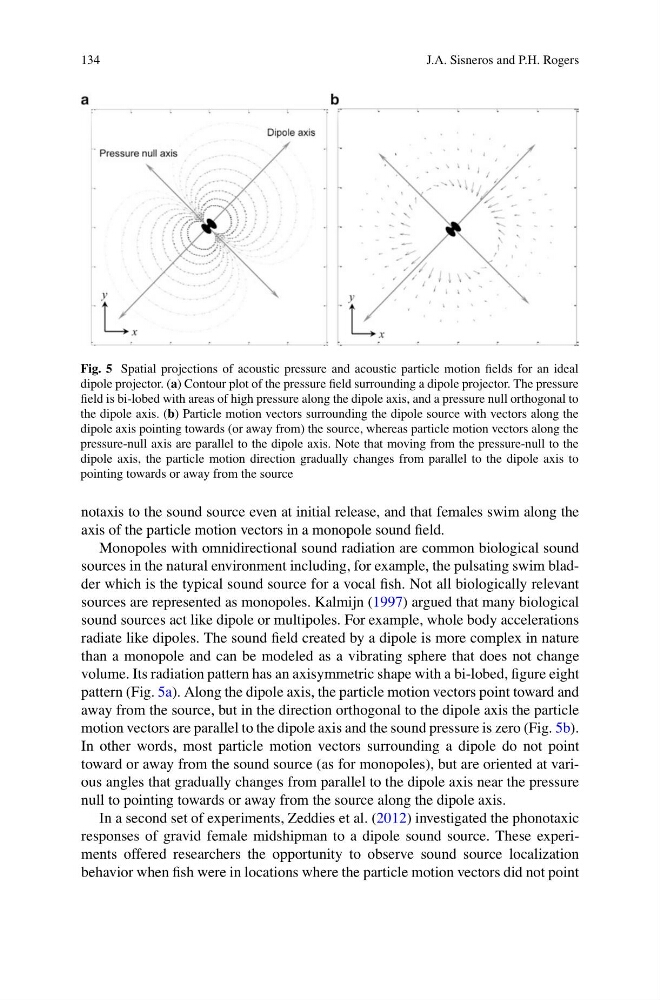
volume. Its radiation pattern has an axisymmetric shape with a bi-lobed, figure eight
pattern (Fig. 5a). Along the dipole axis, the particle motion vectors point toward and
away from the source, but in the direction orthogonal to the dipole axis the particle
motion vectors are parallel to the dipole axis and the sound pressure is zero (Fig. 5b).
In other words, most particle motion vectors surrounding a dipole do not point
toward or away from the sound source (as for monopoles), but are oriented at various angles that gradually changes from parallel to the dipole axis near the pressure
null to pointing towards or away from the source along the dipole axis.
In a second set of experiments, Zeddies et al. (2012) investigated the phonotaxic
responses of gravid female midshipman to a dipole sound source. These experiments offered researchers the opportunity to observe sound source localization
behavior when fish were in locations where the particle motion vectors did not point
Fig. 5 Spatial projections of acoustic pressure and acoustic particle motion fields for an ideal
dipole projector. (a) Contour plot of the pressure field surrounding a dipole projector. The pressure
field is bi-lobed with areas of high pressure along the dipole axis, and a pressure null orthogonal to
the dipole axis. (b) Particle motion vectors surrounding the dipole source with vectors along the
dipole axis pointing towards (or away from) the source, whereas particle motion vectors along the
pressure-null axis are parallel to the dipole axis. Note that moving from the pressure-null to the
dipole axis, the particle motion direction gradually changes from parallel to the dipole axis to
pointing towards or away from the source
J.A. Sisneros and P.H. Rogers
notaxis to the sound source even at initial release, and that females swim along the
axis of the particle motion vectors in a monopole sound field.
Monopoles with omnidirectional sound radiation are common biological sound
sources in the natural environment including, for example, the pulsating swim bladder which is the typical sound source for a vocal fish. Not all biologically relevant
sources are represented as monopoles. Kalmijn (1997) argued that many biological
sound sources act like dipole or multipoles. For example, whole body accelerations
radiate like dipoles. The sound field created by a dipole is more complex in nature
than a monopole and can be modeled as a vibrating sphere that does not change
volume. Its radiation pattern has an axisymmetric shape with a bi-lobed, figure eight
pattern (Fig. 5a). Along the dipole axis, the particle motion vectors point toward and
away from the source, but in the direction orthogonal to the dipole axis the particle
motion vectors are parallel to the dipole axis and the sound pressure is zero (Fig. 5b).
In other words, most particle motion vectors surrounding a dipole do not point
toward or away from the sound source (as for monopoles), but are oriented at various angles that gradually changes from parallel to the dipole axis near the pressure
null to pointing towards or away from the source along the dipole axis.
In a second set of experiments, Zeddies et al. (2012) investigated the phonotaxic
responses of gravid female midshipman to a dipole sound source. These experiments offered researchers the opportunity to observe sound source localization
behavior when fish were in locations where the particle motion vectors did not point
Fig. 5 Spatial projections of acoustic pressure and acoustic particle motion fields for an ideal
dipole projector. (a) Contour plot of the pressure field surrounding a dipole projector. The pressure
field is bi-lobed with areas of high pressure along the dipole axis, and a pressure null orthogonal to
the dipole axis. (b) Particle motion vectors surrounding the dipole source with vectors along the
dipole axis pointing towards (or away from) the source, whereas particle motion vectors along the
pressure-null axis are parallel to the dipole axis. Note that moving from the pressure-null to the
dipole axis, the particle motion direction gradually changes from parallel to the dipole axis to
pointing towards or away from the source
J.A. Sisneros and P.H. Rogers