

51
distribution of breeding success among the males of this population could be
affected, with unknown long-term effects on the structure of this population (SousaLima and Clark 2009).
Au and Green (2000) studied the effects of whale-watching boat noise on humpback whales in west Maui, Hawaii, and found that boats with outboard engines
produced sounds at a greater level than the ambient background noise produced by
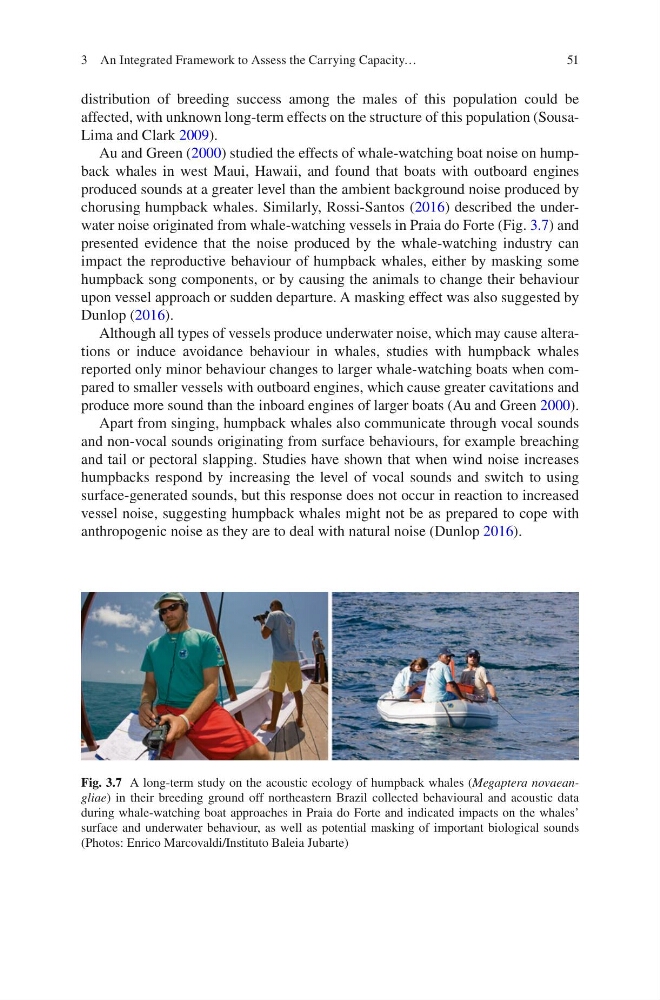
chorusing humpback whales. Similarly, Rossi-Santos (2016) described the underwater noise originated from whale-watching vessels in Praia do Forte (Fig. 3.7) and
presented evidence that the noise produced by the whale-watching industry can
impact the reproductive behaviour of humpback whales, either by masking some
humpback song components, or by causing the animals to change their behaviour
upon vessel approach or sudden departure. A masking effect was also suggested by
Dunlop (2016).
Although all types of vessels produce underwater noise, which may cause alterations or induce avoidance behaviour in whales, studies with humpback whales
reported only minor behaviour changes to larger whale-watching boats when compared to smaller vessels with outboard engines, which cause greater cavitations and
produce more sound than the inboard engines of larger boats (Au and Green 2000).
Apart from singing, humpback whales also communicate through vocal sounds
and non-vocal sounds originating from surface behaviours, for example breaching
and tail or pectoral slapping. Studies have shown that when wind noise increases
humpbacks respond by increasing the level of vocal sounds and switch to using
surface-generated sounds, but this response does not occur in reaction to increased
vessel noise, suggesting humpback whales might not be as prepared to cope with
anthropogenic noise as they are to deal with natural noise (Dunlop 2016).
Fig. 3.7 A long-term study on the acoustic ecology of humpback whales (Megaptera novaeangliae) in their breeding ground off northeastern Brazil collected behavioural and acoustic data
during whale-watching boat approaches in Praia do Forte and indicated impacts on the whales’
surface and underwater behaviour, as well as potential masking of important biological sounds
(Photos: Enrico Marcovaldi/Instituto Baleia Jubarte)
3 An Integrated Framework to Assess the Carrying Capacity…
distribution of breeding success among the males of this population could be
affected, with unknown long-term effects on the structure of this population (SousaLima and Clark 2009).
Au and Green (2000) studied the effects of whale-watching boat noise on humpback whales in west Maui, Hawaii, and found that boats with outboard engines
produced sounds at a greater level than the ambient background noise produced by
chorusing humpback whales. Similarly, Rossi-Santos (2016) described the underwater noise originated from whale-watching vessels in Praia do Forte (Fig. 3.7) and
presented evidence that the noise produced by the whale-watching industry can
impact the reproductive behaviour of humpback whales, either by masking some
humpback song components, or by causing the animals to change their behaviour
upon vessel approach or sudden departure. A masking effect was also suggested by
Dunlop (2016).
Although all types of vessels produce underwater noise, which may cause alterations or induce avoidance behaviour in whales, studies with humpback whales
reported only minor behaviour changes to larger whale-watching boats when compared to smaller vessels with outboard engines, which cause greater cavitations and
produce more sound than the inboard engines of larger boats (Au and Green 2000).
Apart from singing, humpback whales also communicate through vocal sounds
and non-vocal sounds originating from surface behaviours, for example breaching
and tail or pectoral slapping. Studies have shown that when wind noise increases
humpbacks respond by increasing the level of vocal sounds and switch to using
surface-generated sounds, but this response does not occur in reaction to increased
vessel noise, suggesting humpback whales might not be as prepared to cope with
anthropogenic noise as they are to deal with natural noise (Dunlop 2016).
Fig. 3.7 A long-term study on the acoustic ecology of humpback whales (Megaptera novaeangliae) in their breeding ground off northeastern Brazil collected behavioural and acoustic data
during whale-watching boat approaches in Praia do Forte and indicated impacts on the whales’
surface and underwater behaviour, as well as potential masking of important biological sounds
(Photos: Enrico Marcovaldi/Instituto Baleia Jubarte)
3 An Integrated Framework to Assess the Carrying Capacity…