

495
in the western Adriatic Sea is thought to be a result of the high levels of pollution
and other disturbances (Bearzi et al. 1997). Richardson et al. (1995) also cite numerous examples of cetacean populations that have modified habitat use and reduced
total living area due to noise disturbance.
Mortality records show that 43 Guiana dolphin and 36 franciscana dolphin carcasses were recovered in Babitonga Bay over the last 17 years. The number of dead
animals fluctuates among years, with annual mean values of 2.9 individuals/year for
Guiana dolphins and 2.5 individuals/year for franciscana dolphins; these values represent at the least 1.5% and 5% of the populations, respectively. Mortality is likely
underestimated, as some carcasses may sink or be carried out of the bay with currents rather than being washed ashore.
17.8.1 Interactions with Fisheries
The cause of death could not be determined for many individuals because carcasses
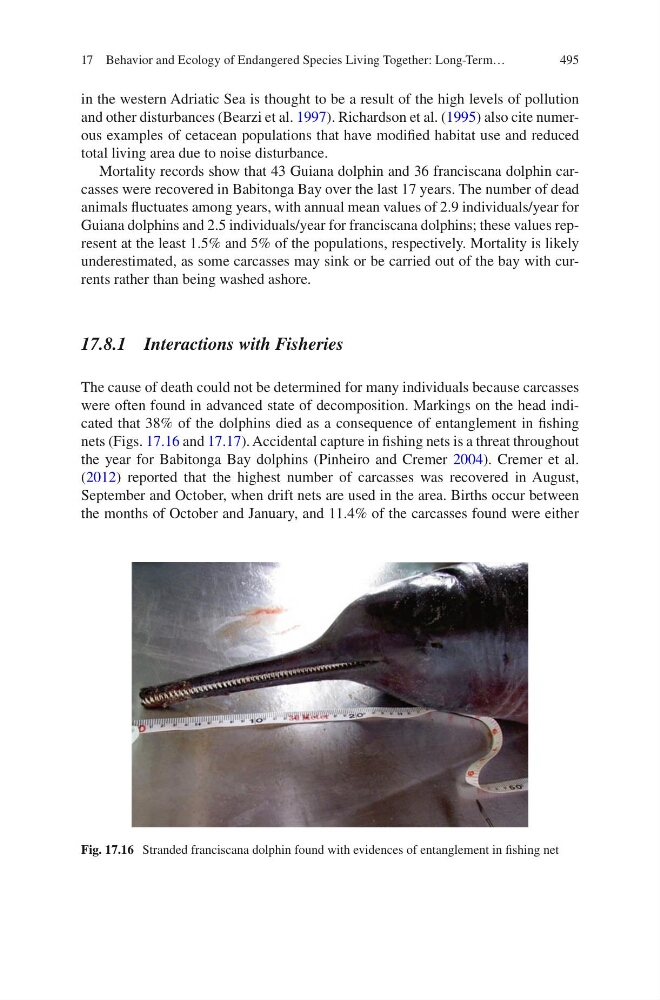
were often found in advanced state of decomposition. Markings on the head indicated that 38% of the dolphins died as a consequence of entanglement in fishing
nets (Figs. 17.16 and 17.17). Accidental capture in fishing nets is a threat throughout
the year for Babitonga Bay dolphins (Pinheiro and Cremer 2004). Cremer et al.
(2012) reported that the highest number of carcasses was recovered in August,
September and October, when drift nets are used in the area. Births occur between
the months of October and January, and 11.4% of the carcasses found were either
Fig. 17.16 Stranded franciscana dolphin found with evidences of entanglement in fishing net
17 Behavior and Ecology of Endangered Species Living Together: Long-Term…
in the western Adriatic Sea is thought to be a result of the high levels of pollution
and other disturbances (Bearzi et al. 1997). Richardson et al. (1995) also cite numerous examples of cetacean populations that have modified habitat use and reduced
total living area due to noise disturbance.
Mortality records show that 43 Guiana dolphin and 36 franciscana dolphin carcasses were recovered in Babitonga Bay over the last 17 years. The number of dead
animals fluctuates among years, with annual mean values of 2.9 individuals/year for
Guiana dolphins and 2.5 individuals/year for franciscana dolphins; these values represent at the least 1.5% and 5% of the populations, respectively. Mortality is likely
underestimated, as some carcasses may sink or be carried out of the bay with currents rather than being washed ashore.
17.8.1 Interactions with Fisheries
The cause of death could not be determined for many individuals because carcasses
were often found in advanced state of decomposition. Markings on the head indicated that 38% of the dolphins died as a consequence of entanglement in fishing
nets (Figs. 17.16 and 17.17). Accidental capture in fishing nets is a threat throughout
the year for Babitonga Bay dolphins (Pinheiro and Cremer 2004). Cremer et al.
(2012) reported that the highest number of carcasses was recovered in August,
September and October, when drift nets are used in the area. Births occur between
the months of October and January, and 11.4% of the carcasses found were either
Fig. 17.16 Stranded franciscana dolphin found with evidences of entanglement in fishing net
17 Behavior and Ecology of Endangered Species Living Together: Long-Term…