

491
78.95%, and 40% of the population had a residence rate greater than 50% (Sartori
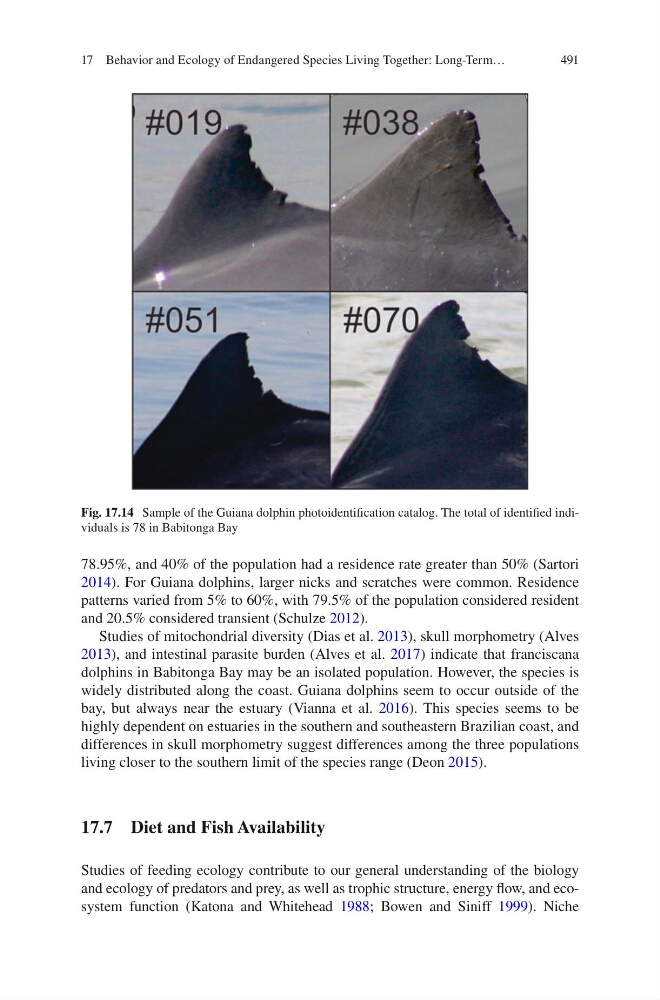
2014). For Guiana dolphins, larger nicks and scratches were common. Residence
patterns varied from 5% to 60%, with 79.5% of the population considered resident
and 20.5% considered transient (Schulze 2012).
Studies of mitochondrial diversity (Dias et al. 2013), skull morphometry (Alves
2013), and intestinal parasite burden (Alves et al. 2017) indicate that franciscana
dolphins in Babitonga Bay may be an isolated population. However, the species is
widely distributed along the coast. Guiana dolphins seem to occur outside of the
bay, but always near the estuary (Vianna et al. 2016). This species seems to be
highly dependent on estuaries in the southern and southeastern Brazilian coast, and
differences in skull morphometry suggest differences among the three populations
living closer to the southern limit of the species range (Deon 2015).
17.7 Diet and Fish Availability
Studies of feeding ecology contribute to our general understanding of the biology
and ecology of predators and prey, as well as trophic structure, energy flow, and ecosystem function (Katona and Whitehead 1988; Bowen and Siniff 1999). Niche
Fig. 17.14 Sample of the Guiana dolphin photoidentification catalog. The total of identified individuals is 78 in Babitonga Bay
17 Behavior and Ecology of Endangered Species Living Together: Long-Term…
78.95%, and 40% of the population had a residence rate greater than 50% (Sartori
2014). For Guiana dolphins, larger nicks and scratches were common. Residence
patterns varied from 5% to 60%, with 79.5% of the population considered resident
and 20.5% considered transient (Schulze 2012).
Studies of mitochondrial diversity (Dias et al. 2013), skull morphometry (Alves
2013), and intestinal parasite burden (Alves et al. 2017) indicate that franciscana
dolphins in Babitonga Bay may be an isolated population. However, the species is
widely distributed along the coast. Guiana dolphins seem to occur outside of the
bay, but always near the estuary (Vianna et al. 2016). This species seems to be
highly dependent on estuaries in the southern and southeastern Brazilian coast, and
differences in skull morphometry suggest differences among the three populations
living closer to the southern limit of the species range (Deon 2015).
17.7 Diet and Fish Availability
Studies of feeding ecology contribute to our general understanding of the biology
and ecology of predators and prey, as well as trophic structure, energy flow, and ecosystem function (Katona and Whitehead 1988; Bowen and Siniff 1999). Niche
Fig. 17.14 Sample of the Guiana dolphin photoidentification catalog. The total of identified individuals is 78 in Babitonga Bay
17 Behavior and Ecology of Endangered Species Living Together: Long-Term…