

490
in 2010 and 2011 was estimated at 209 individuals (95% CI: 174–252) by Schulze
(2012) using photoidentification techniques and mark-recapture methods. Cremer
et al. (2011) generated similar estimates about 10 years prior using distance sampling method over linear transects, with values of 245 (95% CI: 142–422) individuals for 2001, 186 (95% CI: 93–374) for 2002, and 179 (95% CI: 93–144) for 2003.
Guiana dolphin abundance in Babitonga Bay is intermediate compared to other
populations, however the population is small enough to require precautionary management (Thompson et al. 2000). For franciscana dolphins, distance sampling produced a population estimate of 50 individuals (95% CI: 28–89) from 2001 to 2003
(Cremer and Simões-Lopes 2008) and 55 individuals in 2011 (Zerbini et al. 2011).
Photoidentification techniques with mark-recapture methods obtained similar estimates (i.e., between 52 and 82 individuals from 2011 to 2013) (Sartori 2014).
Population size varies slightly with birth and death rates in the area, but remains
stable over time.
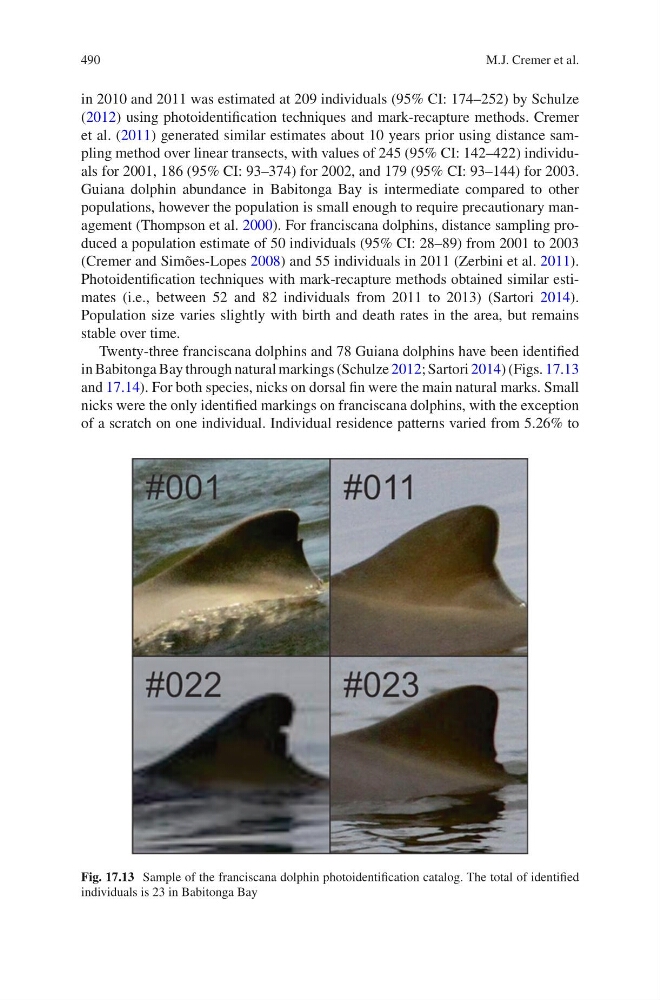
Twenty-three franciscana dolphins and 78 Guiana dolphins have been identified
in Babitonga Bay through natural markings (Schulze 2012; Sartori 2014) (Figs. 17.13
and 17.14). For both species, nicks on dorsal fin were the main natural marks. Small
nicks were the only identified markings on franciscana dolphins, with the exception
of a scratch on one individual. Individual residence patterns varied from 5.26% to
Fig. 17.13 Sample of the franciscana dolphin photoidentification catalog. The total of identified
individuals is 23 in Babitonga Bay
M.J. Cremer et al.
in 2010 and 2011 was estimated at 209 individuals (95% CI: 174–252) by Schulze
(2012) using photoidentification techniques and mark-recapture methods. Cremer
et al. (2011) generated similar estimates about 10 years prior using distance sampling method over linear transects, with values of 245 (95% CI: 142–422) individuals for 2001, 186 (95% CI: 93–374) for 2002, and 179 (95% CI: 93–144) for 2003.
Guiana dolphin abundance in Babitonga Bay is intermediate compared to other
populations, however the population is small enough to require precautionary management (Thompson et al. 2000). For franciscana dolphins, distance sampling produced a population estimate of 50 individuals (95% CI: 28–89) from 2001 to 2003
(Cremer and Simões-Lopes 2008) and 55 individuals in 2011 (Zerbini et al. 2011).
Photoidentification techniques with mark-recapture methods obtained similar estimates (i.e., between 52 and 82 individuals from 2011 to 2013) (Sartori 2014).
Population size varies slightly with birth and death rates in the area, but remains
stable over time.
Twenty-three franciscana dolphins and 78 Guiana dolphins have been identified
in Babitonga Bay through natural markings (Schulze 2012; Sartori 2014) (Figs. 17.13
and 17.14). For both species, nicks on dorsal fin were the main natural marks. Small
nicks were the only identified markings on franciscana dolphins, with the exception
of a scratch on one individual. Individual residence patterns varied from 5.26% to
Fig. 17.13 Sample of the franciscana dolphin photoidentification catalog. The total of identified
individuals is 23 in Babitonga Bay
M.J. Cremer et al.