

487
the current is more common (e.g., Bordino 2002; Mendes et al. 2002; Fury and
Harrison 2011).
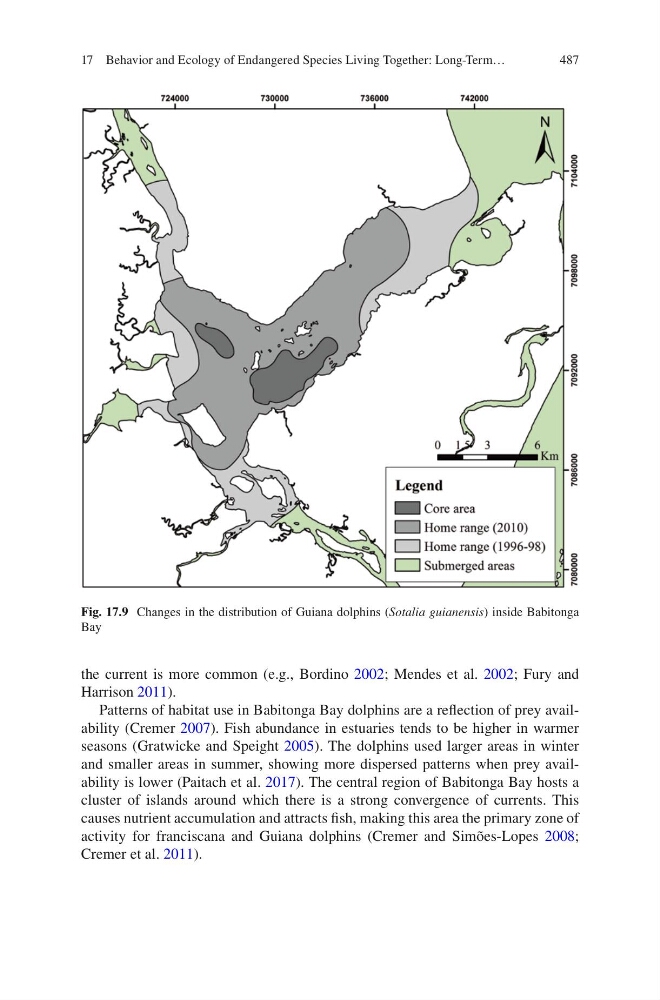
Patterns of habitat use in Babitonga Bay dolphins are a reflection of prey availability (Cremer 2007). Fish abundance in estuaries tends to be higher in warmer
seasons (Gratwicke and Speight 2005). The dolphins used larger areas in winter
and smaller areas in summer, showing more dispersed patterns when prey availability is lower (Paitach et al. 2017). The central region of Babitonga Bay hosts a
cluster of islands around which there is a strong convergence of currents. This
causes nutrient accumulation and attracts fish, making this area the primary zone of
activity for franciscana and Guiana dolphins (Cremer and Simões-Lopes 2008;
Cremer et al. 2011).
Fig. 17.9 Changes in the distribution of Guiana dolphins (Sotalia guianensis) inside Babitonga
Bay
17 Behavior and Ecology of Endangered Species Living Together: Long-Term…
the current is more common (e.g., Bordino 2002; Mendes et al. 2002; Fury and
Harrison 2011).
Patterns of habitat use in Babitonga Bay dolphins are a reflection of prey availability (Cremer 2007). Fish abundance in estuaries tends to be higher in warmer
seasons (Gratwicke and Speight 2005). The dolphins used larger areas in winter
and smaller areas in summer, showing more dispersed patterns when prey availability is lower (Paitach et al. 2017). The central region of Babitonga Bay hosts a
cluster of islands around which there is a strong convergence of currents. This
causes nutrient accumulation and attracts fish, making this area the primary zone of
activity for franciscana and Guiana dolphins (Cremer and Simões-Lopes 2008;
Cremer et al. 2011).
Fig. 17.9 Changes in the distribution of Guiana dolphins (Sotalia guianensis) inside Babitonga
Bay
17 Behavior and Ecology of Endangered Species Living Together: Long-Term…