

453
their location are recorded for each sighting. Photographs taken from all aerial surveys
have been used to create a catalogue of right whales identified off southern Brazil.
To classify group composition and obtain life-history parameters the following
definitions of different age/sex categories are usually applied in right whale studies:
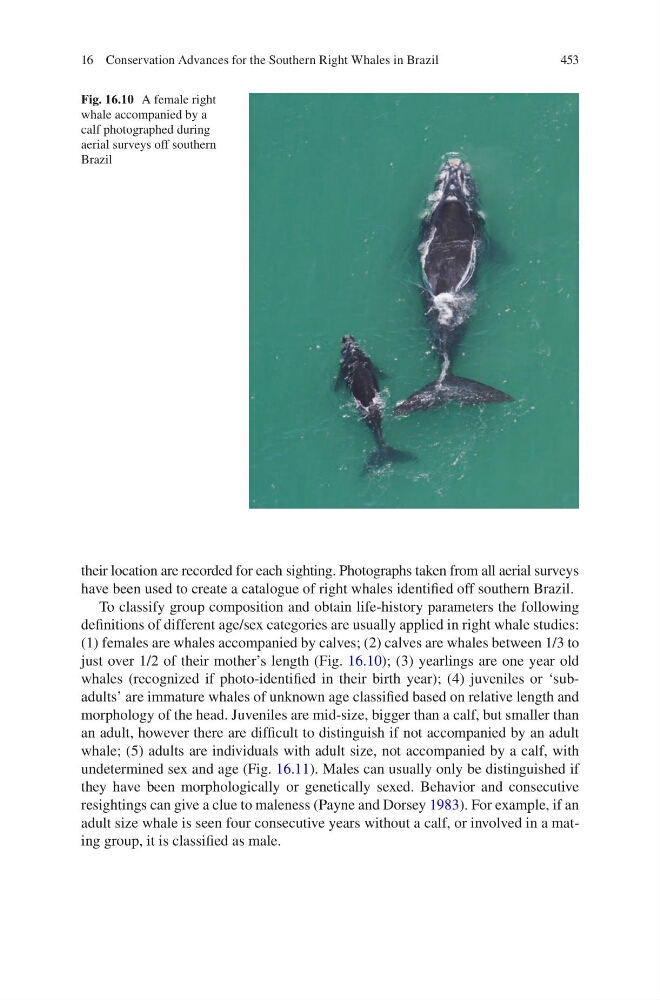
(1) females are whales accompanied by calves; (2) calves are whales between 1/3 to
just over 1/2 of their mother’s length (Fig. 16.10); (3) yearlings are one year old
whales (recognized if photo-identified in their birth year); (4) juveniles or ‘subadults’ are immature whales of unknown age classified based on relative length and
morphology of the head. Juveniles are mid-size, bigger than a calf, but smaller than
an adult, however there are difficult to distinguish if not accompanied by an adult
whale; (5) adults are individuals with adult size, not accompanied by a calf, with
undetermined sex and age (Fig. 16.11). Males can usually only be distinguished if
they have been morphologically or genetically sexed. Behavior and consecutive
resightings can give a clue to maleness (Payne and Dorsey 1983). For example, if an
adult size whale is seen four consecutive years without a calf, or involved in a mating group, it is classified as male.
Fig. 16.10 A female right
whale accompanied by a
calf photographed during
aerial surveys off southern
Brazil
16 Conservation Advances for the Southern Right Whales in Brazil
their location are recorded for each sighting. Photographs taken from all aerial surveys
have been used to create a catalogue of right whales identified off southern Brazil.
To classify group composition and obtain life-history parameters the following
definitions of different age/sex categories are usually applied in right whale studies:
(1) females are whales accompanied by calves; (2) calves are whales between 1/3 to
just over 1/2 of their mother’s length (Fig. 16.10); (3) yearlings are one year old
whales (recognized if photo-identified in their birth year); (4) juveniles or ‘subadults’ are immature whales of unknown age classified based on relative length and
morphology of the head. Juveniles are mid-size, bigger than a calf, but smaller than
an adult, however there are difficult to distinguish if not accompanied by an adult
whale; (5) adults are individuals with adult size, not accompanied by a calf, with
undetermined sex and age (Fig. 16.11). Males can usually only be distinguished if
they have been morphologically or genetically sexed. Behavior and consecutive
resightings can give a clue to maleness (Payne and Dorsey 1983). For example, if an
adult size whale is seen four consecutive years without a calf, or involved in a mating group, it is classified as male.
Fig. 16.10 A female right
whale accompanied by a
calf photographed during
aerial surveys off southern
Brazil
16 Conservation Advances for the Southern Right Whales in Brazil