

34
2.9 Conservation
Throughout this period of study, information on the biology and ecology of the
estuarine dolphin allowed us to understand some of its needs in Cananéia estuary as
well as the various interactions of this species with humans and their technologies.
Cananéia is within an area of great biological and scenic abundance [“World
Natural Heritage Site” and “Atlantic Forest Biosphere Reserve” (UNESCO 1992,
1999)]. Here, two activities are widely developed: artisanal fishing and tourism.
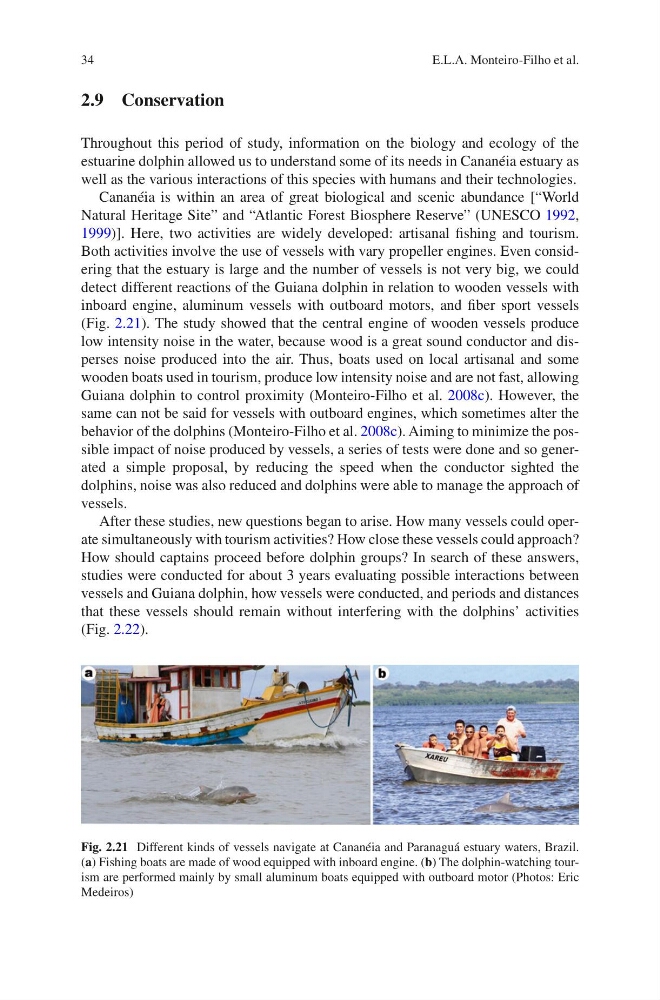
Both activities involve the use of vessels with vary propeller engines. Even considering that the estuary is large and the number of vessels is not very big, we could
detect different reactions of the Guiana dolphin in relation to wooden vessels with
inboard engine, aluminum vessels with outboard motors, and fiber sport vessels
(Fig. 2.21). The study showed that the central engine of wooden vessels produce
low intensity noise in the water, because wood is a great sound conductor and disperses noise produced into the air. Thus, boats used on local artisanal and some
wooden boats used in tourism, produce low intensity noise and are not fast, allowing
Guiana dolphin to control proximity (Monteiro-Filho et al. 2008c). However, the
same can not be said for vessels with outboard engines, which sometimes alter the
behavior of the dolphins (Monteiro-Filho et al. 2008c). Aiming to minimize the possible impact of noise produced by vessels, a series of tests were done and so generated a simple proposal, by reducing the speed when the conductor sighted the
dolphins, noise was also reduced and dolphins were able to manage the approach of
vessels.
After these studies, new questions began to arise. How many vessels could operate simultaneously with tourism activities? How close these vessels could approach?
How should captains proceed before dolphin groups? In search of these answers,
studies were conducted for about 3 years evaluating possible interactions between
vessels and Guiana dolphin, how vessels were conducted, and periods and distances
that these vessels should remain without interfering with the dolphins’ activities
(Fig. 2.22).
Fig. 2.21 Different kinds of vessels navigate at Cananéia and Paranaguá estuary waters, Brazil.
(a) Fishing boats are made of wood equipped with inboard engine. (b) The dolphin-watching tourism are performed mainly by small aluminum boats equipped with outboard motor (Photos: Eric
Medeiros)
E.L.A. Monteiro-Filho et al.
2.9 Conservation
Throughout this period of study, information on the biology and ecology of the
estuarine dolphin allowed us to understand some of its needs in Cananéia estuary as
well as the various interactions of this species with humans and their technologies.
Cananéia is within an area of great biological and scenic abundance [“World
Natural Heritage Site” and “Atlantic Forest Biosphere Reserve” (UNESCO 1992,
1999)]. Here, two activities are widely developed: artisanal fishing and tourism.
Both activities involve the use of vessels with vary propeller engines. Even considering that the estuary is large and the number of vessels is not very big, we could
detect different reactions of the Guiana dolphin in relation to wooden vessels with
inboard engine, aluminum vessels with outboard motors, and fiber sport vessels
(Fig. 2.21). The study showed that the central engine of wooden vessels produce
low intensity noise in the water, because wood is a great sound conductor and disperses noise produced into the air. Thus, boats used on local artisanal and some
wooden boats used in tourism, produce low intensity noise and are not fast, allowing
Guiana dolphin to control proximity (Monteiro-Filho et al. 2008c). However, the
same can not be said for vessels with outboard engines, which sometimes alter the
behavior of the dolphins (Monteiro-Filho et al. 2008c). Aiming to minimize the possible impact of noise produced by vessels, a series of tests were done and so generated a simple proposal, by reducing the speed when the conductor sighted the
dolphins, noise was also reduced and dolphins were able to manage the approach of
vessels.
After these studies, new questions began to arise. How many vessels could operate simultaneously with tourism activities? How close these vessels could approach?
How should captains proceed before dolphin groups? In search of these answers,
studies were conducted for about 3 years evaluating possible interactions between
vessels and Guiana dolphin, how vessels were conducted, and periods and distances
that these vessels should remain without interfering with the dolphins’ activities
(Fig. 2.22).
Fig. 2.21 Different kinds of vessels navigate at Cananéia and Paranaguá estuary waters, Brazil.
(a) Fishing boats are made of wood equipped with inboard engine. (b) The dolphin-watching tourism are performed mainly by small aluminum boats equipped with outboard motor (Photos: Eric
Medeiros)
E.L.A. Monteiro-Filho et al.