

422
In Aug, 7, 2008, four animals were observed, for 85 min, with behavior such as
breaching (n = 4) and tail-up during short dives (n = 37) and in Aug, 30, 2008,
during 70 min, 4 animals were sighted performing head exposition (n = 2), tail-up
during dives (n = 11) and pectoral fin slapping (n = 2).
15.3.4 Dive Time
To determine dive times, 956 measurements were obtained for 52 humpback whale
observed groups (Table 15.2). The time at the sea surface, indicated a general pattern
of few (2–5) very short breathings (less than 30 s) and one longer dive (>30 to 780 s).
Four groups of alone males were singing while measured, confirmed by underwater recordings. In Aug, 10, 2008, the singer male was at 51 m deep, showing long
dive patterns and performed fluke exhibition in travelling behavior. Another sighting, in Aug, 30, 2008, a sequence of long dives (7 measurements >200 s) of the male
at 40 m deep was registered, showing 5 fluke exhibitions in displacement behavior.
In Aug, 28, a singer male was observed in active behavior with breaching and singing while showed a dive pattern of 4 dives less than 60 s and then one long (>100 s).
Depth was not registered. In the last observation, during the research cruise of Jul,
14, 2009, a singer male was in rest behavior at 36 m deep, and the song caption was
12
10
8
6
4
Number of Sightings
2
0
2005
2006
2008
Years
2009
1 Ad
2 Ad
3 Ad
4 Ad
FefiEp
FefiEpE
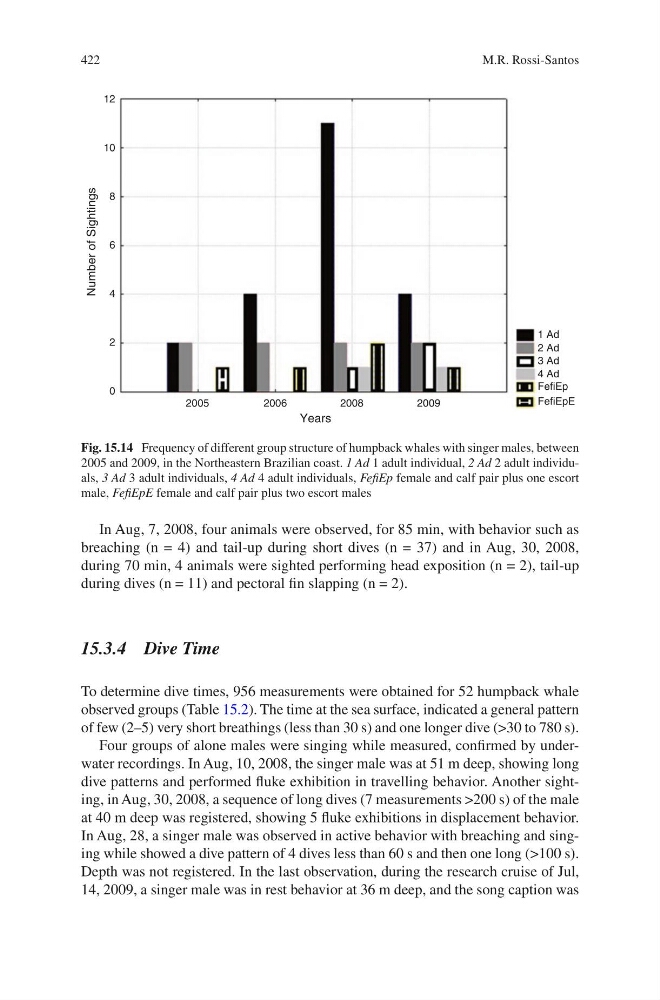
Fig. 15.14 Frequency of different group structure of humpback whales with singer males, between
2005 and 2009, in the Northeastern Brazilian coast. 1 Ad 1 adult individual, 2 Ad 2 adult individuals, 3 Ad 3 adult individuals, 4 Ad 4 adult individuals, FefiEp female and calf pair plus one escort
male, FefiEpE female and calf pair plus two escort males
M.R. Rossi-Santos
In Aug, 7, 2008, four animals were observed, for 85 min, with behavior such as
breaching (n = 4) and tail-up during short dives (n = 37) and in Aug, 30, 2008,
during 70 min, 4 animals were sighted performing head exposition (n = 2), tail-up
during dives (n = 11) and pectoral fin slapping (n = 2).
15.3.4 Dive Time
To determine dive times, 956 measurements were obtained for 52 humpback whale
observed groups (Table 15.2). The time at the sea surface, indicated a general pattern
of few (2–5) very short breathings (less than 30 s) and one longer dive (>30 to 780 s).
Four groups of alone males were singing while measured, confirmed by underwater recordings. In Aug, 10, 2008, the singer male was at 51 m deep, showing long
dive patterns and performed fluke exhibition in travelling behavior. Another sighting, in Aug, 30, 2008, a sequence of long dives (7 measurements >200 s) of the male
at 40 m deep was registered, showing 5 fluke exhibitions in displacement behavior.
In Aug, 28, a singer male was observed in active behavior with breaching and singing while showed a dive pattern of 4 dives less than 60 s and then one long (>100 s).
Depth was not registered. In the last observation, during the research cruise of Jul,
14, 2009, a singer male was in rest behavior at 36 m deep, and the song caption was
12
10
8
6
4
Number of Sightings
2
0
2005
2006
2008
Years
2009
1 Ad
2 Ad
3 Ad
4 Ad
FefiEp
FefiEpE
Fig. 15.14 Frequency of different group structure of humpback whales with singer males, between
2005 and 2009, in the Northeastern Brazilian coast. 1 Ad 1 adult individual, 2 Ad 2 adult individuals, 3 Ad 3 adult individuals, 4 Ad 4 adult individuals, FefiEp female and calf pair plus one escort
male, FefiEpE female and calf pair plus two escort males
M.R. Rossi-Santos