

390
specimen dorsal fin were extracted to cover its entire structure (including distal
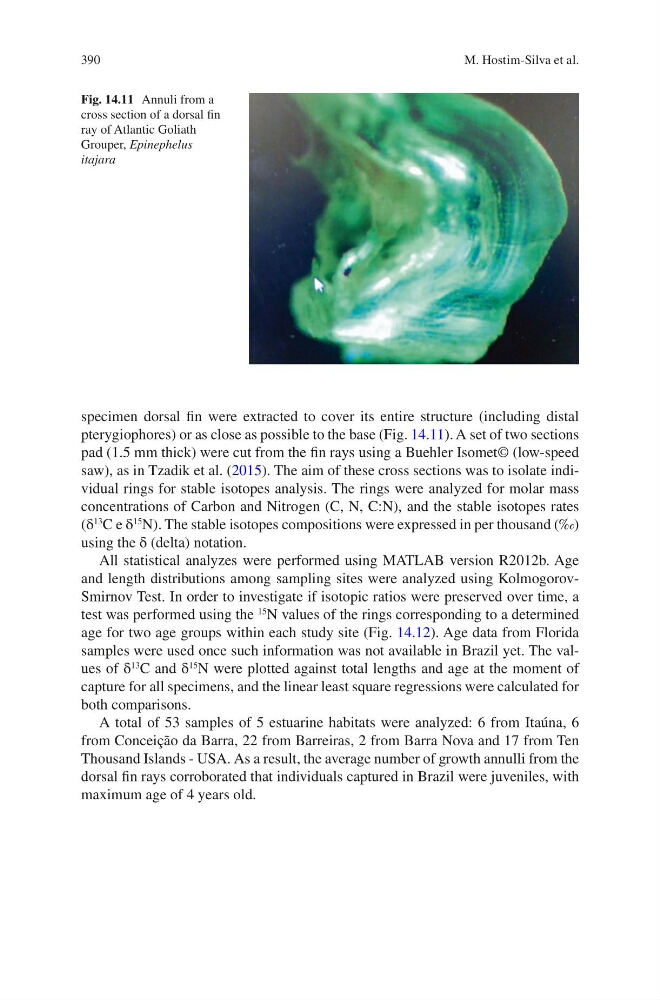
pterygiophores) or as close as possible to the base (Fig. 14.11). A set of two sections
pad (1.5 mm thick) were cut from the fin rays using a Buehler Isomet© (low-speed
saw), as in Tzadik et al. (2015). The aim of these cross sections was to isolate individual rings for stable isotopes analysis. The rings were analyzed for molar mass
concentrations of Carbon and Nitrogen (C, N, C:N), and the stable isotopes rates
(δ
13
C e δ
15
N). The stable isotopes compositions were expressed in per thousand (‰)
using the δ (delta) notation.
All statistical analyzes were performed using MATLAB version R2012b. Age
and length distributions among sampling sites were analyzed using KolmogorovSmirnov Test. In order to investigate if isotopic ratios were preserved over time, a
test was performed using the
15
N values of the rings corresponding to a determined
age for two age groups within each study site (Fig. 14.12). Age data from Florida
samples were used once such information was not available in Brazil yet. The values of δ
13
C and δ
15
N were plotted against total lengths and age at the moment of
capture for all specimens, and the linear least square regressions were calculated for
both comparisons.
A total of 53 samples of 5 estuarine habitats were analyzed: 6 from Itaúna, 6
from Conceição da Barra, 22 from Barreiras, 2 from Barra Nova and 17 from Ten
Thousand Islands - USA. As a result, the average number of growth annulli from the
dorsal fin rays corroborated that individuals captured in Brazil were juveniles, with
maximum age of 4 years old.
Fig. 14.11 Annuli from a
cross section of a dorsal fin
ray of Atlantic Goliath
Grouper, Epinephelus
itajara
M. Hostim-Silva et al.
specimen dorsal fin were extracted to cover its entire structure (including distal
pterygiophores) or as close as possible to the base (Fig. 14.11). A set of two sections
pad (1.5 mm thick) were cut from the fin rays using a Buehler Isomet© (low-speed
saw), as in Tzadik et al. (2015). The aim of these cross sections was to isolate individual rings for stable isotopes analysis. The rings were analyzed for molar mass
concentrations of Carbon and Nitrogen (C, N, C:N), and the stable isotopes rates
(δ
13
C e δ
15
N). The stable isotopes compositions were expressed in per thousand (‰)
using the δ (delta) notation.
All statistical analyzes were performed using MATLAB version R2012b. Age
and length distributions among sampling sites were analyzed using KolmogorovSmirnov Test. In order to investigate if isotopic ratios were preserved over time, a
test was performed using the
15
N values of the rings corresponding to a determined
age for two age groups within each study site (Fig. 14.12). Age data from Florida
samples were used once such information was not available in Brazil yet. The values of δ
13
C and δ
15
N were plotted against total lengths and age at the moment of
capture for all specimens, and the linear least square regressions were calculated for
both comparisons.
A total of 53 samples of 5 estuarine habitats were analyzed: 6 from Itaúna, 6
from Conceição da Barra, 22 from Barreiras, 2 from Barra Nova and 17 from Ten
Thousand Islands - USA. As a result, the average number of growth annulli from the
dorsal fin rays corroborated that individuals captured in Brazil were juveniles, with
maximum age of 4 years old.
Fig. 14.11 Annuli from a
cross section of a dorsal fin
ray of Atlantic Goliath
Grouper, Epinephelus
itajara
M. Hostim-Silva et al.