

333
13.1.4 Anthropogenic Noise Effects
In the last decade there has been an increase in studies on anthropogenic noise in the
oceans and their impact on cetacean ecology in their natural habitats. The issue has
been widely discussed in recent years suggesting that usually cause changes in their
communication skills (Branstetter and Finneran 2008). This change in the communication capacity can generate, therefore, potential impacts of different magnitudes
on the animals, which may have basically behavioral character, acoustic or physiological. Effects can also be divided into short-term, long-term and in extreme cases,
fatalities (Nowacek et al. 2007).
In a study on cetacean reactions to anthropogenic noise, Nowacek et al. (2007)
characterized the effects for each character mentioned above. The character behavioral effects include changes in patterns of breathing, dip and rise to the surface and
foraging (Weilgart 2007). Acoustic character responses include changes in the modulation frequency, maximum frequency of the signal, duration and repetition of
vocalizations according to the source of the noise (May-Collado and Wartzok 2008).
The physiological effects are the Permanent Thresholds Shifts (PTS) or Temporary
Thresholds Shifts (TTS) of hearing by the auditory system (Ketten 2004), changes
in heartbeat rate (Lyamin et al. 2015) and stress (Wright et al. 2007).
Changes in behavioral patterns of cetaceans have been widely documented especially as a result of vessel traffic. The main effects on dolphin species are: avoidance
of the area when in presence of boats (Watkins 1986; Janik and Thompson 1996;
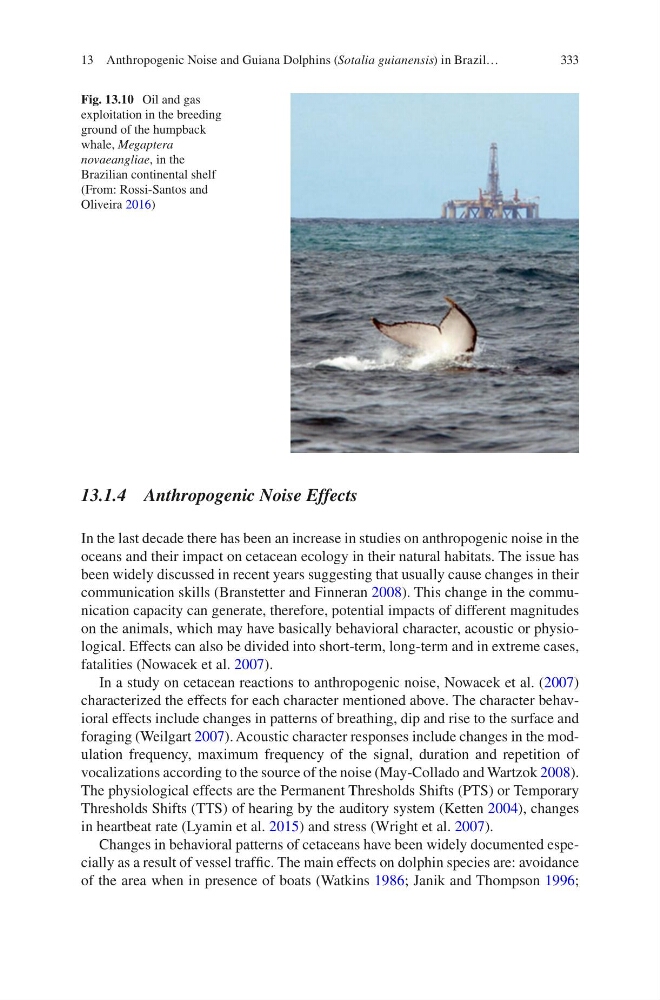
Fig. 13.10 Oil and gas
exploitation in the breeding
ground of the humpback
whale, Megaptera
novaeangliae, in the
Brazilian continental shelf
(From: Rossi-Santos and
Oliveira 2016)
13 Anthropogenic Noise and Guiana Dolphins (Sotalia guianensis) in Brazil…
13.1.4 Anthropogenic Noise Effects
In the last decade there has been an increase in studies on anthropogenic noise in the
oceans and their impact on cetacean ecology in their natural habitats. The issue has
been widely discussed in recent years suggesting that usually cause changes in their
communication skills (Branstetter and Finneran 2008). This change in the communication capacity can generate, therefore, potential impacts of different magnitudes
on the animals, which may have basically behavioral character, acoustic or physiological. Effects can also be divided into short-term, long-term and in extreme cases,
fatalities (Nowacek et al. 2007).
In a study on cetacean reactions to anthropogenic noise, Nowacek et al. (2007)
characterized the effects for each character mentioned above. The character behavioral effects include changes in patterns of breathing, dip and rise to the surface and
foraging (Weilgart 2007). Acoustic character responses include changes in the modulation frequency, maximum frequency of the signal, duration and repetition of
vocalizations according to the source of the noise (May-Collado and Wartzok 2008).
The physiological effects are the Permanent Thresholds Shifts (PTS) or Temporary
Thresholds Shifts (TTS) of hearing by the auditory system (Ketten 2004), changes
in heartbeat rate (Lyamin et al. 2015) and stress (Wright et al. 2007).
Changes in behavioral patterns of cetaceans have been widely documented especially as a result of vessel traffic. The main effects on dolphin species are: avoidance
of the area when in presence of boats (Watkins 1986; Janik and Thompson 1996;
Fig. 13.10 Oil and gas
exploitation in the breeding
ground of the humpback
whale, Megaptera
novaeangliae, in the
Brazilian continental shelf
(From: Rossi-Santos and
Oliveira 2016)
13 Anthropogenic Noise and Guiana Dolphins (Sotalia guianensis) in Brazil…